

What Happens To My Medical Waste
Have you ever wondered what happens to your medical waste? MedPro Disposal details the journey your medical waste takes, from a patient getting their blood drawn to the final disposal of the waste.
Get a Free QuoteSix steps from the exam room to final disposal
Biohazardous waste has to be handled according to state and federal guidelines at every step. Here is what happens, in order.
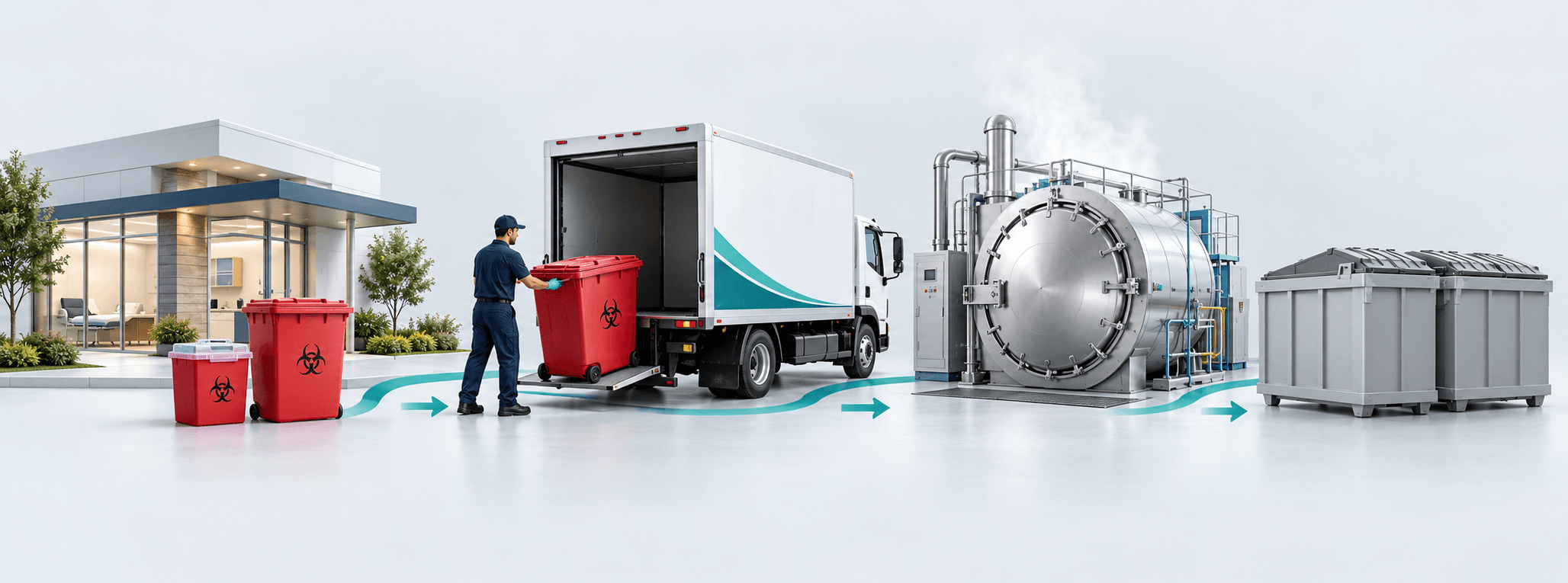
Waste is created at the point of care
It starts with everyday care: a patient has blood drawn, a wound is dressed, an injection is given. Some of what is left behind can carry infection, so it cannot be handled like ordinary trash. The World Health Organization estimates that about 15% of health-care waste is hazardous material that may be infectious, chemical or radioactive.
Only trained staff should handle it. OSHA's bloodborne pathogens standard requires employers to train employees who may be exposed, at hire and at least once a year.
It goes into the right container
Sharps such as needles and lancets go into a designated sharps container that is closable, puncture-resistant and leakproof. Other regulated medical waste goes into its own labeled containers, and pharmaceuticals follow a separate path.
Improper handling puts staff, waste handlers and the environment at risk, which is why sorting at the source matters more than any later step.
Full containers are stored securely
When a container is full it is closed, never emptied or reused, and moved to a designated, secured storage area to wait for pickup. State rules set how long waste can be stored on site, and the limits differ by state and by type of waste.
A licensed provider collects it
A medical waste company picks the waste up at a set service frequency and takes it away in packaging and vehicles that meet state and federal transport rules. Many states require haulers to be registered or permitted, so it is worth asking any provider for proof.
Some states require a manifest, the tracking document that lists the type and quantity of waste, the handling instructions and the signatures of the people involved. Keep the records your state requires.
It is treated at a permitted facility
The waste is taken to a treatment facility, where it is treated by one of three common methods (below) so that it is no longer infectious.
Treated waste is disposed of
Once the waste has been made non-infectious, it can be disposed of as the state allows, generally in a permitted landfill. Autoclaved waste is often shredded and compacted first to reduce its size.
How the waste is made safe
The treatment facility uses one of these methods. Which one applies depends on the type of waste and on what your state allows.
Autoclave
Steam under high pressure. Many states require at least 121°C (250°F) held for 30 minutes or more, depending on the state and the load. The World Health Organization prefers autoclaving and similar non-burn methods over incineration where they are feasible.
Incinerate
Burned in a controlled environment until it becomes ash. The World Health Organization notes that only modern incinerators running at 850 to 1,100°C with special gas-cleaning equipment meet international emission standards. Some waste, such as certain pathological and pharmaceutical waste, is not suitable for steam treatment and is incinerated instead.
Chemical treatment
The waste is exposed to disinfecting agents. The World Health Organization warns that chemical disinfectants can reach the environment if they are not handled and disposed of properly.
Common questions about where medical waste goes
Who regulates medical waste?
Mostly your state. Medical waste is regulated primarily by state environmental and health departments, and the EPA has not had authority specific to medical waste since the federal Medical Waste Tracking Act expired in 1991. Other federal agencies still have a say: OSHA sets the worker-safety rules for handling it (including sharps containers and training), and the Department of Transportation sets rules for moving it. Because states differ, the same waste can have different storage, tracking and treatment rules from one state to the next.
What is a medical waste manifest?
A manifest is the tracking document that travels with a shipment of regulated medical waste. It records the type and quantity of the waste, the handling instructions, and the signatures of the people involved. Some states require a manifest or tracking record and others do not, so check your state's rules and keep whatever records your state requires.
How long can medical waste be stored before pickup?
It depends on your state and on the type of waste. Many states set a limit on how long regulated medical waste can sit on site, and the limit can differ for sharps, red-bag waste and other categories. Once a container is full it should be closed and moved to a secured, designated storage area to wait for pickup. Your state environmental or health agency has the exact limits, and your pickup schedule should be set with them in mind.
Who is allowed to haul medical waste?
Rules vary by state. Many states require regulated medical waste haulers to be registered or permitted with the state environmental or health agency, so ask any provider for its license or permit before you sign. The waste also has to be packaged, labeled and transported to meet state and federal rules, which is why the pickup is done by trained drivers and not by facility staff.
How is medical waste treated?
The most common methods are autoclaving, incineration and chemical treatment. Autoclaving uses steam under pressure, and many states set a minimum of 121°C (250°F) held for 30 minutes or more, depending on the state and the load. Incineration burns the waste in a controlled environment, and the World Health Organization notes that only modern incinerators operating at 850 to 1,100°C with special gas-cleaning equipment can meet international emission standards. Chemical treatment exposes the waste to disinfecting agents. The World Health Organization prefers autoclaving and similar non-burn methods over incineration where they are feasible.
Is waste still hazardous after it is treated?
Treatment is meant to make the waste non-infectious, and treated waste is then generally disposed of in a permitted landfill. Many facilities shred and compact autoclaved waste first to reduce its size. What the treated waste has to look like, and where it can go, is set by state rules, so the exact handling after treatment is not the same everywhere.
What happens to sharps containers?
Sharps go into a closable, puncture-resistant, leakproof container, as OSHA's bloodborne pathogens standard requires. When the container is full it is closed, stored securely and collected, and the whole container goes to treatment with its contents. Containers should never be opened, emptied or reused.
Does pharmaceutical waste follow the same path?
No. Pharmaceutical waste is a separate stream from sharps and red-bag waste. Some types, such as certain pathological, trace chemotherapy and pharmaceutical waste, are not suitable for steam treatment (California's rules say so explicitly), and hazardous pharmaceuticals are covered by EPA's hazardous waste pharmaceuticals rule (40 CFR Part 266, Subpart P) as well as state rules. Keep pharmaceuticals out of your sharps and red-bag containers.
Can regulated medical waste go in the regular trash?
No. Regulated medical waste has to be segregated, packaged in the right containers and handled by a provider that treats it before disposal. Putting sharps or other regulated waste in the regular trash puts janitorial staff and waste handlers at risk, and it can bring fines under your state's rules.
How often should medical waste be picked up?
There is no single answer. The right schedule depends on how much waste you generate, the size of your containers, how much storage space you have, and your state's storage limits. A good provider sets the schedule with you and changes it as your volume changes.
Sources
- Health-care waste (fact sheet) — World Health Organization
- Medical waste — U.S. Environmental Protection Agency
- Bloodborne pathogens standard, 29 CFR 1910.1030 — Occupational Safety and Health Administration
- Medical waste treatment process (steam sterilization requirements) — County of San Diego Department of Environmental Health and Quality
Last reviewed October 20, 2026. Medical waste rules are set by each state and change over time; check with your state agency for the rules that apply to your facility.
Ready to see what your facility would pay?
More than 40,000 healthcare providers have switched to MedPro Disposal for a safer and more affordable medical waste disposal and compliance training solution. Tell us about your facility and a specialist will follow up fast.
Or call 888-641-6131Get Your Free Quote
Tell us a bit about your facility and we'll follow up fast.