MedPro Disposal

Hazardous Waste Disposal Services

Safe, compliant, and cost-effective solutions — tailored to your facility.

When it comes to hazardous waste disposal, compliance and reliability are non-negotiable. MedPro Disposal simplifies a complex, heavily regulated process — from waste profiling and DOT-approved packaging to licensed transport, manifests, and final disposal.

Not sure what you have? Send us a Safety Data Sheet (SDS) or even a photo, and we'll build a waste profile for free.

Get Your Free Quote

Start with your name and number — it takes about a minute.

No spam, ever. We'll only use this to follow up on your quote.

This site is protected by reCAPTCHA and the Google Privacy Policy and Terms of Service apply.

Prefer to talk? Call (888) 641-6131
  • BBB A+ Rated
  • 40,000+ Clients Nationwide
  • Since 2009
  • 97% Client Retention
  • Save an Average of 30%

Quick Answer

Hazardous waste is waste that is ignitable, corrosive, reactive, or toxic, or that the EPA specifically lists, and it is regulated under the Resource Conservation and Recovery Act (RCRA). Every business that generates a waste must determine whether it is hazardous. RCRA then regulates it “cradle to grave”: the generator is responsible for it from the moment it's created until final treatment or disposal at a permitted facility, even after a vendor picks it up. How long you can store it and what paperwork you need depend on how much you generate each month.

Monthly limit for a very small quantity generator (about 220 lbs)
100 kg
Monthly volume that makes you a large quantity generator (about 2,200 lbs)
1,000 kg
Maximum on-site storage for small quantity generators
180 days
Maximum on-site storage for large quantity generators
90 days
Clients served by MedPro Disposal nationwide
40,000+
Hazardous Waste, Defined

What Is Hazardous Waste?

How the EPA decides whether a waste is hazardous.

Hazardous waste is material that poses significant risks to human health, property, or the environment because of its chemical composition or physical properties. The U.S. Environmental Protection Agency (EPA) regulates it under the Resource Conservation and Recovery Act (RCRA), and non-compliance can result in severe fines or legal action. Hazardous waste is separate from biohazard and regulated medical waste — a chemical, not an infectious, risk.

Characteristic Wastes

A waste is hazardous if it shows one of four characteristics: ignitable (flammable solvents, alcohol-based products), corrosive (strong acids and bases), reactive (oxidizers and unstable compounds), or toxic (wastes that can leach harmful levels of substances such as mercury, silver, or certain solvents).

Listed Wastes

The EPA also publishes lists of specific wastes that are hazardous regardless of testing, including some discarded commercial chemical products and pharmaceuticals. Acutely hazardous listed wastes carry a much lower threshold — just 1 kilogram a month.

Who Generates It

Hazardous Waste in Healthcare and Beyond

Hazardous waste shows up in more places than most facilities expect. Common sources include:

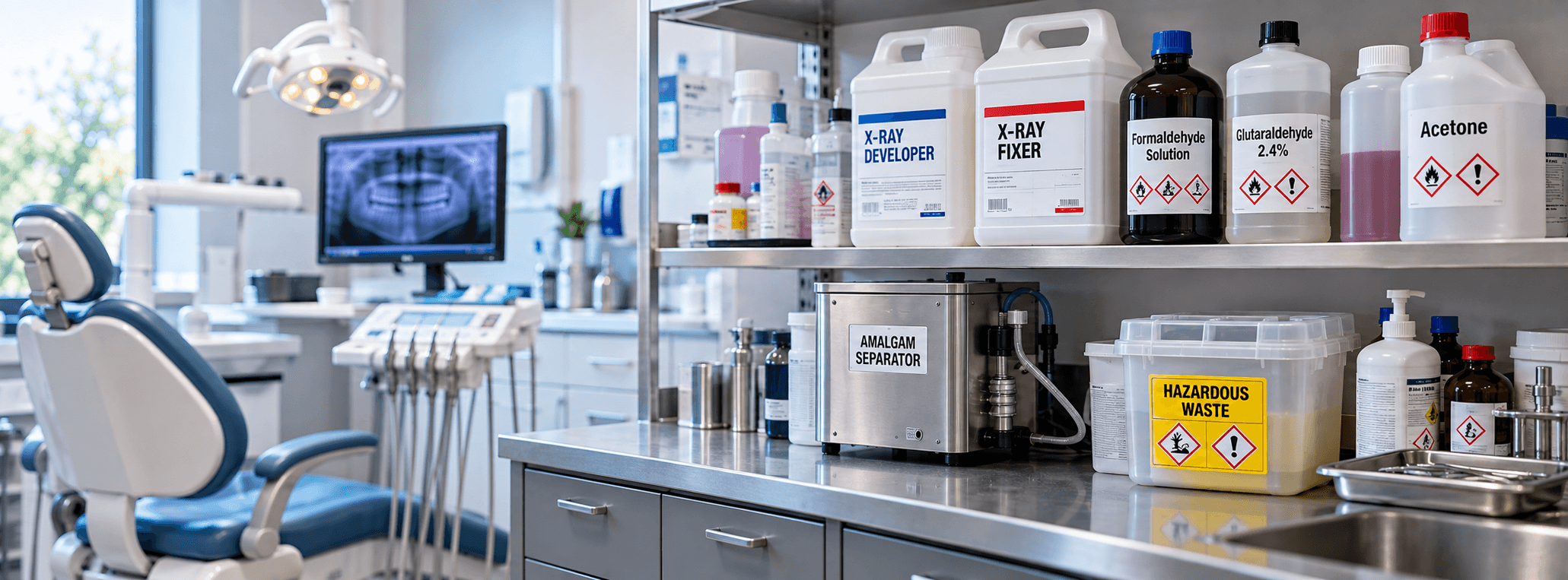
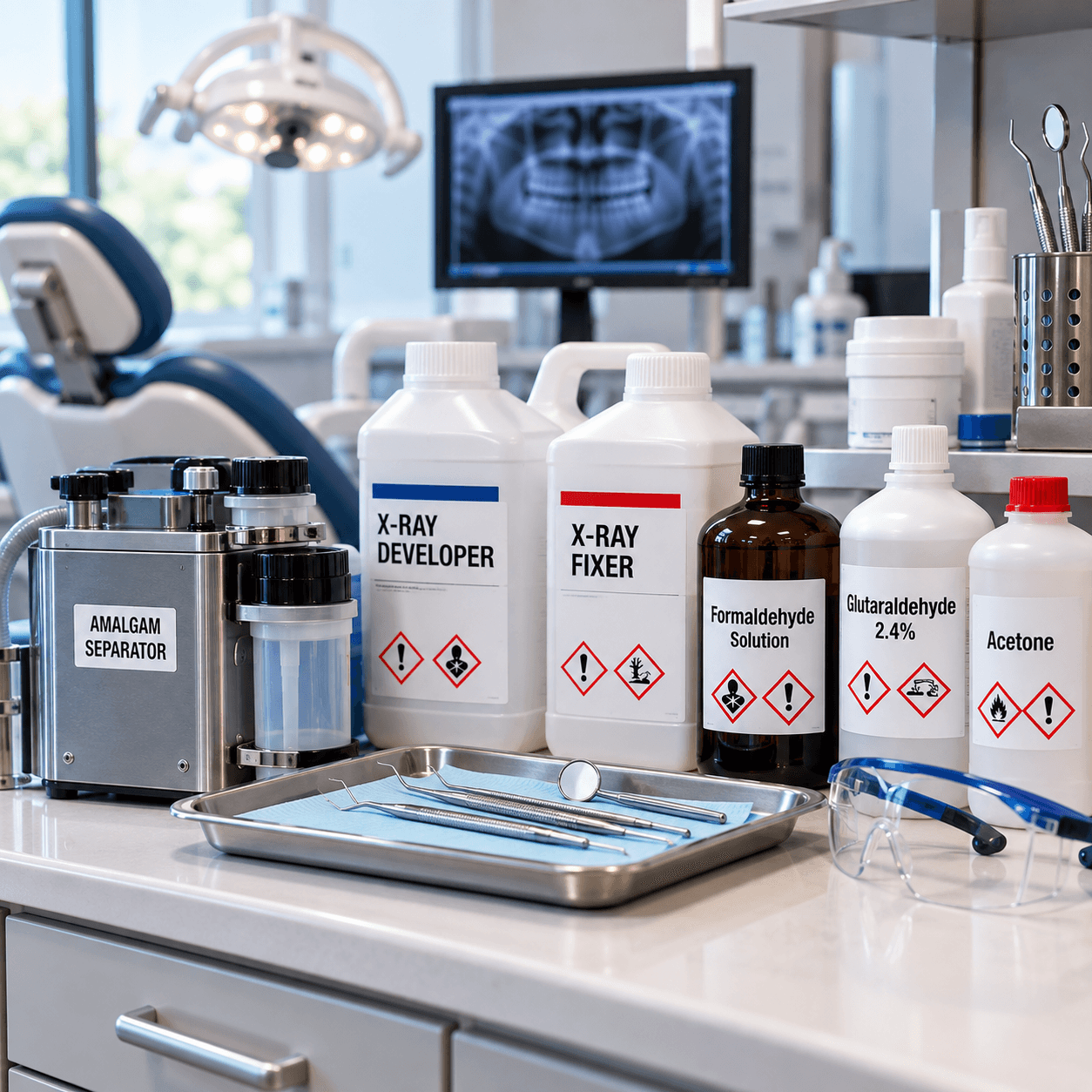
  • Dental and veterinary practices: old X-ray chemicals, disinfectants, and amalgam waste.
  • Laboratories and research centers: lab packs, expired reagents, and chemical containers.
  • Funeral homes: embalming fluids and solvents.
  • Warehouses and distribution centers: bulk expired or damaged chemical products.
  • Manufacturing facilities: production byproducts, solvents, and degreasers.
Dental office counter with X-ray developer, X-ray fixer, formaldehyde, glutaraldehyde, and acetone containers beside an amalgam separator
If It's Hazardous, We Handle It

Hazardous Materials We Dispose Of

Lab Reagents & Lab Packs

Laboratory reagents and lab pack waste, packed and profiled for compliant shipment.

Expired & Off-Spec Chemicals

Expired products and off-spec chemicals from pharmacies, labs, and warehouses.

Solvents, Paints & Adhesives

Solvents, paints, thinners, and adhesives — typically ignitable hazardous waste.

Acids, Bases & Oxidizers

Acids, bases, oxidizers, and reactive compounds that need careful segregation.

Mercury-Containing Equipment

Thermometers, gauges, and switches containing mercury.

Pesticides, Aerosols & Cleanouts

Pesticides, herbicides, aerosols, and full warehouse or facility cleanout waste.

Know Your Category

RCRA Hazardous Waste Generator Categories

Your monthly volume sets your category — and your category sets your storage limits and paperwork.

RCRA Hazardous Waste Generator Categories
CategoryGenerates per MonthOn-Site Storage LimitKey Requirements
Very small quantity generator (VSQG)≤ 100 kg (220 lbs) non-acute and ≤ 1 kg acuteNo federal time limit while under 1,000 kg on siteHazardous waste determination; send waste to an authorized facility
Small quantity generator (SQG)> 100 kg and < 1,000 kg non-acute180 days (270 if 200+ miles to treatment), up to 6,000 kgEPA ID number, manifests, e-Manifest registration
Large quantity generator (LQG)≥ 1,000 kg (2,200 lbs) non-acute, or > 1 kg acute90 daysEPA ID number, manifests, contingency plan, and training
Special Categories

Universal Waste and the Dental Amalgam Rule

Some common hazardous wastes have their own, simpler federal rules.

Under 40 CFR Part 273, five categories can be managed as “universal waste” under streamlined standards instead of full hazardous waste rules. Dental offices also have a specific wastewater rule for amalgam.

  • Universal waste includes batteries, pesticides, mercury-containing equipment, lamps, and aerosol cans.
  • Universal waste still needs proper labeling, storage, and a compliant destination — it just follows lighter handling rules.
  • Dental offices that place or remove amalgam must use an amalgam separator that removes at least 95% of amalgam from wastewater (40 CFR Part 441).
  • Existing dental offices had to comply by July 14, 2020; collected amalgam must go to a proper recycling or disposal outlet, never the drain or trash.
How It Works

How Our Hazardous Waste Disposal Process Works

  1. 1

    Identification & Profiling

    We classify your materials under RCRA. Send an SDS or a photo and we'll build a waste profile for free.

  2. 2

    Packaging & Labeling

    Leak-proof, DOT-approved containers, secondary containment, and labels that meet federal and state rules.

  3. 3

    Licensed Transportation

    Licensed professionals transport your waste to an authorized Treatment, Storage, and Disposal Facility (TSDF).

  4. 4

    Manifests & Tracking

    We handle manifests and compliance certificates, available 24/7 in our secure client portal.

  5. 5

    Compliance & Cost Optimization

    Ongoing support and compliance audits to reduce waste volume and lower disposal costs.

Compliance Checklist

Is Your Hazardous Waste Program Compliant?

Six checks for any facility that generates hazardous waste.

Your Self-Check

0/6in place

Tick what your facility already has in place. MedPro can help close the gaps.

Get Compliant Help
Why MedPro Disposal

End-to-End Hazardous Waste Disposal, Not Just a Pickup

Clients served nationwide

40,000+

Client retention

97%

Waste profiling from an SDS or photo

Free

Dedicated account manager, from quote to compliance

1

Know Your Responsibility

Who's Liable for Hazardous Waste?

RCRA makes the generator responsible for hazardous waste from cradle to grave. That means no disposal company — MedPro included — can assume full title and liability for your hazardous waste. Your facility keeps that responsibility, which is why choosing a compliant, well-documented partner matters.

For other regulated medical waste streams — sharps, infectious waste, trace chemotherapy, and non-hazardous, non-controlled pharmaceutical waste — MedPro can assume full title and liability, backed by $33 million in liability insurance coverage.

  • Hazardous waste: your facility keeps cradle-to-grave responsibility; MedPro provides compliant transport, TSDF disposal, and complete documentation.
  • Sharps, infectious waste, trace chemo, and non-hazardous pharmaceuticals: MedPro takes full title once the waste leaves your facility.
Who We Serve

Industries We Serve

Chemical and hazardous waste shows up wherever there are reagents, fixatives, hazardous drugs, or embalming chemicals.

Reference

Hazardous Waste Glossary

RCRA
The Resource Conservation and Recovery Act — the federal law under which the EPA regulates hazardous waste.
Cradle to Grave
RCRA's principle that the generator is responsible for hazardous waste from creation through final disposal.
Generator Category
VSQG, SQG, or LQG status, based on how much hazardous waste a site generates in a calendar month.
Acute Hazardous Waste
Listed wastes that are dangerous in small amounts; generating more than 1 kg a month makes you a large quantity generator.
TSDF
A permitted Treatment, Storage, and Disposal Facility that receives hazardous waste for final management.
Hazardous Waste Manifest
EPA Form 8700-22, the shipping document that tracks hazardous waste from generator to TSDF.
Lab Pack
Small containers of compatible laboratory chemicals packed together in a larger drum with absorbent for shipment.
Universal Waste
Batteries, pesticides, mercury-containing equipment, lamps, and aerosol cans managed under streamlined EPA rules.
SDS
Safety Data Sheet — the manufacturer's document describing a chemical's hazards, used to profile waste.
FAQ

Frequently Asked Questions

Still have a question? Call (888) 641-6131 and talk to a real person.

What is considered hazardous waste?

Under RCRA, a waste is hazardous if it's ignitable, corrosive, reactive, or toxic, or if the EPA specifically lists it. Common examples include solvents, paints and thinners, acids and bases, oxidizers, mercury-containing equipment, old X-ray chemicals, expired lab reagents, and some pharmaceuticals.

How do I know which generator category I'm in?

Add up the hazardous waste your site generates in a calendar month. Up to 100 kg (220 lbs) of non-acute waste and up to 1 kg of acute waste makes you a very small quantity generator; more than 100 kg but less than 1,000 kg makes you a small quantity generator; 1,000 kg (2,200 lbs) or more, or more than 1 kg of acute waste, makes you a large quantity generator.

How long can we store hazardous waste on-site?

Small quantity generators can store waste up to 180 days (270 days if the treatment facility is 200 or more miles away) and never more than 6,000 kg. Large quantity generators have 90 days. Very small quantity generators have no federal time limit unless they accumulate 1,000 kg or more. Some states are stricter.

How do I safely store hazardous waste before pickup?

Keep it in compatible, clearly labeled, leak-proof containers that stay sealed, upright, and away from high-traffic or public areas. Follow state and federal segregation rules and storage limits.

What documentation should I keep?

Keep manifests, tracking forms, disposal certificates, and training records. Small and large quantity generators ship hazardous waste on EPA Form 8700-22 and must register with EPA's e-Manifest system. MedPro makes your documents available 24/7 in our secure client portal.

Does MedPro assume full title and liability for hazardous waste?

No — and neither can any other disposal company. Your facility has cradle-to-grave responsibility for the hazardous waste it generates. For other regulated medical waste, like sharps, infectious waste, trace chemotherapy, and non-hazardous, non-controlled pharmaceutical waste, MedPro can assume full title and liability, backed by $33M in liability insurance coverage.

How often should my facility schedule pickups?

It depends on your volume and storage limits. Facilities that generate hazardous waste regularly may need weekly or monthly pickups to stay compliant. MedPro offers weekly, bi-weekly, and monthly schedules.

Is hazardous waste the same as biohazard or medical waste?

No. Hazardous waste is a chemical risk regulated by the EPA under RCRA. Biohazard and regulated medical waste is an infectious risk regulated mainly by OSHA and the states. See biohazard waste disposal and pharmaceutical waste disposal for those streams.

What are the rules for dental amalgam?

Dental offices that place or remove amalgam must use an amalgam separator that removes at least 95% of amalgam from wastewater, under EPA's dental effluent rule (40 CFR Part 441). Existing offices had to comply by July 14, 2020.

Does MedPro provide certified hazardous waste transport?

Yes. MedPro provides regulated waste transport vehicles for hazardous waste, in compliance with DOT and EPA regulations from pickup to final disposal at an authorized TSDF. Request a free quote to get started.


Request Pricing

Ready to Get Started?

When it comes to hazardous waste disposal, don't take chances. Call 888-641-6131 or request your custom quote.

Call for Quick Quote(888) 641-6131

Get Your Free Quote

Tell us a bit about your facility and we'll follow up fast.

What services are you interested in?

No spam, ever. We'll only use this to follow up on your quote.

This site is protected by reCAPTCHA and the Google Privacy Policy and Terms of Service apply.