

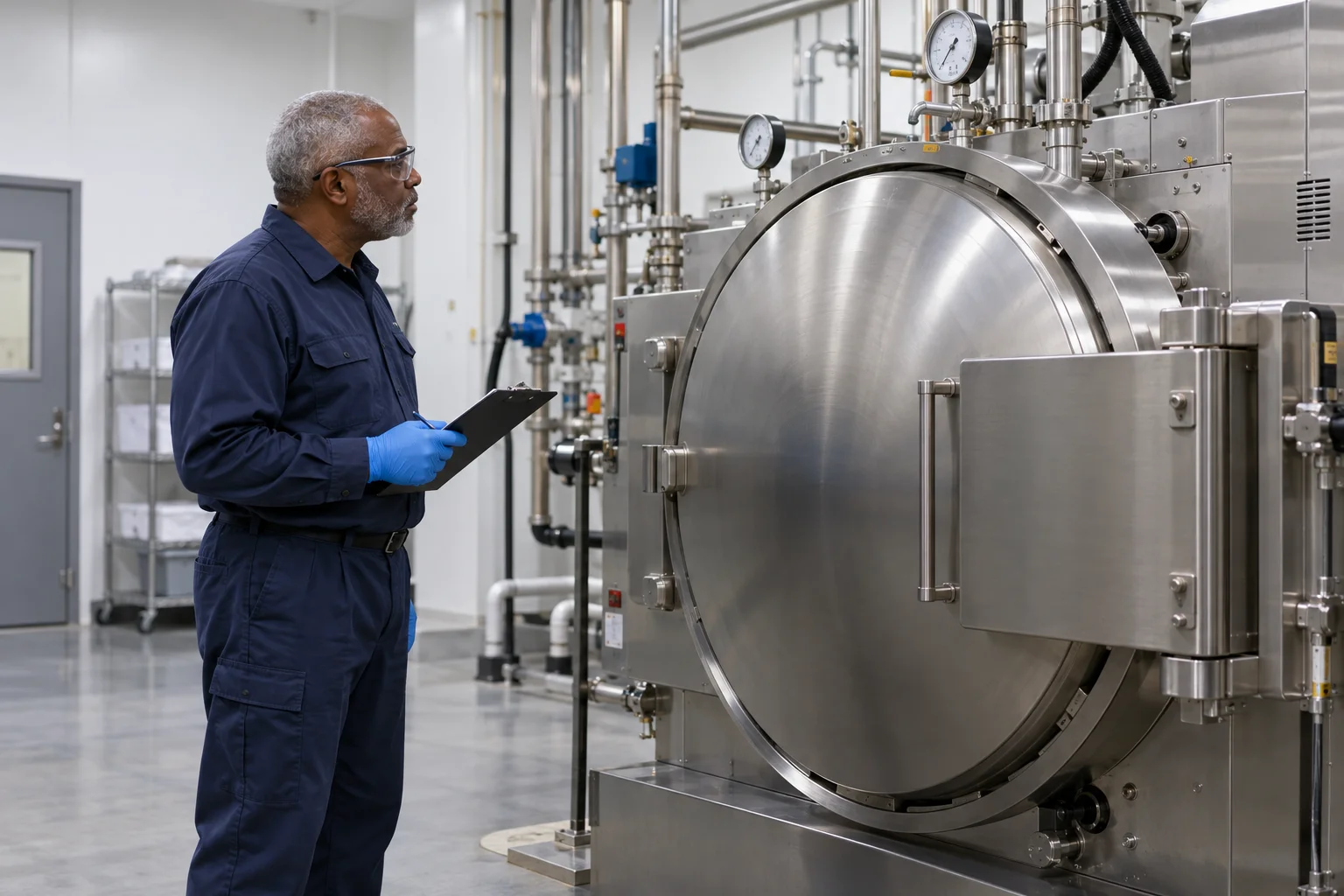
After medical waste is picked up it goes on quite a journey. Let me outline the main steps of what happens to medical waste after it’s picked up below:
- A licensed medical waste company will pick it up from your facility.
- A waste truck hauls it to a treatment facility.
- The waste is then put through an autoclave until sanitary.
- After it has been properly sanitized the waste is properly disposed of in a sanitary landfill.
That being said, some medical waste doesn’t go to waste! Plastic items in particular can be autoclaved and then melted down into recyclable material to be reused in an effort to lessen the impact on our environment.
Find Out How Much You Can Save Instantly. Try our on-line savings calculator.
Savings calculator
How Are Medical Waste Disposal Transporters and Companies Regulated?
Biohazardous waste disposal licenses and regulations vary state by state and sometimes county by county. To even start a medical waste disposal company, you must acquire a permit from the EPA or your state’s environmental regulator.
For instance, according to the Texas Commission on Environmental Quality having medical waste transported by anyone other than the generator, the transporter must "obtain a registration by rule, and initiate and maintain a record of each waste shipment collection and deposition in the form of a manifest or other similar documentation, containing the information required by §§326.53(b)(8) and (9)Exit the TCEQ; the transporter may use the Regulated Medical Waste Manifest (form TCEQ-310) for that purpose."
The EPA requires all medical waste haulers to get an EPA Identification Number, they must comply with the EPA’s Hazardous Waste Manifest System and obey all applicable US Department of Transportation Hazardous Materials Regulations.
What Is An Autoclave and What Does It Do?
To put it simply, an autoclave is a device you put infected medical waste into which uses pressurized air and high-heat steam in order to sterilize medical waste.
Autoclaves are used for more than just sterilizing medical waste, though. One interesting use of autoclaves is to turn natural rubber into vulcanized rubber. This process (although not done with an autoclave) was discovered by Charles Goodyear in the 1800s!
You may wonder why someone would use an autoclave instead of the simpler sterilization method, incineration. Well that is actually a very good question! One study shows that incineration is less successful at fully sterilizing medical waste when compared to autoclaving it. Also, the only waste an autoclave makes is the waste you put into it. When you incinerate waste it creates ashes and carbon monoxide which has to be released into the air.
Can Treated Medical Waste Go into a Regular Landfill?
No! Even after the medical waste has been treated it must be put into what’s called a “sanitary landfill.”
Sanitary landfills are landfills where the waste put into them is sealed off from the rest of environment until it is deemed safe. According to the Massachusetts Institute of Technology the waste is considered safe when it has “completely degraded biologically, chemically and physically.”
Sanitary landfills have four requirements. One, they must fully or partially stop water leakage. This is because if the waste contained in the sanitary landfill is for some reason still contaminated we wouldn’t want the contamination leaking into our public water.
Second, local environmental engineers must be involved in the planning and building of the landfill. These engineers must develop a waste disposal plan and a final restoration plan.
Third, there must be full time staff at the landfill to supervise the site, perform maintenance, and make sure waste is being disposed of properly. Finally, the waste has to be compacted and fully covered daily so none is taken by local wildlife or blown away during heavy winds.
So as you can see the trip from your practice to the landfill is quite long and full of safety regulations, for good reason. If you would like to see this trip in infographic form, click HERE.
Common Questions
- What counts as medical waste?
- Medical waste is any waste generated during the diagnosis, treatment, or immunization of humans or animals that may be contaminated with blood, body fluids, or other infectious material — including sharps, blood-soaked dressings, cultures, and pathological tissue. Non-contaminated items like standard packaging are not regulated medical waste.
- What's the difference between medical waste and biohazard waste?
- Biohazard waste is a subset of medical waste. Medical waste is the broad category (including sharps and pharmaceuticals); biohazard waste specifically refers to material containing or potentially containing infectious agents.
- How often does medical waste need to be picked up?
- It depends on generation volume and your state's maximum on-site storage time, commonly 7–90 days. Small practices often use weekly, biweekly, or monthly service; hospitals typically need multiple pickups per week.
- What happens to medical waste after pickup?
- Most regulated medical waste is autoclaved (steam-sterilized) to achieve at least a 6-log reduction in microorganisms. Waste that can't be autoclaved — pathological or chemotherapy waste — is typically incinerated under EPA air-quality controls. You receive documentation confirming compliant treatment.
Want more like this in your Google results?
Add MedPro as a preferred source on Google