
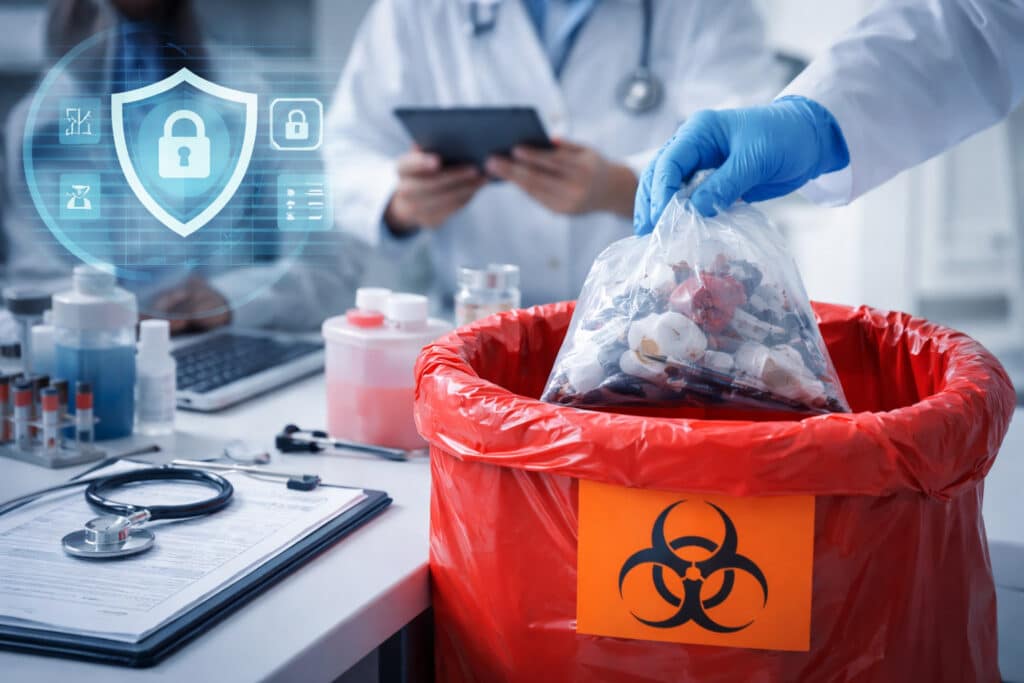
HIPAA compliance and medical waste management are more closely connected than many healthcare providers realize. Under the Health Insurance Portability and Accountability Act (HIPAA), any medical waste that contains protected health information (PHI) – including labeled prescription bottles, specimen cups, sharps containers, and paper records – must be disposed of in a way that prevents unauthorized access or disclosure. Simply placing these items in a standard trash bin is a federal violation. In 2026, regulators expect documented processes, clear accountability, and consistent staff training across every facility type, from small physician practices to large hospital systems.
What Types of Medical Waste Are Covered Under HIPAA?
HIPAA does not only apply to digital records or paper charts. Any physical item that can be linked to a patient and contains health-related information qualifies as PHI under the law.
Common Medical Waste Items That Contain PHI
Healthcare providers frequently overlook these items during disposal:
- Labeled prescription bottles – patient name, medication, and dosage are visible
- Specimen cups and blood collection tubes – often carry patient identifiers
- Empty IV bags and tubing – may display patient labels
- Medical sharps – syringes or needles with patient-identifying labels
- Hospital identification bracelets – contain names and medical record numbers
- Appointment sign-in sheets – reveal patient names and visit dates
- Diagnostic images – X-rays and MRIs with patient data attached
Red Bag and Blue Container Requirements
Red bags are designated for biohazardous waste such as blood-soaked materials, discarded surgical equipment, and pathological waste. If any item in a red bag carries PHI, HIPAA disposal requirements apply in addition to standard biohazard handling rules.
Blue containers are used for RCRA-regulated hazardous pharmaceutical waste, including expired medications, controlled substances, and bulk powders. When patient names or medical record numbers appear on these containers, they are classified as PHI under HIPAA.
HIPAA Disposal Rules: What the Law Actually Requires
Under 45 CFR 164.530(c), covered entities must implement reasonable safeguards to prevent unauthorized use or disclosure of PHI during disposal. The law does not mandate a single disposal method, but it does set clear expectations.
Core Legal Requirements
- PHI cannot be placed in publicly accessible dumpsters unless it has been rendered completely unreadable and unrecoverable
- Electronic PHI (ePHI) stored on hard drives, USB drives, or copier memory must be purged or physically destroyed before equipment is reused or discarded
- Disposal vendors who handle PHI must sign a Business Associate Agreement (BAA) with the covered entity
- Every workforce member involved in PHI disposal – including volunteers – must receive documented training
Penalties for Non-Compliance
The Office for Civil Rights (OCR) enforces HIPAA disposal violations. Fines vary based on the level of negligence:
| Violation Type | Per-Violation Fine | Annual Maximum |
|---|---|---|
| Unknowing | $100 – $50,000 | $25,000 |
| Reasonable Cause | $1,000 – $50,000 | $100,000 |
| Willful Neglect (Corrected) | $10,000 – $50,000 | $250,000 |
| Willful Neglect (Uncorrected) | $50,000 | $1,000,000 |
In one documented case, a hospital paid $800,000 after PHI was found in an unsecured dumpster accessible to the public.
Building a HIPAA-Compliant Medical Waste Disposal Process
A structured, documented process is the most reliable way to maintain HIPAA compliance and medical waste standards across your facility.
Step 1 – Identify and Segregate PHI Waste
Train all staff to recognize what counts as PHI waste before disposal occurs. Use labeled, locked containers in every department – near printers, nurses’ stations, and examination rooms – so staff never have to make a judgment call in the moment.
Step 2 – Choose an Approved Disposal Method
Accepted HIPAA-compliant disposal methods include:
- Shredding – for paper records, prescription labels, and printed documents
- Incineration or pulping – for biohazardous materials containing PHI
- Hard drive destruction – physical destruction of electronic media, not just data wiping
- Certified third-party disposal vendors – with a signed BAA on file
Step 3 – Document the Chain of Custody
In 2026, regulators expect more than verbal assurances. Maintain written records of who handled PHI waste, when it was collected, and how it was destroyed. Manual logs are increasingly viewed as compliance weaknesses – facilities that use certified vendors with documented pickup and destruction records are better positioned during audits.
Step 4 – Train Your Workforce Consistently
HIPAA requires that every employee who handles or supervises PHI disposal receives training. This includes front desk staff, clinical assistants, and any third-party contractors working on your premises. Certifications should be documented and renewed regularly.
HIPAA Compliance Training and Ongoing Obligations for Healthcare Facilities
Compliance is not a one-time event. Healthcare facilities must maintain active training programs, update policies when regulations change, and conduct regular internal audits to identify gaps.
What Ongoing HIPAA Compliance Looks Like
- Annual staff training on PHI handling and disposal procedures
- Written policies covering both physical and electronic PHI destruction
- Regular review of Business Associate Agreements with all disposal vendors
- Internal audits of waste handling workflows across departments
- Documented sanctions for employees who fail to follow disposal procedures
Aligning HIPAA with OSHA Requirements
Improper disposal of medical waste containing PHI can trigger both HIPAA violations and OSHA citations. OSHA’s Bloodborne Pathogen Standard (29 CFR 1910.1030) requires that biohazardous waste be handled, contained, and disposed of in ways that protect worker safety. When a facility’s waste management process is fragmented – with clinical, compliance, and facilities teams operating independently – both regulatory frameworks are harder to satisfy simultaneously.
Facilities that treat medical waste disposal as a unified compliance workflow, rather than a separate facilities task, are consistently better positioned to pass audits under both HIPAA and OSHA standards.
Frequently Asked Questions
Does HIPAA apply to all medical waste, or only paper records?
HIPAA applies to any item that contains PHI, not just paper records. Labeled prescription bottles, specimen cups, sharps containers with patient identifiers, and electronic storage devices all fall under HIPAA disposal requirements if they can be linked to an individual patient.
Can a healthcare provider use a regular shredding company for HIPAA-compliant document destruction?
Only if a signed Business Associate Agreement is in place with that vendor. Any third party that handles PHI on behalf of a covered entity must be bound by a BAA, which outlines their responsibilities for protecting and destroying patient information.
What happens if a staff member accidentally disposes of PHI incorrectly?
The covered entity – not just the individual employee – is held responsible under HIPAA. The facility must apply documented sanctions and may be subject to OCR investigation and fines depending on the nature and scope of the violation.
Is hard drive deletion enough to comply with HIPAA’s electronic media disposal rules?
No. The HIPAA Security Rule requires that ePHI be rendered unrecoverable before electronic media is reused or discarded. Simply deleting files or formatting a drive does not meet this standard. Physical destruction or certified data wiping that meets NIST standards is required.
How long must healthcare facilities retain records of PHI disposal?
HIPAA itself does not specify a retention period for disposal records, but most state laws require medical records to be kept for 6 to 10 years before destruction. Disposal documentation – including vendor pickup logs and destruction certificates – should be retained for the same period.
Do small physician practices have the same HIPAA disposal obligations as hospitals?
Yes. HIPAA applies equally to all covered entities regardless of size. While implementation may differ – small clinics may use monthly vendor pickups while hospitals may have on-site shredding equipment – the legal standard for protecting PHI through disposal is the same.


