
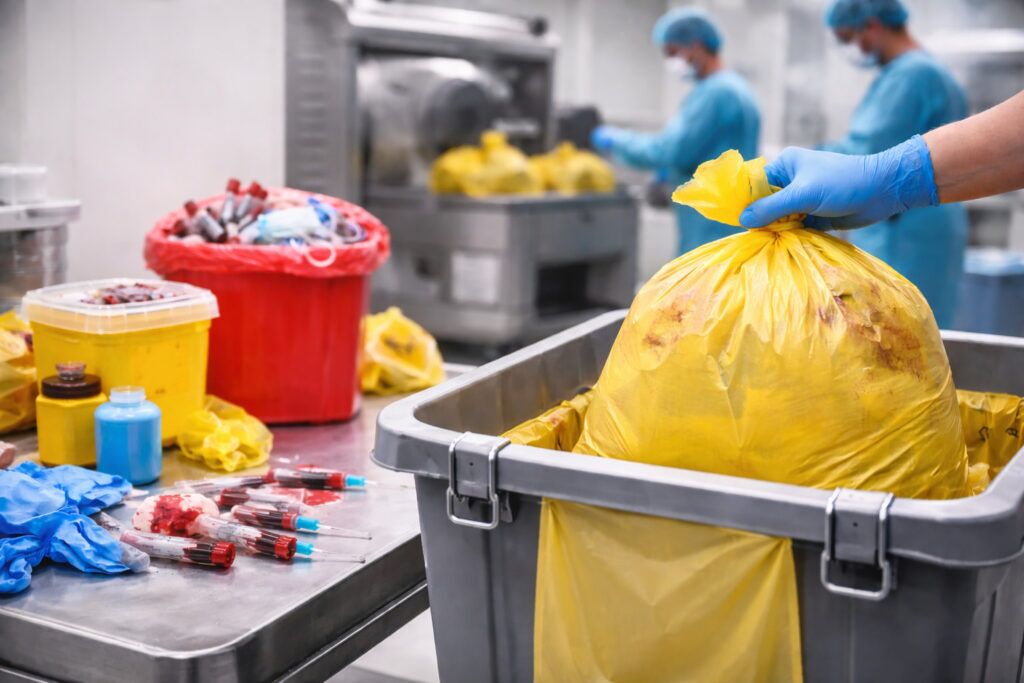
Hospitals dispose of biowaste through a regulated four-step process:
(1) immediate segregation into color-coded containers at the point of generation,
(2) temporary storage in designated secure areas,
(3) collection by licensed medical waste haulers, and
(4) treatment via autoclaving, incineration, or chemical disinfection at EPA-approved facilities. This process is governed by OSHA, EPA, and state regulations to protect healthcare workers, waste handlers, and the public from infectious disease transmission.
The Complete Hospital Biowaste Disposal Process
Understanding how hospitals manage biowaste reveals the complexity and importance of proper medical waste disposal. Here’s the step-by-step journey from patient bedside to final disposal.
Step 1: Point-of-Generation Segregation
What Happens:
The moment biowaste is generated, healthcare workers segregate it into the appropriate container. This is the most critical step – proper segregation determines everything that follows.
Color-Coded System:
- Red bags/containers: Infectious waste (contaminated PPE, bandages, blood-soaked materials)
- Yellow bags/containers: Pathological waste (tissues, organs, body parts)
- White/translucent containers: Sharps (needles, syringes, scalpels)
- Black bags: Pharmaceutical waste (expired medications, chemotherapy drugs)
- Blue bags: Pharmaceutical waste requiring incineration (in some facilities)
Real-World Example:
A nurse removes a blood-soaked bandage from a post-surgical patient. She immediately places it in the red biohazard bag mounted on the wall. The used syringe goes directly into the sharps container. No waste touches regular trash.
Why This Step Matters:
- Prevents cross-contamination
- Ensures proper treatment method
- Reduces disposal costs (treating everything as infectious waste is expensive)
- Protects housekeeping and waste handling staff
- Maintains regulatory compliance
Hospital Training Requirements:
- All clinical staff trained on segregation protocols
- Annual refresher training mandatory
- Visual aids posted in every patient room
- Audits conducted monthly to ensure compliance
- Non-compliance can result in staff discipline
Step 2: Temporary On-Site Storage
What Happens:
Once containers are full (sharps containers at 3/4 capacity, bags when nearly full), they’re moved to designated storage areas within the hospital.
Storage Area Requirements:
- Location: Separate from patient care areas, food service, and public spaces
- Access control: Locked rooms accessible only to authorized personnel
- Ventilation: Negative pressure to prevent odor escape
- Temperature control: Refrigerated storage for pathological waste
- Flooring: Impermeable, easy-to-clean surfaces
- Signage: Biohazard symbols, restricted access warnings
- Fire safety: Fire-resistant construction, sprinkler systems
Storage Duration Limits:
- Room temperature: Maximum 7 days
- Refrigerated (below 40°F): Maximum 30 days
- Frozen: Maximum 90 days (pathological waste only)
Real-World Example:
A large hospital generates 200-300 pounds of biowaste daily. Housekeeping staff collect full containers every 4-6 hours and transport them via dedicated service elevators to a secure storage room in the basement. The room is kept at 38°F and has separate sections for different waste types.
Storage Container Requirements:
- Rigid, leak-proof construction
- Labeled with biohazard symbols
- Dated when sealed
- Manifested for tracking
- Secured to prevent tipping
Safety Protocols:
- Staff wear PPE when handling containers
- Spill kits available in storage areas
- Emergency eyewash stations nearby
- Hand hygiene stations at exit
- Regular pest control inspections
Step 3: Collection by Licensed Haulers
What Happens:
Licensed medical waste transportation companies collect biowaste on a scheduled basis (daily, twice-weekly, or weekly depending on volume).
Hauler Requirements:
- DOT permits: Department of Transportation hazardous materials endorsement
- State licenses: Medical waste transporter license for each state operated in
- Insurance: Minimum $1 million liability coverage
- Vehicle standards: Leak-proof compartments, proper signage, spill containment equipment
- Driver training: Hazardous materials handling certification
Collection Process:
- Hauler arrives at designated loading dock
- Hospital staff verify hauler credentials
- Waste containers loaded into specialized vehicle compartments
- Manifest signed by both parties (tracking document)
- Hauler provides copy of manifest to hospital
- Waste tracked via GPS to treatment facility
Real-World Example:
Every Tuesday and Friday at 6 AM, a medical waste hauler arrives at Northwestern Memorial Hospital. The driver scans each container’s barcode, loads 15-20 containers into the truck’s locked compartment, and provides digital manifest confirmation. The hospital’s environmental services director receives real-time tracking updates.
Manifest System:
The manifest is a legal document tracking waste from generation to disposal:
- Hospital name and EPA ID number
- Waste type and quantity
- Date and time of pickup
- Hauler company and driver information
- Treatment facility destination
- Signatures from generator and transporter
- Tracking number for reference
Transportation Safety:
- Vehicles inspected before each route
- Containers secured to prevent shifting
- Spill kits carried on every vehicle
- Emergency contact numbers posted
- Route planning to avoid residential areas when possible
- Real-time GPS tracking
Step 4: Treatment at Licensed Facilities
What Happens:
Biowaste arrives at EPA-approved treatment facilities where it’s processed using one of three primary methods.
Treatment Method 1: Autoclaving (Steam Sterilization)
Used For:
- Sharps waste (80% of hospital sharps)
- Contaminated PPE and textiles
- Laboratory cultures
- Non-pathological infectious waste
The Process:
- Waste containers loaded into large autoclave chambers
- Steam heated to 250-270°F at 15-30 PSI pressure
- Treatment cycle runs 30-60 minutes
- All pathogens killed (bacteria, viruses, fungi, spores)
- Waste cooled and mechanically shredded
- Shredded waste tested for sterility
- Disposed in municipal solid waste landfill
Real-World Example:
A hospital’s sharps containers arrive at an autoclave facility. Workers load 50 containers into a chamber the size of a small room. The autoclave runs for 45 minutes at 270°F. Post-treatment testing confirms zero viable pathogens. The sterilized waste is shredded to be unrecognizable and sent to a landfill.
Advantages:
- No air emissions
- Environmentally friendly
- Cost-effective
- Allows material recycling after sterilization
- Reduces waste volume by 80%
Monitoring:
- Temperature and pressure logged every cycle
- Biological indicators tested regularly
- State inspections quarterly
- Records maintained for 3 years
Treatment Method 2: Incineration
Used For:
- Pathological waste (tissues, organs, body parts)
- Pharmaceutical waste (expired drugs, chemotherapy)
- Trace chemotherapy-contaminated materials
- Chemical waste
- Waste that cannot be autoclaved
The Process:
- Waste loaded into incineration chambers
- Primary chamber burns at 1,600-1,800°F
- Secondary chamber burns at 2,000-2,200°F (destroys toxic compounds)
- Ash residue collected
- Emissions filtered through pollution control equipment
- Ash tested for hazardous materials
- Ash disposed in hazardous waste landfill
Real-World Example:
A hospital’s pathological waste (surgical specimens, amputated limbs, placental tissue) is incinerated at a medical waste facility. The high temperatures completely destroy all organic material. The resulting ash weighs 5% of the original waste weight and is buried in a lined hazardous waste landfill.
Advantages:
- Complete destruction of all materials
- Reduces waste volume by 95%
- Handles all waste types
- Destroys pharmaceuticals completely
Environmental Controls:
- Continuous emissions monitoring
- Particulate filters
- Acid gas scrubbers
- Heavy metal capture systems
- EPA air quality permits required
Monitoring:
- Emissions tested continuously
- Temperature logged every minute
- Ash tested for toxicity
- State inspections monthly
- Records maintained for 5 years
Treatment Method 3: Chemical Disinfection
Used For:
- Liquid biowaste (blood, body fluids)
- Laboratory waste
- Dialysis waste
- Some sharps waste
The Process:
- Waste mixed with chemical disinfectants (sodium hypochlorite, peracetic acid, chlorine dioxide)
- Contact time: 20-60 minutes
- Chemical neutralizes pathogens
- Treated waste tested for sterility
- Liquid discharged to sanitary sewer (with EPA approval)
- Solid residue sent to landfill
Real-World Example:
A dialysis center generates 50 gallons of dialysate (used dialysis fluid) daily. The fluid is treated with sodium hypochlorite for 30 minutes, tested for pathogens, and discharged to the sanitary sewer system per EPA and local sewer authority approval.
Advantages:
- Effective for liquid waste
- No air emissions
- Lower cost than incineration
- Can be done on-site in some facilities
Monitoring:
- Chemical concentration tested daily
- Contact time verified
- Effluent tested for pathogens
- pH and temperature logged
- Sewer authority inspections annually
Hospital-Specific Biowaste Management Protocols
Large Academic Medical Centers (500+ Beds)
Volume:
- 20,000-30,000 pounds of biowaste per week
- 200-300 sharps containers per week
- 50-100 pounds of pharmaceutical waste per week
Management:
- Dedicated environmental services department
- On-site waste coordinator
- Daily pickups by haulers
- Multiple storage areas throughout facility
- Automated tracking systems
Example Protocol:
Northwestern Memorial Hospital (Chicago):
- 12 satellite storage rooms on different floors
- Central storage in basement with refrigeration
- Daily pickups Monday-Saturday
- Autoclaving for 90% of waste
- Incineration for pathological and pharmaceutical waste
Community Hospitals (100-300 Beds)
Volume:
- 5,000-10,000 pounds of biowaste per week
- 50-100 sharps containers per week
- 10-30 pounds of pharmaceutical waste per week
Management:
- Environmental services manager oversees waste
- Single central storage area
- 2-3 pickups per week
- Contracted hauler and treatment
Example Protocol:
Edward Hospital (Naperville):
- Central storage room near loading dock
- Pickups Tuesday, Thursday, Saturday
- All waste sent to off-site treatment
- MedPro Disposal handles all collection and treatment
Specialty Hospitals (Surgery Centers, Cancer Centers)
Volume:
- 2,000-5,000 pounds of biowaste per week
- High percentage of pathological or pharmaceutical waste
- 20-50 sharps containers per week
Management:
- Specialized waste streams
- More frequent pharmaceutical waste pickups
- Chemotherapy waste requires special handling
Example Protocol:
Northwestern Medicine Cancer Center:
- Separate containers for trace chemotherapy waste
- Weekly pharmaceutical waste pickup
- All chemotherapy waste incinerated
- Staff trained on cytotoxic waste handling
Regulatory Compliance Requirements for Hospitals
OSHA Bloodborne Pathogens Standard
Requirements:
- Written exposure control plan
- Annual employee training
- Hepatitis B vaccination offered to all at-risk employees
- Post-exposure evaluation and follow-up
- Sharps injury log maintained
- Engineering controls (sharps containers, safety needles)
Inspections:
- OSHA can inspect without notice
- Violations: $10,000-$15,000 per violation
- Repeat violations: Up to $150,000
Hospital Compliance:
- Annual training for all clinical staff
- Monthly audits of waste handling practices
- Sharps injury review committee
- Continuous improvement programs
EPA Medical Waste Tracking
Requirements:
- Manifest system for all regulated medical waste
- Generator EPA ID number
- Tracking from generation to disposal
- Records maintained for 3 years
- Annual reporting to state EPA
Violations:
- Up to $70,000 per violation
- Criminal penalties for knowing violations
- Facility closure possible for severe violations
Hospital Compliance:
- Electronic manifest system
- Quarterly audits of manifest records
- Staff training on documentation
- Backup paper manifests for system failures
State and Local Regulations (Illinois Example)
Illinois EPA Requirements:
- Medical waste generator permit
- Annual waste reduction plan
- Spill response procedures
- Employee training documentation
- Storage area inspections
Local Health Department:
- Facility inspections annually
- Waste storage area approval
- Complaint investigations
- Public health reporting
Cost of Hospital Biowaste Disposal
Pricing Factors:
- Volume: More waste = lower per-pound cost
- Waste type: Pathological and pharmaceutical waste costs 2-3x more than infectious waste
- Pickup frequency: More frequent pickups increase cost
- Treatment method: Incineration costs 2-4x more than autoclaving
- Location: Urban areas typically have lower costs due to competition
Typical Hospital Costs:
Large Hospital (500 beds):
- $15,000-$30,000 per month
- $0.30-$0.50 per pound for infectious waste
- $1.00-$2.00 per pound for pathological waste
- $2.00-$4.00 per pound for pharmaceutical waste
Medium Hospital (200 beds):
- $5,000-$12,000 per month
- $0.40-$0.70 per pound for infectious waste
- $1.50-$2.50 per pound for pathological waste
- $2.50-$5.00 per pound for pharmaceutical waste
Small Hospital (50 beds):
- $1,500-$4,000 per month
- $0.50-$1.00 per pound for infectious waste
- $2.00-$3.00 per pound for pathological waste
- $3.00-$6.00 per pound for pharmaceutical waste
Best Practices for Hospital Biowaste Management
1. Comprehensive Staff Training
- Initial training for all new hires
- Annual refresher training
- Department-specific protocols
- Hands-on demonstrations
- Competency testing
2. Waste Minimization Programs
- Source reduction (use less disposable items)
- Reusable instruments when possible
- Right-sizing containers (don’t use large sharps containers for small volume)
- Proper segregation (don’t contaminate regular trash)
Impact: Hospitals can reduce waste by 20-30% through proper segregation alone
3. Technology Integration
- Barcode tracking of containers
- Automated manifest generation
- Real-time waste volume monitoring
- Predictive analytics for pickup scheduling
- Digital training modules
4. Continuous Improvement
- Monthly waste audits
- Staff feedback mechanisms
- Benchmarking against similar facilities
- Root cause analysis of incidents
- Recognition programs for compliant departments
5. Emergency Preparedness
- Surge capacity plans for pandemic situations
- Backup hauler contracts
- On-site treatment options for emergencies
- Increased storage capacity
- Staff cross-training
COVID-19 Example:
During the pandemic, hospitals generated 2-3x normal biowaste volumes. Facilities with surge plans maintained compliance while others faced storage and pickup challenges.
Frequently Asked Questions
How much biowaste does a hospital generate?
Average hospitals generate 25-30 pounds of biowaste per staffed bed per day. A 200-bed hospital produces approximately 5,000-6,000 pounds of biowaste weekly.
What happens if a hospital runs out of storage space?
Hospitals must arrange emergency pickups with haulers or use backup storage areas. Storing waste beyond capacity limits is a violation. Some facilities have on-site treatment equipment for emergencies.
Can hospitals treat biowaste on-site?
Yes, with proper permits. Some hospitals have on-site autoclaves or chemical treatment systems. This requires EPA and state permits, trained operators, and compliance monitoring. Most hospitals find off-site treatment more cost-effective.
How do hospitals handle biowaste during emergencies?
Emergency plans include increased pickup frequency, temporary storage solutions, backup hauler contracts, and mutual aid agreements with nearby facilities.
What’s the difference between hospital and clinic biowaste disposal?
The process is the same, but hospitals generate much higher volumes, have more waste types, and face stricter regulatory oversight. Small clinics often use mail-back programs or shared pickup services.
Do hospitals recycle any biowaste?
After autoclaving, some plastics and metals can be recovered and recycled. However, most treated biowaste goes to landfills. Hospitals focus more on reducing waste generation than recycling treated waste.
Partner with Experts for Hospital Biowaste Disposal
Hospital biowaste management requires expertise, reliability, and regulatory compliance. MedPro Disposal provides comprehensive solutions for healthcare facilities:
- Scheduled pickups – Daily, weekly, or custom schedules
- All waste types – Sharps, pathological, pharmaceutical, infectious
- Licensed treatment – EPA-approved autoclaving and incineration
- Complete documentation – Manifests, certificates, compliance reports
- Staff training support – Help your team stay compliant
- Emergency services – 24/7 availability for urgent needs


