
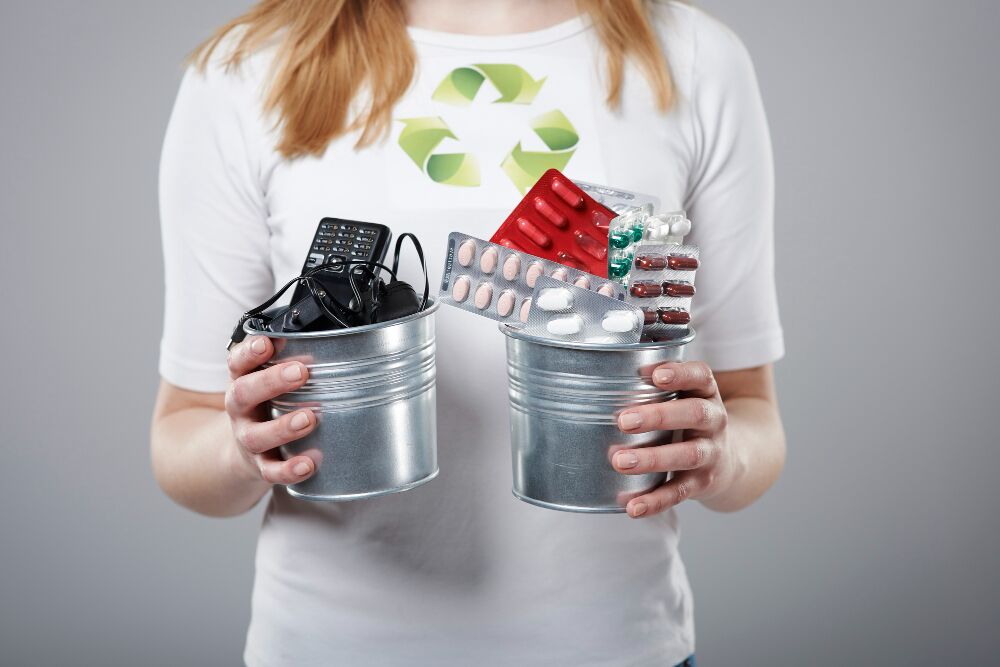
If your healthcare facility is still flushing expired medications down the drain or tossing them in the regular trash, you’re not just breaking the law – you’re exposing your organization to serious fines, environmental harm, and patient safety risks. Knowing how to dispose of pharmaceutical waste safely and legally is no longer optional for US healthcare providers; it’s a compliance requirement enforced by multiple federal agencies.
At MedPro Disposal, we work with clinics, hospitals, long-term care facilities, and medical practices across the country every day. This guide draws on that hands-on experience to walk you through exactly what the regulations require, how to classify your waste correctly, and what best practices keep your facility protected.
What Is Pharmaceutical Waste?
Pharmaceutical waste is any medication or drug-related product that is expired, unused, contaminated, or no longer needed. It includes a wide range of materials generated across healthcare settings, such as:
- Unused prescription medications
- Expired over-the-counter drugs
- Partially used IV bags and vials
- Chemotherapy agents and cytotoxic drugs
- Controlled substances such as opioids and benzodiazepines
- Nicotine patches and other OTC cessation products (with some exemptions)
Not all pharmaceutical waste is treated the same way. The type of drug, its chemical properties, and the quantity your facility generates all determine how it must be handled and disposed of under federal and state law.
Why Proper Pharmaceutical Waste Disposal Matters
The stakes around pharmaceutical waste disposal are higher than many facility managers realize. The US pharmaceutical waste management market reached $1.61 billion in 2026 and is projected to grow to $2.18 billion by 2031 – a direct reflection of how seriously regulators and healthcare systems are taking this issue.
Here’s why it matters for your facility specifically:
- Environmental contamination. Pharmaceuticals flushed into the sewer system contaminate waterways, harm aquatic ecosystems, and can enter drinking water supplies.
- Regulatory penalties. The EPA, DEA, and OSHA all have enforcement authority over pharmaceutical waste. Non-compliance carries escalating fines and, in serious cases, criminal liability.
- Drug diversion risk. Improperly stored or discarded controlled substances create opportunities for theft and misuse – a significant liability in today’s opioid enforcement environment.
- Accreditation consequences. Facilities accredited by The Joint Commission are expected to demonstrate compliant waste management practices during audits.
Studies show that education programs on proper waste segregation can boost correct classification rates by up to 65% – yet many facilities still lack consistent staff training.
Pharmaceutical Waste Disposal Regulations in the US
Understanding the regulatory landscape is the foundation of legal pharmaceutical waste disposal. Several federal agencies have overlapping jurisdiction, and state regulations can be even more stringent.
EPA: The Resource Conservation and Recovery Act (RCRA)
The Environmental Protection Agency regulates hazardous pharmaceutical waste under the Resource Conservation and Recovery Act (RCRA). In February 2019, the EPA finalized the Management Standards for Hazardous Waste Pharmaceuticals (40 CFR Part 266, Subpart P), which took effect on August 21, 2019.
Key requirements under Subpart P include:
- No sewering. Hazardous waste pharmaceuticals – including controlled substances – cannot be disposed of into a sewer system under any circumstances.
- Cradle-to-grave manifests. Facilities must maintain complete documentation from the point of generation through final destruction.
- Notification requirements. Healthcare facilities subject to Subpart P must notify the EPA of their status as a hazardous waste pharmaceutical generator.
- State adoption. As of late 2024, the majority of states have adopted the rule. If you’re in a state that hasn’t yet, federal minimums still apply – and your state may have additional requirements.
DEA: Controlled Substance Disposal
The Drug Enforcement Administration governs how controlled substances are destroyed. Under the Secure and Responsible Drug Disposal Act, DEA-registered collectors must render controlled substances “non-retrievable” before disposal. Incineration remains the most common method, though the DEA has been exploring alternatives.
Facilities that are DEA registrants can modify their registration to become authorized collectors. If your facility is not an authorized collector, you must transfer controlled substance waste to one that is.
OSHA and DOT
The Occupational Safety and Health Administration sets worker safety standards for handling pharmaceutical waste, particularly hazardous drugs listed by the National Institute for Occupational Safety and Health (NIOSH). The Department of Transportation regulates the packaging and transport of pharmaceutical waste off-site.
Important: State regulations may be more stringent than federal rules. Always check with your state environmental agency in addition to following federal requirements.
How to Classify Your Pharmaceutical Waste
Proper classification is where most facilities run into trouble. Misclassifying pharmaceutical waste is one of the most common compliance violations – and it’s entirely preventable.
The Four Main Categories
1. RCRA Hazardous Waste Pharmaceuticals
These are drugs that appear on the EPA’s P-list (acutely hazardous) or U-list (toxic). Common examples include certain chemotherapy agents, warfarin at specific concentrations, and nicotine products (with some exemptions). These require the strictest handling and disposal protocols.
2. Non-RCRA Hazardous Waste Pharmaceuticals
Many drugs don’t meet the federal RCRA definition of hazardous waste but are still regulated at the state level or present environmental risks. These include many common antibiotics, antidepressants, and hormones.
3. Controlled Substance Waste
Opioids, benzodiazepines, stimulants, and other Schedule I-V substances fall under DEA jurisdiction regardless of their RCRA classification. They require separate handling, documentation, and authorized destruction.
4. Trace Chemotherapy Waste
Containers, tubing, and PPE that have come into contact with chemotherapy agents are classified as trace chemo waste and require incineration at a permitted facility.
Safe Pharmaceutical Waste Disposal Methods
Once you’ve classified your waste correctly, the disposal method follows from the classification. Here are the primary methods used in healthcare settings across the US:
Incineration
Incineration at a permitted high-temperature facility is the gold standard for most hazardous pharmaceutical waste, including P-listed drugs, controlled substances, and cytotoxic agents. It renders drugs non-retrievable and eliminates environmental contamination risk.
Pharmaceutical Waste Containers and Mail-Back Programs
For non-hazardous pharmaceutical waste, specially designed pharmaceutical waste containers – often color-coded blue – allow facilities to segregate and collect medications for off-site disposal. Mail-back programs are increasingly popular for controlled substance destruction in smaller practice settings.
Drug Deactivation Systems
On-site drug deactivation products (such as activated carbon-based systems) can render certain medications non-recoverable at the point of care. The DEA has recognized some of these systems as compliant for controlled substance destruction, though requirements vary by state.
Reverse Distribution
Some pharmaceuticals can be returned to manufacturers or reverse distributors for credit. This is a legitimate option for certain unexpired or manufacturer-recalled products, but it does not apply to all pharmaceutical waste streams.
How to Dispose of Expired Medications in Healthcare Facilities
Expired medications are among the most common pharmaceutical waste streams in hospitals, clinics, and long-term care facilities. Here’s how to handle them correctly:
- Do not flush expired medications. This is explicitly prohibited for hazardous pharmaceuticals under EPA Subpart P and is strongly discouraged for all pharmaceuticals due to water contamination risk.
- Do not place them in regular trash. This creates diversion risk for controlled substances and environmental liability for hazardous drugs.
- Segregate by waste type. Separate expired controlled substances, RCRA hazardous drugs, and non-hazardous pharmaceuticals into the appropriate containers.
- Document everything. Maintain a log of what was discarded, when, and how it was disposed of. This is your protection during an audit.
- Work with a licensed disposal vendor. A permitted pharmaceutical waste disposal company will provide compliant containers, scheduled pickups, and certificates of destruction.
Pharmaceutical Waste Disposal for Clinics and Hospitals: Step-by-Step
Whether you’re managing a small outpatient clinic or a large hospital system, the core process for compliant pharmaceutical waste disposal follows the same framework.
Step 1: Conduct a waste assessment.
Identify every pharmaceutical waste stream your facility generates. This includes medications in patient rooms, the pharmacy, operating rooms, and nursing stations.
Step 2: Classify each waste stream.
Determine whether each category is RCRA hazardous, non-RCRA hazardous, a controlled substance, or trace chemotherapy waste. When in doubt, consult your disposal vendor or the EPA’s 10-Step Blueprint for Managing Pharmaceutical Waste in US Healthcare Facilities.
Step 3: Set up segregation stations.
Place clearly labeled, color-coded containers at every point of generation. Blue containers are standard for non-hazardous pharmaceutical waste. Black containers are used for RCRA hazardous pharmaceutical waste.
Step 4: Train your staff.
All personnel who handle medications – including nurses, pharmacists, physicians, and environmental services staff – must understand how to segregate waste correctly. Annual training is not just best practice; it’s a regulatory expectation.
Step 5: Establish a pickup schedule.
Work with your licensed disposal vendor to schedule regular pickups that prevent containers from exceeding storage limits. Overfull or improperly stored containers are a common audit finding.
Step 6: Maintain your documentation.
Keep manifests, certificates of destruction, and training records on file. Most regulations require records to be retained for at least three years.
Step 7: Review and audit internally.
Conduct periodic internal audits of your waste segregation practices. Catching errors before a regulatory inspection is far less costly than a violation.
Common Mistakes to Avoid
Even well-intentioned facilities make errors that create compliance exposure. Here are the most frequently cited mistakes in pharmaceutical waste management:
- Flushing medications – still one of the most common violations despite explicit EPA prohibition
- Mixing pharmaceutical waste with regular medical waste – creates cross-contamination and classification errors
- Failing to label containers properly – RCRA labeling requirements are specific and enforced
- Exceeding storage time limits – most states set maximum storage periods for hazardous pharmaceutical waste
- Skipping staff training – the majority of violations trace back to undertrained personnel
- Using an unlicensed disposal vendor – if your vendor isn’t compliant, your facility is still liable
- Not maintaining manifests – documentation gaps are heavily scrutinized during audits
Pro Tips from Compliance Experts
After working with healthcare facilities of every size across the US, here’s what the most compliant organizations consistently do well:
Appoint a dedicated waste compliance coordinator. Someone needs to own this program. Facilities with a designated point person for pharmaceutical waste compliance have far fewer violations.
Don’t rely on product labels alone. Not every medication is labeled with its hazardous waste classification. Cross-reference your formulary against the EPA’s P-list and U-list, and the NIOSH hazardous drug list, at least annually.
Request certificates of destruction from your vendor. Every disposal event should generate a certificate of destruction. File these immediately. They are your primary defense in an enforcement action.
Ask your vendor about state-specific requirements. Federal rules set the floor, but states like California, New York, and Massachusetts have additional requirements. A good disposal partner knows your state’s rules.
Plan for waste volume spikes. Medication returns after a patient discharge, formulary changes, and drug recalls can all create sudden increases in pharmaceutical waste volume. Have a protocol in place before it happens.
FAQ
What is the legal way to dispose of pharmaceutical waste in the US?
The legal method depends on the type of pharmaceutical waste. Hazardous pharmaceutical waste must be managed under EPA RCRA regulations (40 CFR Part 266, Subpart P), which prohibit sewer disposal and require incineration or other permitted treatment methods. Controlled substances must be rendered non-retrievable under DEA regulations. Non-hazardous pharmaceutical waste must meet state-specific requirements. Working with a licensed pharmaceutical waste disposal company is the most reliable way to ensure full compliance across all categories.
Can healthcare facilities flush unused medications down the drain?
No. The EPA’s Management Standards for Hazardous Waste Pharmaceuticals explicitly prohibit the disposal of hazardous pharmaceutical waste into a sewer system. While this rule applies specifically to hazardous pharmaceuticals, flushing any medication is strongly discouraged due to water contamination risks and is prohibited in many states regardless of hazard classification.
How often should a clinic or hospital schedule pharmaceutical waste pickups?
Pickup frequency depends on the volume of waste your facility generates and applicable storage time limits. Most states set maximum storage periods for hazardous pharmaceutical waste – commonly 90 days for small quantity generators. High-volume facilities typically schedule monthly or bi-monthly pickups. Your licensed disposal vendor can help you determine the right schedule based on your generator status and state requirements.
What happens if a healthcare facility improperly disposes of pharmaceutical waste?
Penalties for improper pharmaceutical waste disposal can be severe. The EPA can issue fines for RCRA violations, the DEA can take action for controlled substance mishandling, and OSHA can cite facilities for worker safety violations. Fines can reach tens of thousands of dollars per day per violation. Beyond financial penalties, facilities may face reputational damage, loss of accreditation, and increased regulatory scrutiny going forward.
Do pharmaceutical waste disposal regulations apply to small clinics and private practices?
Yes. All healthcare facilities that generate pharmaceutical waste are subject to federal and state regulations, regardless of size. The EPA does recognize different generator categories – Very Small Quantity Generators (VSQGs), Small Quantity Generators (SQGs), and Large Quantity Generators (LQGs) – with somewhat different requirements. However, even VSQGs must comply with the prohibition on sewer disposal and must use compliant disposal methods. Small practices are not exempt.
Conclusion
Pharmaceutical waste disposal is one of the most regulated – and most frequently mishandled – compliance areas in US healthcare. Getting it right requires understanding the overlapping requirements of the EPA, DEA, OSHA, and your state environmental agency, classifying your waste streams correctly, training your staff consistently, and partnering with a licensed disposal vendor who knows the rules as well as you do.
The good news is that with the right systems in place, safe pharmaceutical waste disposal is straightforward and manageable – regardless of your facility’s size.
MedPro Disposal specializes in pharmaceutical waste disposal for healthcare facilities across the United States. We provide compliant containers, scheduled pickups, certificates of destruction, and expert guidance on EPA and DEA requirements – so your team can focus on patient care, not compliance paperwork.
Ready to simplify your pharmaceutical waste program? Contact MedPro Disposal today for a free compliance assessment and customized disposal plan for your facility.


