
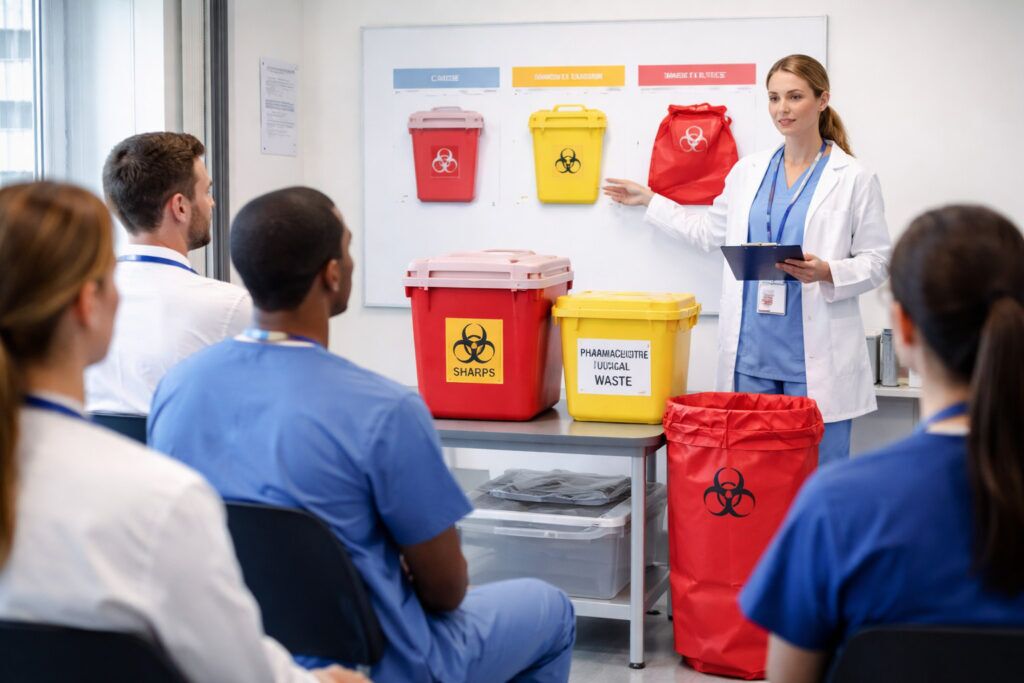
Create faculty-specific medical waste training via needs assessment, tailored curriculum on identification and disposal, LMS tracking, and engaging formats like micro-learning. Meets OSHA annual requirements and DOT/EPA rules, avoiding $14,502 average fines per violation. Reduces accidents, ensures audit readiness, and builds safety culture. Partner with services like MedPro Disposal for compliance.
Struggling to keep faculty compliant with medical waste protocols amid busy teaching schedules? Inadequate medical waste management training exposes your healthcare institution to OSHA fines averaging $14,502 per serious violation. This guide delivers a proven step-by-step framework to build an engaging program that ensures safety and regulatory adherence.
What Is a Medical Waste Training Program for Faculty?
A medical waste training program for faculty is a specialized educational system designed for educators, researchers, and supervisors in academic healthcare settings. Unlike general medical waste training for healthcare staff, this curriculum addresses the unique responsibilities of faculty members who oversee laboratories, clinical rotations, and student safety. It ensures that those teaching the next generation of healthcare professionals are themselves experts in current disposal protocols.
The goal isn’t just compliance. It is about establishing a standard of safety that trickles down from professors to students. An effective program covers the identification, segregation, and disposal of regulated medical waste (RMW) specific to research and educational environments. It bridges the gap between theoretical knowledge and the practical application of OSHA and EPA guidelines in a busy academic setting.
Why Faculty-Specific Training Matters in Healthcare Compliance
Faculty members occupy a critical position in the chain of command. They are often the primary supervisors in settings where accidents are most likely to happen, such as teaching labs or university clinics. If a faculty member is unsure about waste segregation rules, their students will inevitably learn bad habits. This creates a cycle of non-compliance that can last for years.
In practice, faculty are responsible for:
- Modeling correct behavior for students and junior staff
- Identifying hazardous materials in research settings
- Responding to spills or exposure incidents immediately
- Ensuring their department avoids costly regulatory fines
When faculty training is neglected, institutions face higher risks of injury and legal penalties. A targeted faculty medical waste compliance training approach ensures that compliance is a core part of the curriculum, not an afterthought.
Key Regulatory Requirements for Medical Waste Training
Federal regulations set strict baselines for who needs training and how often. The Occupational Safety and Health Administration (OSHA) requires training on bloodborne pathogens upon hire and annually thereafter. However, waste disposal involves multiple agencies, including the Department of Transportation (DOT) and the EPA.
Here is the breakdown of timing requirements:
Institutions must maintain detailed records of these sessions. If an inspector arrives, you must produce proof that every faculty member handling regulated waste has completed their required modules. Failure to provide these records is a common reason for penalties.
Benefits of an Effective Faculty Training Program
Investing in robust faculty training protects your institution’s reputation and bottom line. When faculty members are confident in their compliance knowledge, they run safer, more efficient laboratories and classrooms. This reduces the likelihood of needle sticks, chemical exposures, and improper disposal incidents that can shut down research projects.
Key benefits include:
- Cost Reduction: Proper segregation prevents expensive red bag waste from being filled with regular trash.
- Risk Mitigation: Educated faculty prevent accidents before they happen.
- Regulatory Readiness: You are always prepared for a surprise audit.
- Culture of Safety: Students adopt the serious attitude toward safety that they see their professors demonstrate.
Step-by-Step Guide to Building Your Program
Creating a training program from scratch might feel overwhelming, but it becomes manageable when you break it down into phases. You do not need to reinvent the wheel. The most successful programs follow a logical progression that aligns with your institution’s specific academic calendar and research activities.
The following steps outline how to move from a general concept to a fully operational training system. This approach ensures you cover all regulatory bases while keeping the content relevant to your faculty’s daily work.
Step 1: Conduct a Needs Assessment
Before you create content, you must understand what your faculty actually handles. A nursing instructor faces different risks than a chemistry professor. Start by auditing the specific waste streams generated in each department.
Ask these questions:
- Does this department handle sharps, chemicals, or pathological waste?
- What is the current level of compliance knowledge?
- Have there been recent accidents or “near misses” in this area?
This data allows you to target your training so faculty don’t waste time on irrelevant topics.
Step 2: Develop Tailored Curriculum
Once you know the risks, you can build the lessons. The curriculum must be practical and actionable. According to industry standards, your core modules should cover five specific areas to ensure comprehensive safety.
Your training materials should teach faculty to:
- Identify and classify medical waste correctly
- Demonstrate how to handle and pack medical waste
- Mark and label containers according to DOT standards
- Follow safety guidelines to avoid accidents or injuries
- Sign the medical waste manifest properly
Step 3: Select Delivery Formats and Tools
Faculty members are busy professionals. Requiring them to sit in a classroom for four hours is rarely effective. Instead, mix your delivery methods to respect their time while ensuring retention.
Consider these formats:
- On-demand digital modules: Allow faculty to complete training during office hours.
- Micro-learning: Short, 5-minute videos covering specific topics like “Sharps Safety.”
- In-person workshops: Best for hands-on spill drills or complex packing demonstrations.
The right mix depends on your facility’s size and technology resources.
Step 4: Implement, Track, and Certify
You need a system to prove the training happened. An automated Learning Management System (LMS) is usually the best tool for this. It can assign courses, send automatic reminders when certifications are about to expire, and generate compliance reports for administrators.
When a faculty member finishes a course, issue a digital certificate immediately. This provides positive reinforcement and gives them a record for their own professional files. Ensure your tracking system is backed up and easily accessible for audits.
Best Practices for Maximum Engagement and Retention
Compliance training has a reputation for being dry, but it doesn’t have to be. To keep faculty engaged, connect the rules to their real-world responsibilities. Use case studies from your own institution or recent news stories to show the consequences of non-compliance.
Strategies that work:
- Keep it brief: Cut the fluff and get straight to the requirements.
- Make it visual: Use photos of correct vs. incorrect labeling from your own labs.
- Test for understanding: Use short quizzes throughout the training, not just at the end.
- Update regularly: If a regulation changes in 2026, update the slide deck immediately.
When faculty see that the training is current and relevant, they are more likely to take it seriously.
Common Mistakes to Avoid in Faculty Training
Even well-intentioned programs can fail if they fall into common traps. The biggest mistake is treating faculty training exactly like general staff training. Faculty have different liabilities and supervisory roles that generic courses often miss.
Avoid these pitfalls:
- The “One-Size-Fits-All” Approach: A biology professor needs different details than a clinical instructor.
- Ignoring State Rules: Federal rules are the baseline, but your state may have stricter disposal laws.
- Lack of Updates: Using training materials from five years ago is a compliance violation waiting to happen.
- No Feedback Loop: If faculty are confused by a policy, you need a way for them to ask questions.
Measuring Program Success and Continuous Improvement
How do you know if your program is working? You need to look at data beyond just “completion rates.” High test scores are good, but behavioral changes are better.
Look for these indicators of success:
- Reduction in improper disposal incidents (e.g., fewer sharps in regular trash)
- Lower accident rates in student labs.
- Positive feedback from faculty regarding the training’s usefulness.
- Clean audits from regulatory agencies.
Review these metrics annually. If you see a spike in specific violations, adjust your curriculum to address that gap in the next training cycle.
Partnering with MedPro Disposal for Compliant Training Solutions
Managing a comprehensive training program in-house is a heavy lift. Keeping track of changing regulations, updating courseware, and chasing down faculty for renewals takes significant time.
MedPro Disposal simplifies this process. We offer robust compliance solutions that support medical waste management training alongside OSHA, HIPAA, and disposal requirements. Our online portal allows you to assign training, track progress, and store certificates in one secure location.
We help you ensure that your faculty focuses on teaching and research, while we handle the complexities of regulatory education. By partnering with us, you get a reliable system that keeps your institution safe, compliant, and ready for any inspection.
Frequently Asked Questions
How often must faculty in Naperville, IL complete medical waste training?
Illinois EPA requires initial RMW training within 30 days of handling waste, with annual refreshers. Naperville institutions follow this, plus OSHA’s annual bloodborne pathogens training, documented via LMS for audits.
What are Illinois-specific rules for medical waste segregation?
Illinois mandates four RMW categories: sharps, infectious, chemotherapeutic, and pharmaceutical waste. In Naperville, facilities must use color-coded containers – red for infectious, yellow for chemo – per IEPA guidelines, beyond federal EPA standards.
How much medical waste do Naperville universities generate yearly?
Naperville-area universities like North Central College produce about 1-2 tons of RMW annually from labs and clinics. Proper faculty training cuts costs by 20-30% through accurate segregation, avoiding overfilled red bags.
Can Naperville faculty use free online resources for RMW training?
Yes, Illinois EPA offers free RMW webinars and guides at epa.illinois.gov. Supplement with OSHA’s Bloodborne Pathogens eTool, but verify completion certificates meet Naperville Fire Department’s local inspection standards.
What penalties do Naperville schools face for RMW training violations?
EPA fines range from $1,000-$50,000 per violation in Naperville, plus potential lab shutdowns. Recent DuPage County cases averaged $10,000 fines for missing faculty records during unannounced audits.


