
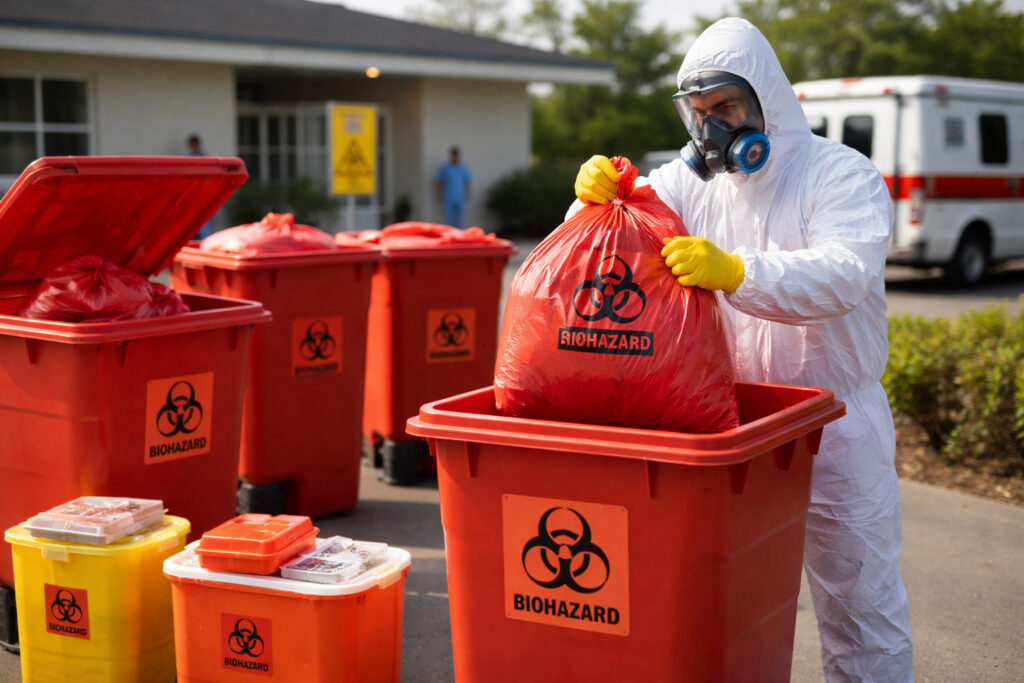
Biohazard waste compliance requirements in 2026 mandate that healthcare facilities follow federal RCRA and OSHA Bloodborne Pathogens Standard (29 CFR 1910.1030) as baseline regulations, while state agencies enforce additional requirements for segregation, storage durations, treatment methods, and biohazard waste pickup compliance. Non-compliance with these layered regulations can result in fines ranging from $1,000 to $75,000 per violation or $25,000 per day, making it essential for facilities to understand both federal frameworks and state-specific mandates that govern waste handling from generation through final disposal.
Understanding the federal compliance baseline for biohazard waste
The federal regulatory framework establishes minimum standards that all healthcare facilities must meet, regardless of location.
Primary federal agencies and their authority
The Environmental Protection Agency (EPA) regulates biohazard waste disposal through the Resource Conservation and Recovery Act (RCRA), which governs hazardous waste management including treatment methods that impact air, soil, and water. OSHA enforces the Bloodborne Pathogens Standard (29 CFR 1910.1030), requiring facilities to implement exposure control plans, provide personal protective equipment, and train employees on safe handling procedures.
The Department of Transportation (DOT) regulates packaging, labeling, and transport of regulated medical waste under 49 CFR 173.197, mandating proper container specifications and manifest documentation. The Centers for Disease Control and Prevention (CDC) provides biosafety guidelines particularly for laboratories handling infectious agents at biosafety levels 3 and 4.
Federal requirements for waste generators
Healthcare facilities generating biohazard waste must maintain a written waste management plan documenting segregation procedures, storage protocols, and disposal arrangements. All biohazard waste containers must be leak-resistant, puncture-proof, and clearly labeled with the universal biohazard symbol before transport.
Federal regulations require that waste handlers receive annual training on exposure risks, proper PPE usage, and emergency response procedures. Facilities must also maintain records of waste shipments, including manifests that track waste from generation through final disposal.
State-specific biohazard waste compliance requirements
While federal regulations provide the baseline, state agencies hold primary enforcement authority and often impose stricter requirements.
Midwest state compliance mandates
Illinois facilities operate under IEPA Solid Waste rules (35 Ill. Adm. Code 726), requiring segregation of regulated medical waste, storage for no more than 30 days in secure areas, and use of licensed haulers for treatment via autoclaving or incineration. Violations can result in fines up to $50,000 per day.
Minnesota’s Pollution Control Agency mandates that pathological and sharps waste must be incinerated, autoclaved, or inactivated through approved methods. Storage duration limits are strictly enforced, with penalties reaching $25,000 per day for non-compliance.
Missouri requires generators to maintain written procedures and use either incineration or state-approved alternative treatment methods, with penalties varying by violation severity.
Regional variations in treatment requirements
Southern states emphasize clear segregation and disposal pathways. South Carolina (R.61-105) requires detailed recordkeeping and either incineration or disinfection before final disposal, with penalties up to $10,000 per day. Tennessee (Rule 0400-11-01) mandates autoclaving or incineration for most waste streams, with pathological waste specifically requiring incineration, and violations costing between $2,500 and $25,000 daily.
Western states combine environmental protection with specific treatment mandates. Nevada (NAC 444) requires infectious waste treatment or incineration with separate handling for chemotherapy wastes, while Utah mandates destruction or disinfection before landfill disposal with sharps in approved containers.
Storage duration and facility requirements
State regulations specify maximum storage timeframes based on climate. Temperate regions typically allow 72 hours in winter and 48 hours in summer for non-refrigerated storage, while warm climates restrict storage to 48 hours in cool months and 24 hours in hot months.
Storage areas must feature impermeable floors with drainage systems, adequate ventilation, pest-proof construction, and restricted access. Water supplies, cleaning equipment, and protective gear must be readily accessible in designated storage zones.
Biohazard waste pickup compliance and transport regulations
Proper transport compliance protects public safety and ensures regulatory adherence throughout the disposal chain.
Licensed transporter requirements
All carriers must register with state waste regulation authorities and maintain current permits. Biohazard waste pickup compliance requires transporters to use vehicles specifically designed for medical waste, with closed and locked compartments that minimize container damage during transit.
Transport vehicles must display appropriate hazard markings and carry emergency response equipment. Drivers require specialized training in spill containment, exposure prevention, and regulatory documentation.
Manifest and documentation standards
Each waste shipment must be accompanied by a manifest tracking the waste from generation point to final disposal facility. Manifests must include waste classification, quantity (weight or volume), generator information, transporter details, and treatment facility destination.
Generators retain responsibility for ensuring their waste reaches properly licensed treatment facilities. Documentation must be maintained for a minimum of three years, with some states requiring longer retention periods.
Packaging specifications for transport
DOT regulations (49 CFR 173.197) mandate rigid, leak-resistant, moisture-proof containers with sufficient strength to prevent bursting. All packages must be marked with UN 3291 designation and display the universal biohazard symbol.
Color-coding systems help distinguish waste types: red containers for infectious waste, yellow for chemotherapy materials, and orange for highly infectious substances. Sharps must be placed in puncture-resistant containers that are sealed before transport.
Ensuring ongoing compliance in 2026
Maintaining compliance requires systematic approaches to training, documentation, and partnership selection.
Employee training and exposure control
OSHA mandates annual training for all employees with potential exposure to biohazard waste. Training must cover waste identification, proper segregation techniques, container selection, PPE usage, and emergency response procedures.
Facilities must maintain written exposure control plans that identify job classifications with exposure risk, outline prevention measures, and establish post-exposure protocols. Documentation of all training sessions and exposure incidents is required for regulatory audits.
Selecting compliant disposal partners
Healthcare facilities should verify that disposal partners hold all required federal, state, and local permits. Request proof of liability insurance, treatment facility certifications, and transporter registrations.
Disposal partners should provide clear documentation of treatment methods, maintain consistent pickup schedules, and offer manifest tracking systems. Facilities remain legally responsible for their waste until final treatment, making partner selection critical for compliance.
Audit preparation and recordkeeping
Maintain comprehensive records including waste manifests, training documentation, exposure control plans, and disposal partner certifications. Conduct internal audits quarterly to identify compliance gaps before regulatory inspections.
Document all corrective actions taken in response to violations or near-misses. Keep copies of state-specific regulations accessible to staff and update procedures promptly when regulations change.
Frequently asked questions
What are the penalties for biohazard waste compliance violations in 2026?
Federal and state penalties vary significantly by jurisdiction and violation severity. OSHA violations can result in fines up to $15,625 per violation, while state penalties range from $1,000 to $75,000 per violation or $25,000 per day for ongoing violations. Serious violations involving public health risks carry the highest penalties and may include facility closure orders.
How do I determine which state regulations apply to my facility?
Your facility must comply with regulations in the state where waste is generated, not where your business is headquartered. Contact your state Environmental Protection Agency or Department of Health to obtain current regulations. Multi-state operators must maintain separate compliance programs for each state where they generate biohazard waste.
What is the difference between biohazard waste pickup compliance and general medical waste disposal?
Biohazard waste pickup compliance specifically addresses the transport phase, requiring licensed carriers, proper vehicle specifications, manifest documentation, and DOT packaging standards. General medical waste disposal encompasses the entire lifecycle from generation through final treatment, including segregation, storage, transport, and disposal methods.
Can facilities treat biohazard waste on-site instead of using pickup services?
On-site treatment is permitted if facilities maintain properly functioning autoclaves or other approved treatment equipment and obtain necessary permits. However, facilities must demonstrate treatment effectiveness through regular biological indicator testing, maintain detailed treatment logs, and ensure treated waste meets non-infectious standards before disposal. Many facilities find contracted pickup services more cost-effective than maintaining on-site treatment infrastructure.
How often must biohazard waste training be conducted?
OSHA requires initial training upon hire and annual refresher training for all employees with potential exposure. Additional training is required when job duties change, new equipment is introduced, or after exposure incidents. State regulations may mandate more frequent training intervals, so verify your state’s specific requirements.
What documentation must be retained for biohazard waste compliance audits?
Facilities must maintain waste manifests, employee training records, exposure control plans, waste characterization documentation, transporter licenses, treatment facility permits, and disposal receipts. Federal regulations require three-year retention, though many states mandate five to seven years. Digital and physical copies should be organized by date and waste type for efficient audit response.

Ben Brenner is a founding partner at MedPro Disposal with over 9 years of hands-on experience in healthcare operations and medical waste management. He works closely with healthcare facilities to ensure OSHA-compliant sharps disposal, regulatory adherence, and safe waste handling practices. Ben contributes industry-backed insights based on real operational experience in the healthcare sector.