
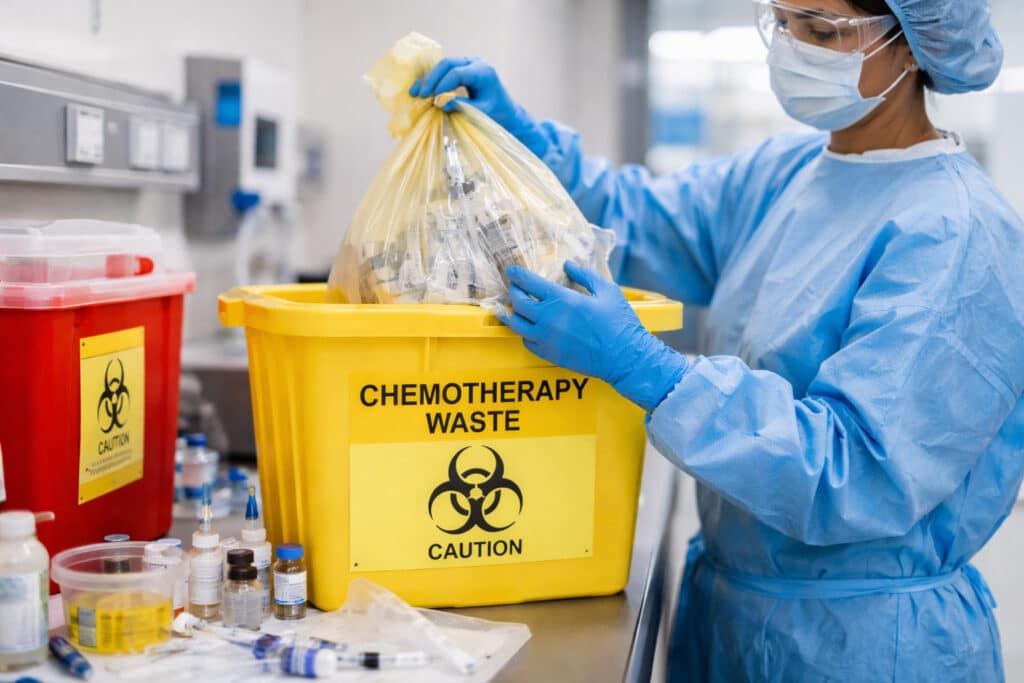
Chemotherapy waste must be stored for no longer than 90 days from the date of generation before disposal, according to EPA regulations. However, most healthcare facilities aim for much shorter storage periods—typically 7 to 30 days—to minimize safety risks and maintain compliance. The exact timeframe depends on your facility’s waste classification (hazardous vs. non-hazardous), state regulations, and storage capacity. Proper labeling with accumulation start dates is mandatory, and waste must be kept in designated, secure areas away from general traffic. Understanding chemotherapy waste storage time requirements is critical for regulatory compliance and workplace safety.
Understanding Chemotherapy Waste Storage Regulations
Chemotherapy waste storage regulations are governed primarily by the Environmental Protection Agency (EPA) under the Resource Conservation and Recovery Act (RCRA). Healthcare facilities generating chemotherapy waste are typically classified as either small quantity generators (SQG) or large quantity generators (LQG), which determines their specific storage time limits.
Federal Storage Time Requirements
Large quantity generators must dispose of hazardous chemotherapy waste within 90 days of the accumulation start date. Small quantity generators have up to 180 days (or 270 days if the disposal facility is more than 200 miles away). These timelines begin when the waste container is first used, not when it’s filled.
State-Specific Variations
Many states impose stricter chemotherapy waste disposal requirements than federal standards. California, New York, and Massachusetts, for example, may require disposal within 30 to 60 days. Always verify your state’s Department of Environmental Protection guidelines to ensure full compliance with local chemo waste storage regulations.
Best Practices for Chemotherapy Waste Storage
Proper storage goes beyond simply meeting time requirements—it involves maintaining safe conditions that protect staff, patients, and the environment.
Designated Storage Areas
Chemotherapy waste must be stored in a secure, well-ventilated area with restricted access. Storage locations should be:
- Away from patient care areas and food preparation zones
- Clearly marked with appropriate hazard warnings
- Equipped with spill containment measures
- Protected from extreme temperatures and weather exposure
Container Requirements
Use only EPA-approved containers that are rigid, leak-proof, and properly labeled. Each container must display the accumulation start date, the words “Hazardous Waste” or “Chemotherapy Waste,” and appropriate hazard identification symbols.
Documentation and Tracking
Maintain detailed logs of all chemotherapy waste, including generation dates, quantities, and disposal dates. This documentation is essential during inspections and demonstrates compliance with chemotherapy waste storage time limits.
Factors That Influence Storage Duration
Several operational and regulatory factors determine how long your facility can safely store chemotherapy waste before disposal.
Waste Classification
Not all chemotherapy waste is classified as hazardous. Some medications don’t meet EPA criteria for hazardous waste, which may allow for different disposal pathways and storage timelines. Conduct a proper waste characterization to determine which regulations apply.
Generator Status
Your facility’s generator status directly impacts storage time allowances. Facilities producing more than 1,000 kg of hazardous waste per month are LQGs with a 90-day limit, while those generating between 100-1,000 kg monthly are SQGs with extended timeframes.
Storage Capacity
Practical storage capacity often necessitates more frequent disposal than regulations require. Limited space, safety concerns, and operational efficiency typically drive facilities to schedule pickups every 1-4 weeks rather than waiting the full regulatory period.
Consequences of Non-Compliance
Failing to meet chemotherapy waste disposal requirements can result in serious penalties and operational disruptions.
Violations may lead to fines ranging from $2,500 to $70,000 per day, depending on severity and jurisdiction. Beyond financial penalties, non-compliance can trigger:
- Mandatory facility inspections and increased regulatory oversight
- Suspension of waste handling permits
- Legal liability for environmental contamination
- Reputational damage affecting patient trust and accreditation status
Regular staff training, routine audits, and partnership with certified medical waste disposal companies help maintain compliance and avoid these consequences.
Frequently Asked Questions
How do I determine my facility’s generator status?
Calculate the total amount of hazardous waste your facility generates per calendar month. Generating over 1,000 kg monthly classifies you as a large quantity generator, while 100-1,000 kg makes you a small quantity generator.
Can chemotherapy waste be stored with other medical waste?
No. Chemotherapy waste must be segregated from other waste streams and stored in designated containers. Mixing waste types violates regulations and creates disposal complications.
What happens if I exceed the 90-day storage limit?
Exceeding storage time limits constitutes a regulatory violation subject to EPA enforcement actions, including fines and corrective action orders. Immediate disposal and documentation of the incident are required.
Do all chemotherapy drugs require the same storage timeframe?
Storage timeframes depend on whether the drug is classified as hazardous waste under RCRA, not the drug itself. Some chemotherapy agents aren’t RCRA-hazardous and may follow different disposal pathways.
How should I label chemotherapy waste containers?
Each container must display the accumulation start date, the words “Hazardous Waste” or “Chemotherapy Waste,” the generator’s name and address, and EPA hazard codes if applicable.
Are there special requirements for storing trace chemotherapy waste?
Trace chemotherapy waste (items with residual amounts) may have different requirements than bulk chemotherapy waste. Many states allow trace waste to be managed as non-hazardous, but verify your local regulations for specific guidance.

Ben Brenner is a founding partner at MedPro Disposal with over 9 years of hands-on experience in healthcare operations and medical waste management. He works closely with healthcare facilities to ensure OSHA-compliant sharps disposal, regulatory adherence, and safe waste handling practices. Ben contributes industry-backed insights based on real operational experience in the healthcare sector.