
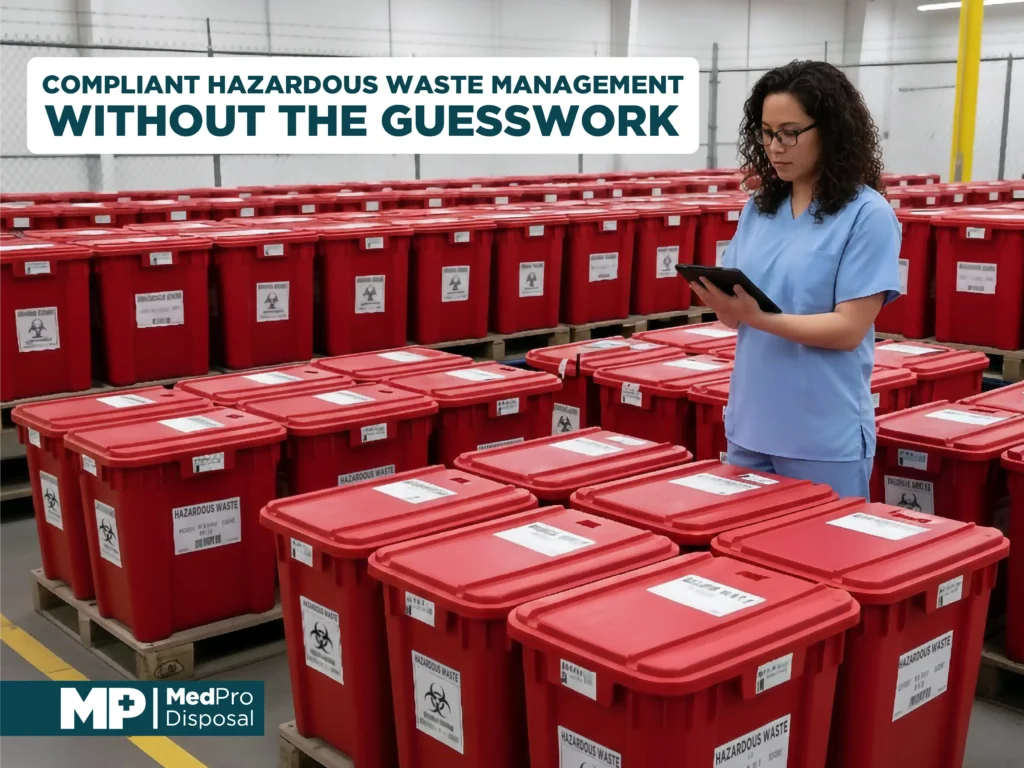
Hazardous waste disposal in healthcare facilities is crucial due to the potential harm it poses to staff, patients, and the environment. Proper hazardous waste disposal involves safe handling, transportation, and treatment of waste.
Learn how hazardous waste disposal works in healthcare facilities—and how a reliable provider can reduce risk, ensure compliance, manage costs, and keep you prepared for regulatory requirements.
What Are the Different Types of Hazardous Waste?
Hazardous waste disposal in healthcare facilities involves multiple waste streams that require accurate identification and segregation, essential to avoid increased compliance risk and unnecessary disposal costs.
Hazardous Medical Waste Disposal Services for Infectious Waste
Infectious waste includes materials contaminated with blood or germs that present infection risk, such as cultures, swabs, isolation waste, and tissues or organs. These types of waste require specialized waste solutions and disposal methods.
Pharmaceutical Waste Disposal Services in Healthcare Settings
Pharmaceutical waste includes expired, unused, or contaminated medications, as well as cytotoxic agents and those listed as RCRA-regulated. Experts classify certain drugs as hazardous due to their toxicity, ignitability, or environmental impact. This waste must be segregated from regulated medical waste and general trash.
Hazardous Pharmaceutical Waste Disposal and Chemotherapy Waste
Chemotherapy waste and some hazardous pharmaceuticals are dual regulated. The U.S. Environmental Protection Agency (EPA) governs hazardous classification and disposal, while the U.S. Drug Enforcement Administration (DEA) regulates controlled substances.
How Medical Waste Disposal Regulations Define Hazardous Waste
Hazardous waste is distinct from regulated medical waste, which includes biohazardous materials such as blood-contaminated items. Instead, hazardous waste is defined by its chemical characteristics or EPA listing status.
Which Regulations Govern Hazardous Waste Disposal for Healthcare Facilities?
Several federal agencies govern medical waste disposal regulations, each addressing a different compliance area.
The EPA’s Resource Conservation and Recovery Act (RCRA)
The U.S. Environmental Protection Agency (EPA) oversees the hazardous classification of waste and its disposal under its Resource Conservation and Recovery Act (RCRA). Hazardous waste pharmaceuticals fall under Subpart P, which establishes cradle-to-grave requirements for compliant removal, recordkeeping, and manifesting, and provides generator status exemptions for certain pharmaceutical wastes.
The Role of the Occupational Safety and Health Administration (OSHA)
The Occupational Safety and Health Administration (OSHA) is responsible for ensuring employee safety in healthcare settings.
OSHA’s Bloodborne Pathogens Standard (29 CFR 1910.1030) requires that healthcare employers:
- Safely manage sharps, infectious waste, and other biohazardous materials.
- Use puncture-resistant and leak-proof, and clearly labeled containers,
- Implement proper handling procedures and defined exposure response plans.
- Conduct regular training on waste segregation, container usage, and spill response.
- Maintain appropriate personal protective equipment (PPE) and documented safety protocols as part of compliant healthcare waste management solutions.
These requirements help reduce needlestick injuries, prevent disease transmission, and improve clinical safety. Failure to comply can result in workplace injuries and costly penalties.
The Department of Transportation’s (DOT) Oversight
The Department of Transportation (DOT) regulates the classification, packaging, and transportation of hazardous waste. You can find these rules in DOT’s Hazardous Materials Regulations (49 CFR Parts 171–180). Failure to follow these regulations can lead to leaks, exposure risks, and transportation incidents.
DOT violations carry serious consequences. Civil penalties can exceed $90,000 per violation. Deliberate or repeated violations may result in criminal charges.
DOT intersects with the U.S. Drug Enforcement Administration (DEA). Hazardous pharmaceutical waste disposal involving DEA-regulated drugs requires secure tracking, documented chain-of-custody, and federally approved destruction methods.
The Centers for Medicare & Medicaid Services’ (CMS) Role in Healthcare Waste Management
The CMS is a federal agency within the Department of Health and Human Services. It sets quality and safety standards for healthcare facilities. The CMS evaluates infection control, waste management practices, and documentation. Non-compliance can lead to CMS survey citations and increased liability exposure.
How Should Hazardous Waste Disposal for Healthcare Facilities Be Managed Onsite?
Compliant Hazardous Waste Removal Through Proper Segregation
Compliant hazardous waste removal begins with segregation at your facility. You must keep hazardous drugs, chemotherapy waste, and RCRA-listed materials separate from RMW and regular trash. This is necessary to meet EPA and OSHA rules.
Effective segregation improves safety and helps control disposal costs. By reducing injuries, prevents environmental exposure, and supporting regulatory compliance.
Healthcare Waste Management Solutions for Storage and Packaging
Hazardous waste should be kept in secure, controlled areas with limited access. Proper storage and packaging reduce compliance risk, while monitoring accumulation dates, storage time limits, and conducting routine audits. Safe storage and packaging are essential to effective healthcare waste management.
Pharmaceutical Waste Disposal Services with Licensed Treatment
Licensed treatment is a critical step in pharmaceutical waste disposal services. The treatment method depends on the waste type. Common treatment methods include high-temperature incineration, autoclaving, and approved chemical treatment. Hazardous waste, DEA-regulated drugs, and controlled substances must undergo DEA-compliant treatment for destruction.
Most hazardous healthcare waste disposal providers do not treat waste themselves. Instead, they coordinate with EPA- and state-licensed treatment, storage, and disposal facilities (TSDFs). When considering a hazardous healthcare waste disposal provider, choose one that maintains solid working relationships with local licensed TSDFs.
What Role Does a Hazardous Healthcare Waste Disposal Provider Play?
Hazardous Healthcare Waste Disposal Provider Support for Compliance
Hazardous healthcare waste disposal providers play a central role in helping you meet federal and state compliance requirements. They coordinate licensed transport, managing DOT shipping requirements and compliant EPA treatment standards.
Providers coordinate cradle-to-grave tracking for hazardous waste disposal and coordinate DEA-aligned processes for controlled substances, when applicable. By closing documentation and regulatory gaps, hazardous healthcare waste disposal providers reduce your facility’s liability exposure and minimize operational risk.
Medical Waste Disposal Services Near Me for Audits and Inspections
Local qualified hazardous healthcare waste disposal services play a critical role in staying inspection-ready and maintaining consistent compliance. Providers help by maintaining accurate, up-to-date documentation. They assist with staff training, transport manifests, and certificates of destruction.
In addition, reliable providers help you prepare for inspections by reviewing waste handling practices and conducting internal audits. This proactive approach reduces citation risks during unannounced inspections and visits.
What Affects Hazardous Waste Disposal Cost for Healthcare Facilities?
Hazardous Waste Disposal Cost Drivers Healthcare Facilities Should Know
Costs vary based on waste volume, pickup frequency, waste type, and location. Misclassification—such as placing non-hazardous waste into regulated streams—is one of the biggest cost drivers.
Healthcare Waste Management Solutions That Reduce Disposal Costs
Proper segregation, routine audits, and selecting the right vendor help facilities reduce hazardous waste disposal costs while maintaining compliance.
How Do I Find a Hazardous Healthcare Waste Disposal Provider Near Me?
Healthcare facilities should evaluate providers based on regulatory expertise, documentation support, pricing transparency, and service flexibility.
A provider with nationwide coverage helps close gaps that local providers may struggle to support. In fact, many of the leading hazardous healthcare waste disposal providers operate nationwide. They offer scalable programs to properly dispose of hazardous waste.
These providers also provide standardized containers (or recommend reliable medical suppliers). They offer centralized reporting and consistent compliance across single-site and multi-site healthcare systems.
Choosing the Right Provider for Hazardous Waste Disposal for Healthcare Facilities
A trusted healthcare waste disposal provider like MedPro Disposal can help you manage compliance, control costs, and stay audit ready. MedPro offers nationwide coverage across 48 states, a dedicated customer service team, and predictable pricing—while you retain cradle-to-grave responsibility for hazardous waste.
We provide reliable, compliant hazardous waste disposal solutions tailored to your facility’s size and waste volume. Speak with our team today to build a safer, audit-ready hazardous waste management plan. 📞 Call us today at 888-641-6131 for your FREE, no-obligation quote.