
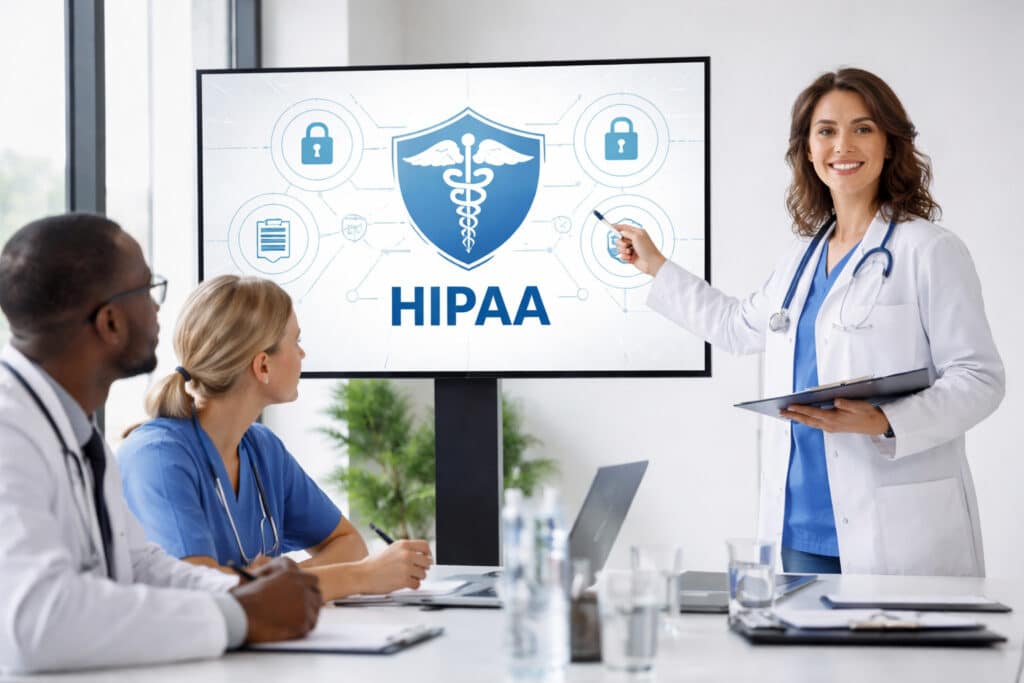
Staying compliant isn’t just about avoiding fines; it’s about keeping your doors open and your patients’ trust intact. As we close out 2025, the pressure on healthcare facilities to protect sensitive data has never been higher. Cyber threats are smarter, regulations are tighter, and the cost of a mistake is steeper than ever.
For practice managers and compliance officers, this means the old “watch a video and sign a paper” approach doesn’t cut it anymore. You need a training strategy that actually changes behavior. This year brought specific shifts in how we handle patient access and breach reporting, making updated training mandatory. If your team is still running on guidelines from three years ago, you are already behind.
What Is HIPAA Compliance Training?
At its simplest, HIPAA compliance training is the educational process that teaches your staff how to handle Protected Health Information (PHI) legally and securely. It translates complex federal laws into daily actions. It covers everything from how a receptionist greets a patient to how a surgeon shares post-op notes.
This training isn’t optional. The law requires that every person in your facility who interacts with patient data—whether they are doctors, nurses, billing specialists, or third-party contractors—understands their responsibilities. It ensures that your team knows the difference between a secure email and a violation waiting to happen. Effective training turns your staff from your biggest security risk into your first line of defense.
Key HIPAA Updates and Requirements for 2025
The rules for 2025 emphasize accountability and speed. Regulators are looking closely at how quickly you onboard new staff and how well you maintain your documentation. It is no longer enough to just train employees; you must prove it with rigorous records.
Current requirements mandate that you:
- Provide initial training within a reasonable time of hiring.
- Offer annual refresher training to all relevant staff members.
- Maintain training records for at least six years to prove compliance during an audit.
Privacy Rule Enhancements
The Privacy Rule has evolved to address modern information sharing. In 2025, there is a renewed focus on reproductive health care privacy and how information is shared between providers. Your training must clarify exactly when staff can share PHI without patient consent and when they absolutely cannot. If your team doesn’t understand these nuances, you risk significant penalties for unauthorized disclosures.
Security Rule Cybersecurity Mandates
The Security Rule is your technical shield. This year, the focus is heavily on cybersecurity hygiene. Training must cover specific technical safeguards like multi-factor authentication and device encryption. Staff need to know why they can’t just plug a random USB drive into a hospital computer or use personal devices for work without proper security protocols in place.
Breach Reporting and Patient Access Changes
Handling a data breach correctly is critical. The 2025 guidelines tighten the window for reporting incidents. Training needs to cover Breach Notification protocols, specifically identifying and reporting unauthorized disclosures immediately. Additionally, patients now have stronger rights to access their digital records quickly. Your staff must know how to fulfill these requests without creating administrative bottlenecks or accidental privacy violations.
How HIPAA Compliance Training Works in Healthcare Facilities
Training is the bridge between written policy and daily practice. In most facilities, this involves a mix of onboarding education for new hires and ongoing cycles for existing staff. The goal is to reduce human error, which remains the biggest threat to data security.
In fact, research shows that human-induced errors are a dominant factor in healthcare data breaches, highlighting why consistent training is non-negotiable. A successful program doesn’t just check a box; it creates a culture where security is second nature.
Core Components of Training Modules
A robust training curriculum must cover the three main pillars of HIPAA regulation. If you miss one, your facility isn’t fully compliant.
Your modules should include:
- Comprehensive Coverage of HIPAA Rules
- HIPAA Privacy Rule: Protecting PHI forms and verbal communication.
- HIPAA Security Rule: Technical safeguards and electronic PHI (ePHI).
- HIPAA Enforcement Rule: Understanding penalties and investigations.
Delivery Methods: Online, In-Person, and Hybrid
Facilities today have options. Online Learning Management Systems (LMS) are popular because they allow staff to train at their own pace and automatically track completion. In-person sessions work well for discussing specific facility workflows or answering complex questions. A hybrid approach often works best—using online modules for the basics and in-person meetings to address specific department risks or recent incidents.
Certification and Ongoing Refresher Processes
Certification isn’t a “one and done” event. To stay compliant in 2025, you need annual refresher courses that address the latest threats.
Your refreshers should cover:
- Recent enforcement cases to illustrate current risks.
- New cybersecurity threats, such as AI-based phishing attacks.
- Emerging technologies, like wearable health devices and their implications for PHI.
Benefits of Prioritizing HIPAA Training This Year
Investing in high-quality training pays off immediately. First, it drastically reduces the risk of fines. HIPAA violations can cost millions, and the Department of Health and Human Services (HHS) is active in enforcement. Proper training shows good faith, which can mitigate penalties if a breach does occur.
Second, it builds patient trust. Patients are more aware of data privacy than ever. When they see your staff handling their information with care—turning screens away, speaking discreetly, using secure portals—they feel safer. This reputation for security can actually be a competitive advantage in your local market. Finally, it prevents operational downtime. A staff trained to spot ransomware can save your facility from weeks of paralyzed systems.
Best Practices for Effective HIPAA Training Programs
Effective training is continuous, not sporadic. The most successful facilities treat HIPAA education as an ongoing conversation rather than an annual annoyance. This means you need frequent training sessions, implementing annual training and providing updates whenever final rules or guidelines are issued.
You also need to focus on specific threats. Phishing awareness programs are essential to educate employees on scams that target healthcare credentials. By making training relevant and frequent, you keep security top-of-mind for everyone from the front desk to the executive suite.
Tailor Content to Staff Roles and Risks
One-size-fits-all training rarely works well. You need role-specific training that targets the actual daily tasks of your employees.
- Clinical staff must be trained on electronic health record (EHR) access protocols and patient confidentiality.
- IT personnel should focus on encryption, threat detection, and creating a secure infrastructure.
- Administrative staff should learn about physical document handling, transmitting PHI, and communication policies.
Integrate Real-World Scenarios and Testing
Theory is boring; real life is memorable. Use real-world scenarios in your training. Describe a situation where a nurse receives a text asking for patient info, or a receptionist sees a familiar face in the waiting room. Ask staff what they would do. Testing shouldn’t just be multiple choice; it should simulate decision-making. Phishing simulations, where IT sends fake scam emails to see who clicks, are incredibly effective teaching tools.
Leverage Automated Tracking Tools
You cannot manage what you don’t measure. Use automated tracking tools or an LMS to monitor who has completed training and who is lagging behind. These tools automatically generate the documentation you need for the “six-year record” requirement. If an auditor walks in tomorrow, you should be able to pull a report showing exactly when every employee was last trained and what they scored.
Common Mistakes in HIPAA Compliance Training
The biggest mistake facilities make is treating training as a formality. If your staff clicks through slides just to get a certificate, they haven’t learned anything. Another major error is failing to update content. Using materials from 2022 leaves you vulnerable to 2025 threats like AI-driven social engineering.
Many facilities also fail to train non-medical staff properly. Your cleaning crew, billing department, and volunteers all need appropriate training levels. Finally, ignoring the “culture of compliance” is fatal. If leadership doesn’t take HIPAA seriously, the staff won’t either, regardless of how many videos they watch.
Choosing a Reliable HIPAA Training Provider
Selecting the right partner is critical for your peace of mind. You want a provider that offers up-to-date content vetted by legal or compliance experts. Look for a vendor that provides a mix of engaging formats—videos, quizzes, and interactive scenarios—rather than dry text.
Check for customization options. Can you add your facility’s specific policies to the module? Also, prioritize reporting features. The provider should make it effortless to export compliance reports. Support is also key; if your team has technical trouble with the training portal, you need a provider who answers the phone.
How MedPro Disposal Supports Your 2025 Compliance
MedPro Disposal understands that you are busy caring for patients, not just managing paperwork. We offer a comprehensive compliance suite designed to take the headache out of meeting 2025 requirements. Our solution includes an online compliance portal with up-to-date HIPAA training modules that cover Privacy, Security, and Breach Notification rules.
We make tracking easy. Our system monitors employee progress and stores certificates automatically, ensuring you are audit-ready at a moment’s notice. Beyond training, we help you manage the physical side of compliance with secure document destruction and medical waste disposal services. We provide the tools you need to protect your patients and your practice without disrupting your daily workflow.
Conclusion
HIPAA compliance in 2025 requires vigilance, updated knowledge, and a commitment to continuous education. The threats are real, but so are the solutions. By implementing role-specific training, leveraging modern tracking tools, and focusing on human behavior, you can secure your facility against data breaches.
Don’t wait for a violation to reveal the gaps in your armor. Review your training program today, ensure your records are current, and give your staff the knowledge they need to succeed. With the right approach, compliance becomes a natural part of your high-quality patient care.
Frequently Asked Questions
What are the HIPAA training requirements for new hires in Naperville healthcare facilities?
New hires must receive HIPAA training within 30 days of starting, per HHS guidelines. Naperville facilities like those affiliated with Edward Hospital track this via LMS to ensure compliance during OCR audits.
How much do HIPAA violations cost healthcare providers in Illinois?
Average HIPAA fines range from $100 to $50,000 per violation, up to $1.5 million annually, per HHS data. In Illinois, 2024 settlements exceeded $2 million, emphasizing training to avoid penalties.
Do volunteers and contractors need HIPAA training?
Yes, all volunteers and contractors handling PHI require HIPAA training tailored to their access level. Naperville clinics use role-based modules to cover this, maintaining six-year records for compliance.
What happens if a healthcare facility fails a HIPAA training audit?
Auditors from HHS OCR review training records; deficiencies can lead to corrective action plans, fines starting at $127 per violation, or increased scrutiny. Proper documentation prevents escalation.
Can small practices in Naperville use free HIPAA training resources?
Small practices can use HHS-provided free toolkits for basics, but experts recommend certified LMS for audit-proof tracking and 2025 updates. Naperville providers often supplement with MedPro for full compliance.