
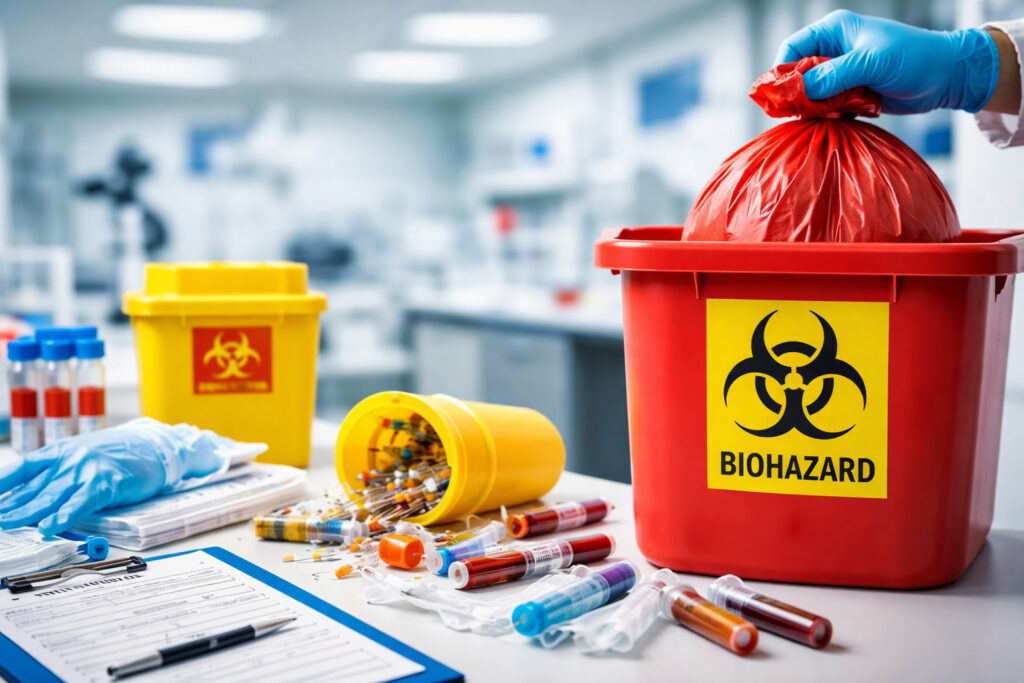
Medical laboratory waste disposal regulations in 2026 require laboratories to follow federal OSHA Bloodborne Pathogens Standard (29 CFR 1910.1030), EPA Resource Conservation and Recovery Act (RCRA), and DOT Hazardous Materials Regulations (49 CFR). State regulations vary significantly, with some states like California and Illinois imposing stricter requirements than federal standards. Laboratories must properly classify waste streams, maintain documentation for at least three years, train staff annually, and use licensed transporters. Non-compliance can result in fines ranging from $5,000 to $75,000 per violation, depending on the state and severity of the infraction.
Federal Medical Laboratory Waste Disposal Regulations
The foundation of laboratory biomedical waste disposal regulations begins with federal oversight. The Occupational Safety and Health Administration (OSHA) mandates that all facilities handling potentially infectious materials must implement exposure control plans under the Bloodborne Pathogens Standard. This requires laboratories to identify tasks with potential exposure, provide personal protective equipment, and establish decontamination procedures.
The Environmental Protection Agency (EPA) regulates hazardous chemical waste under RCRA. Laboratories generating more than 220 pounds of hazardous waste per month must register as Small Quantity Generators and follow specific storage, labeling, and disposal timelines. The Department of Transportation (DOT) requires proper packaging, labeling, and manifesting for waste shipments classified as hazardous materials.
Key Federal Compliance Requirements
Medical lab waste compliance checklists must include waste characterization documentation, employee training records, exposure incident logs, and waste manifests. The EPA requires laboratories to conduct hazardous waste determinations within specific timeframes and maintain generator status documentation. OSHA mandates annual bloodborne pathogen training and hepatitis B vaccination availability for at-risk employees.
State-Specific Laboratory Waste Regulations
State regulations often exceed federal requirements, creating complex compliance landscapes for multi-location laboratories. Understanding regulated medical waste laboratory regulations at the state level is essential for avoiding penalties.
High-Regulation States
California requires registration with the Medical Waste Management Program and mandates specific treatment methods. Laboratories must use approved treatment facilities and maintain detailed tracking documents for seven years. The state imposes storage time limits of seven days at room temperature or 90 days if refrigerated below 0°C.
New York requires permits for medical waste storage exceeding 30 days and mandates quarterly reporting to the Department of Environmental Conservation. Laboratories must use approved transporters and maintain waste logs accessible for inspection.
Illinois enforces the Illinois Environmental Protection Act with strict generator requirements. Naperville-area laboratories must register with the Illinois EPA, follow 90-day storage limits for hazardous waste, and use only licensed Illinois transporters. The state conducts regular inspections and imposes fines up to $50,000 per day for violations.
Moderate-Regulation States
Texas requires registration with the Department of State Health Services and mandates specific packaging standards. The state allows 30-day storage at ambient temperature before requiring treatment or removal.
Florida implements the Biomedical Waste Program requiring permits for generators producing more than 25 pounds monthly. Laboratories must maintain manifests for three years and follow specific color-coding requirements.
Federal-Standard States
States including Montana, Wyoming, and South Dakota primarily follow federal regulations without additional state-specific requirements. However, laboratories must still verify local county and municipal ordinances that may impose additional restrictions.
Creating Your Medical Lab Waste Compliance Checklist
Implementing a comprehensive compliance system requires systematic documentation and regular review processes. Medical laboratory waste disposal regulations 2026 enforcement has intensified, making proactive compliance essential.
Waste Classification and Segregation
Establish clear protocols for identifying and separating biohazardous waste, chemical waste, pharmaceutical waste, and radioactive materials. Each waste stream requires different handling, storage, and disposal methods. Train staff to recognize regulated medical waste including cultures, pathological waste, blood products, sharps, and contaminated materials.
Create visual guides at waste collection points showing proper segregation. Use color-coded containers: red for biohazardous waste, black for chemical waste, yellow for trace chemotherapy waste, and clear for general waste. Label all containers with waste type, accumulation start date, and hazard information.
Documentation and Record-Keeping
Maintain comprehensive records including waste manifests, training certificates, treatment facility permits, transporter licenses, and inspection reports. Federal regulations require three-year retention, but many states mandate longer periods. Illinois requires five years, while California requires seven years.
Implement a tracking system documenting waste from generation through final disposal. Record waste type, quantity, generation date, storage location, removal date, transporter information, and treatment facility confirmation. Digital systems with automated alerts help ensure timely disposal before storage limits expire.
Training and Safety Protocols
Conduct annual training covering waste identification, segregation procedures, spill response, and exposure prevention. Document all training sessions with attendee signatures, dates, and topics covered. OSHA requires initial training upon assignment and annual refresher courses.
Develop standard operating procedures (SOPs) for each waste type addressing generation, handling, storage, and emergency response. Post SOPs at relevant locations and ensure staff can access them during operations. Review and update procedures annually or when regulations change.
State-by-State Compliance Quick Reference
Understanding specific state requirements helps laboratories operating in multiple jurisdictions maintain consistent compliance. Laboratory biomedical waste disposal regulations vary in registration requirements, storage limits, reporting frequency, and penalty structures.
Registration and Permitting
Most states require generator registration, but thresholds vary. California requires registration for any medical waste generation, while Texas mandates registration only for facilities generating more than 50 pounds monthly. Illinois requires both EPA generator registration and medical waste transporter notifications.
Permit renewal frequencies range from annual (New York, New Jersey) to biennial (California, Washington). Maintain renewal calendars with 90-day advance reminders to prevent lapses that could halt operations.
Storage and Treatment Requirements
Storage time limits represent a critical compliance factor. Federal standards allow indefinite storage if properly managed, but states impose specific limits. Review your state’s requirements: California allows 7 days at room temperature, New York permits 30 days, Illinois mandates 90 days for hazardous waste, and Texas allows 30 days for medical waste.
Treatment method approvals also vary by state. Some states require specific technologies like autoclaving or incineration, while others accept alternative treatment methods. Verify your treatment facility holds appropriate state permits for your waste types.
Inspection and Enforcement
State inspection frequencies range from annual scheduled visits to complaint-driven investigations. California and New York conduct regular compliance inspections, while other states focus on complaint response and random audits. Maintain inspection-ready documentation accessible within 24 hours of request.
Penalty structures vary significantly. Minor violations may result in warning notices and corrective action requirements, while serious violations trigger immediate fines. Illinois imposes up to $50,000 daily for continuing violations, California assesses $5,000-$25,000 per violation, and New York charges $2,000-$15,000 depending on severity.
Frequently Asked Questions
What are the main medical laboratory waste disposal regulations for 2026?
Laboratories must comply with federal OSHA, EPA, and DOT regulations, plus state-specific requirements. Key mandates include proper waste classification, staff training, storage time limits, licensed transporter use, and documentation retention for 3-7 years depending on jurisdiction.
How long can medical laboratories store regulated waste before disposal?
Storage limits vary by state and waste type. Federal regulations don’t specify time limits, but California allows 7 days at room temperature, Illinois permits 90 days for hazardous waste, New York allows 30 days, and Texas permits 30 days. Always follow the most restrictive applicable regulation.
What documentation must laboratories maintain for waste disposal compliance?
Required records include waste manifests, training certificates, exposure incident logs, waste characterization documents, transporter licenses, treatment facility permits, and inspection reports. Federal law requires 3-year retention, but states may mandate 5-7 years.
What are the penalties for medical laboratory waste disposal violations?
Penalties range from $2,000 to $75,000 per violation depending on state and severity. Illinois imposes up to $50,000 daily for continuing violations, California assesses $5,000-$25,000 per incident, and federal OSHA fines reach $15,625 for serious violations. Repeat violations and willful non-compliance result in higher penalties.
Do small medical laboratories have different regulations than large facilities?
Small quantity generators (producing less than 220 pounds of hazardous waste monthly) follow simplified federal requirements, but state medical waste regulations often apply regardless of volume. Many states require registration and compliance for any medical waste generation, regardless of facility size.
Which states have the strictest laboratory biomedical waste disposal regulations?
California, New York, Illinois, New Jersey, and Washington maintain the most comprehensive regulations with stricter storage limits, extensive reporting requirements, mandatory permitting, and higher penalties than federal standards. Multi-state laboratories should implement systems meeting the strictest applicable requirements.

Ben Brenner is a founding partner at MedPro Disposal with over 9 years of hands-on experience in healthcare operations and medical waste management. He works closely with healthcare facilities to ensure OSHA-compliant sharps disposal, regulatory adherence, and safe waste handling practices. Ben contributes industry-backed insights based on real operational experience in the healthcare sector.