
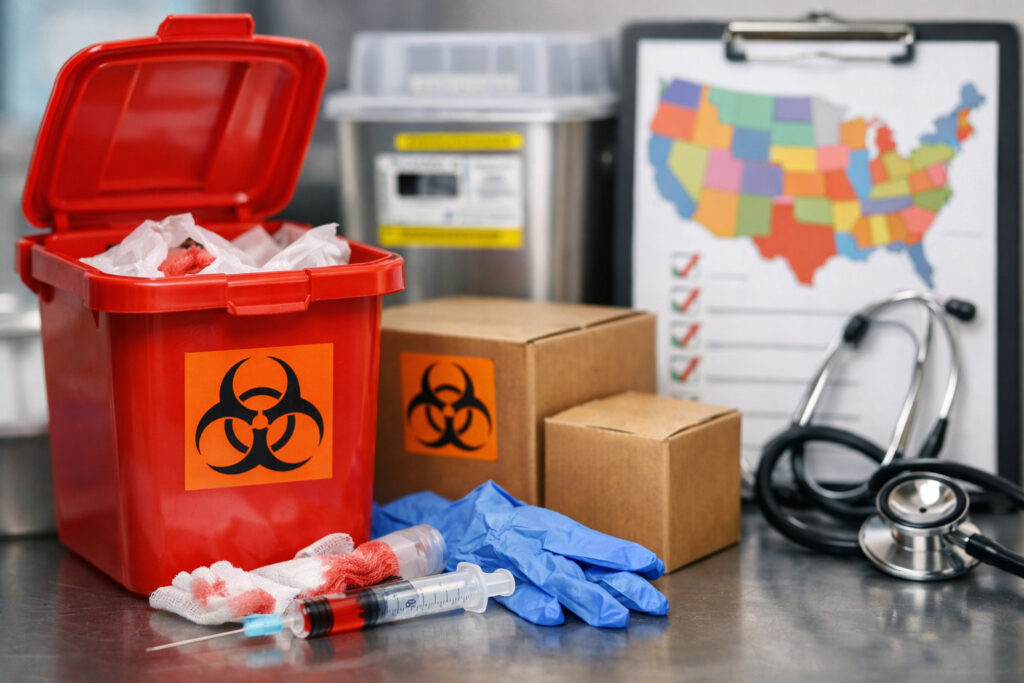
2026 medical waste disposal regulations vary by state, building on federal RCRA baselines with stricter rules on tracking, storage, and treatment like incineration or autoclaving. Illinois facilities in Naperville face Midwest mandates, including Minnesota’s inactivation requirements for sharps. Non-compliance risks fines up to $75,000 per violation or $25,000 daily. Follow state checklists for segregation, labeling, and records to ensure compliance and avoid penalties.
Struggling to navigate the patchwork of medical waste regulations that vary wildly by state in 2026? Non-compliance risks fines up to $75,000 per violation, according to EPA reports. This article provides a clear state-by-state compliance checklist to keep your healthcare facility safe and fully regulated.
Introduction to 2026 Medical Waste Disposal Regulations
As of January 2026, healthcare facilities face a complex web of compliance rules. Managing medical waste isn’t just about tossing items in a red bag; it’s about adhering to a strict hierarchy of federal and state laws that protect public health and govern regulated medical waste disposal. While federal agencies set the baseline, individual states often enforce stricter standards.
For providers in Naperville, IL, and across the nation, staying compliant means understanding these overlapping layers. A single misstep in categorization or disposal can lead to hefty fines. This guide breaks down the current regulations, highlighting the critical differences between federal guidelines and state-specific mandates effectively in force this year.
What Is Medical Waste and Why Does It Require Regulated Disposal?
Medical waste is any waste generated during the diagnosis, treatment, or immunization of humans or animals. It poses distinct risks because it can carry pathogens that spread disease. Regulators classify this waste to ensure it is treated before it hits a landfill under strict disposal of medical waste regulation standards.
According to industry definitions, this category is broad but specific.
Proper disposal prevents environmental contamination and protects healthcare workers, waste haulers, and the general public from infection risks like HIV or Hepatitis.
Federal Regulations: The Baseline for 2026 Compliance
Federal laws provide the foundation for all medical waste management in the United States. The Resource Conservation and Recovery Act (RCRA) is the primary law governing the disposal of solid and hazardous waste. However, the federal government largely delegates the specifics of medical waste disposal regulations to the states.
Here is how the authority is divided:
| Regulator | Authority |
| State Agencies | Primary regulator of medical waste (Environmental & Health Depts) |
| US EPA | Has not had specific authority for medical waste since the Medical Waste Tracking Act expired |
| OSHA | Regulates handling/safety within the workplace |
| DOT | Regulates the transport of waste on public roads |
While the EPA sets the standard for hazardous chemical waste, your local state agency likely holds the real enforcement power for biohazards.
How State Regulations Build on Federal Rules
While federal rules cover the basics, states add the details. Most states have implemented specific medical waste management acts that dictate exactly how waste must be tracked, stored, treated, and disposed of. This means a compliant strategy in Illinois might be a violation in California.
States generally have the authority to be more stringent than federal laws, but never less. This creates a patchwork of requirements where definitions and time limits vary significantly across state lines.
Key Differences in Definitions and Classifications
Not all red bags are created equal. States define “infectious waste” differently, which impacts what you can throw away.
For example, California has some of the strictest rules in the nation. They explicitly list “needles and biomedical wastes contaminated by the human body” alongside specific items like cultures and tissues. New York and Massachusetts follow closely with similar rigor.
In contrast, other states might have broader definitions that allow for more general categorization. You must verify if your specific waste stream—like a blood-soaked bandage—meets your state’s specific threshold for “regulated medical waste.”
Variations in Treatment and Disposal Methods
Once waste leaves your facility, where does it go? That depends entirely on your location. States dictate the required treatment method before final disposal.
- Minnesota: Pathological and Sharp waste must be incinerated, autoclaved, or “inactivated.”
- Missouri: Requires incineration or a state-approved alternative.
- Nevada: Infectious waste must be treated or incinerated; specific chemo wastes are kept separate.
- Pennsylvania: Common disposal methods include incineration or permitted steam sterilization.
Facilities must ensure their waste partner uses the locally mandated treatment method, or the liability could fall back on the generator.
Major 2026 Updates Impacting Healthcare Facilities
Recent regulatory updates have shifted the compliance target for 2026. Specifically, amendments that became effective on March 21, 2025, clarified existing regulations to enhance compliance and reduce confusion.
These updates focus heavily on the intersection of hazardous waste and medical waste.
| Rule Status | Waste Type Addressed |
| Finalized in 2016 | Chemical waste regulated as hazardous waste |
| 2025 Amendments | Clarified corrections to existing regulations |
| Not addressed | General Regulated Medical Waste (RMW) definitions |
Healthcare facilities must review their pharmaceutical waste protocols this year. The distinction between “hazardous waste” (chemical) and “regulated medical waste” (biohazard) is being enforced more strictly to prevent hazardous chemicals from entering standard medical waste treatment streams.
Best Practices for State-Specific Compliance
Staying compliant requires a proactive approach to waste segregation and storage. The most effective strategy is standardizing your process while adapting to local time limits.
Here are the core practices for 2026:
- Label Correctly: Medical waste containers are required to have specific markings and labels in accordance with federal and state regulations. Never leave a container unmarked.
- Watch the Clock: Storage times vary. Facilities like physician offices can typically store waste for up to 90 days in secure, ventilated areas with temperature controls, but some states require weekly pickup.
- Secure the Area: Storage areas must be ventilated and locked to prevent unauthorized access.
Common Compliance Mistakes and How to Avoid Them
Even well-intentioned facilities make avoidable errors. The most frequent mistake is improper segregation. Throwing a pharmaceutical vial into a red sharps container or placing hazardous chemical waste in a standard trash bin are serious violations.
Another common pitfall is record-keeping failures. You must maintain shipping manifests and certificates of destruction for at least three to five years, depending on your state. If an inspector asks for your documentation and you cannot produce it, you are non-compliant, regardless of how safe your physical disposal practices are.
Finally, failing to train staff on 2026 updates leaves gaps. Regulations change; your training modules should too.
Northeast States Compliance Checklist
The Northeast is known for rigorous environmental enforcement. Below are key examples of regulations and potential penalties in this region.
State | Medical Waste Rules | Penalties
New Hampshire
NH Dept of Environmental Services (Env-Sw 904): Waste must be autoclaved or incinerated before landfill disposal. Strict container labeling is mandatory.
Civil penalties vary up to $25,000/day.
Pennsylvania
PA Dept of Environmental Protection: Manifest system required for all “red bag” waste. Common disposal is incineration or steam sterilization.
Fines range from $10,000–$25,000/day.
Facilities in this region should prioritize strict manifest tracking and ensure their disposal partners offer incineration options where required.
Midwest States Compliance Checklist
Midwest states like Illinois, Minnesota, and Missouri have distinct requirements for treatment technologies.
| State | Medical Waste Rules | Penalties |
| Minnesota | MN Pollution Control Agency: Pathological and “Sharp” waste must be incinerated, autoclaved, or “inactivated.” | Fines can reach $25,000/day |
| Missouri | MO Dept of Natural Resources: Generators must keep written procedures. Incineration or state-approved alternatives are required. | Varies by violation severity |
| Wisconsin | WI DNR (NR 526): Infectious waste must be incinerated or treated via autoclave/approved chemical methods. | Varies |
For facilities in Naperville, IL and surrounding areas, understanding these regional nuances is critical for cross-border operations.
Southern States Compliance Checklist
Southern states emphasize segregation and clear disposal paths. The penalties for non-compliance here can be severe.
- South Carolina: Regulated by the SC Department of Health & Environmental Control (R.61-105).
Requirement: Requires clear segregation, recordkeeping, and incineration or disinfection before final disposal.
Penalty: Penalties generally reach up to $10,000/day. - Tennessee: Regulated by the TN Department of Environment & Conservation (Rule 0400-11-01).
Requirement: Autoclaving or incineration is required. Pathological waste often must be incinerated.
Penalty: Violations cost between $2,500 and $25,000/day.
Western States Compliance Checklist
Western states often combine strict environmental protection with specific treatment mandates.
- Nevada: Regulated by the Nevada Division of Environmental Protection (NAC 444).
Requirement: Infectious waste must be treated or incinerated. Certain chemotherapy wastes must be separated.
Penalty: Fines range from $5,000 to $25,000/day. - Utah: Regulated by the Utah Department of Environmental Quality.
Requirement: Infectious waste must be destroyed or disinfected before landfill disposal. Sharps must be in approved containers.
Penalty: $1,000–$10,000/day for first-time violations.
Partnering with MedPro Disposal for Nationwide 2026 Compliance
Navigating fifty different sets of rules is a full-time job. For healthcare providers, the goal is to focus on patient care, not studying legislative updates. MedPro Disposal simplifies this process by providing tailored solutions that meet both federal baselines and local state mandates.
We help facilities across the US stay ahead of regulatory changes.
Whether you are in Naperville, IL, or operating multiple locations nationwide, reliable compliance protects your practice and your community.
Frequently Asked Questions
What are the specific medical waste disposal rules for Naperville, IL facilities in 2026?
Illinois regulates medical waste under the IEPA Solid Waste rules (35 Ill. Adm. Code 726). Facilities in Naperville must segregate RMW, store up to 30 days in secure areas, and use licensed haulers for autoclaving or incineration. Fines reach $50,000 per day for violations.
How do OSHA standards integrate with 2026 state medical waste regulations?
OSHA’s Bloodborne Pathogens Standard (29 CFR 1910.1030) requires safe handling, PPE, and training nationwide, complementing state disposal rules. In Naperville, IL, combine with IEPA storage limits; non-compliance risks $15,625 per violation plus state penalties.
What training is required for staff on 2026 medical waste compliance?
Annual training on segregation, labeling, and state-specific rules is mandatory under OSHA and state laws. Naperville, IL facilities must document IEPA-compliant sessions for all handlers; records kept 3 years prevent fines up to $25,000/day.
How should multi-state healthcare practices handle varying 2026 waste rules?
Use a single compliant vendor like MedPro Disposal for state-specific manifests and treatments. For Naperville, IL operations expanding to Minnesota, track incineration mandates separately; audit quarterly to avoid cross-state fines exceeding $25,000/day.
What are the exact record-keeping requirements for medical waste manifests in 2026?
Retain shipping manifests, treatment certificates, and disposal logs for 3-5 years per state rules. Illinois requires IEPA-approved forms; Naperville facilities must produce them on-site inspections or face $10,000+ penalties.