
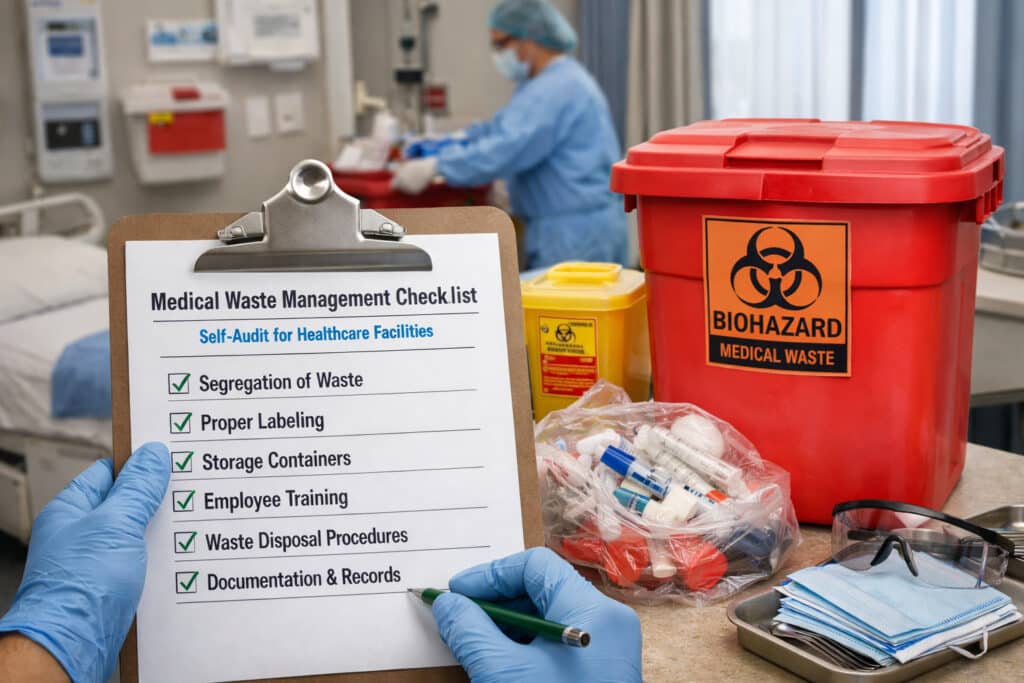
Healthcare facilities in Naperville, IL conduct medical waste self-audits to avoid up to $50,000 EPA/DOT fines per violation. US healthcare generates 5 million tonnes of solid waste yearly, requiring strict segregation, storage, and documentation. Checklist covers identification, handling, transportation, training, and recordkeeping. Regular audits with cross-functional teams identify gaps, prioritize risks, and ensure compliance for safety and efficiency.
Is your healthcare facility in Naperville risking massive fines from sloppy medical waste handling? One mistake in segregation or storage can trigger EPA or DOT violations costing up to $50,000 per incident. This guide delivers a complete self-audit checklist to spot gaps, ensure compliance, and protect your team and patients.
Introduction
Managing medical waste is a massive responsibility for any US healthcare facility. American healthcare produces 5 million tonnes per year of solid waste, and a significant portion of that requires special handling to meet safety standards. If you manage a clinic, hospital, or practice, you know that keeping up with regulations isn’t optional—it’s critical for safety and legal operation.
But here’s the problem: relying solely on memory or outdated manuals can lead to expensive fines and dangerous mistakes. A self-audit acts as a proactive health check for your facility’s waste processes. It helps you catch errors before a regulator does. This guide walks you through conducting a thorough self-audit to keep your facility compliant, safe, and efficient.
What Is a Medical Waste Management Self-Audit?
A medical waste management self-audit is an internal review of how your facility generates, handles, stores, and disposes of regulated waste. Unlike an official inspection from a government agency, this is a process you control. It allows you to identify gaps in your compliance strategy without the immediate threat of penalties.
While you can hire outside help, understanding the process internally is vital. As noted by industry experts:
By conducting your own version of this scrutiny, you gain control over your operations and ensure your team is ready for the real thing.
US Regulations for Medical Waste Management
Navigating the rules for medical waste in the United States can feel complicated because multiple agencies are involved. You have federal oversight from OSHA (worker safety), the EPA (environmental protection), and the DOT. On top of that, state and local laws in places like Naperville, IL, often add specific requirements.
Your self-audit needs to verify compliance across several key areas:
- Medical waste classification (knowing what goes where)
- Proper disposal of regulated items
- Separation of waste types (sharps vs. biohazard vs. trash)
- Storage techniques regarding time and temperature
- Transportation protocols
- Documentation and record-keeping (manifests)
Missing a step in any of these categories can trigger a violation.
Why Healthcare Facilities Should Conduct Self-Audits
You might wonder if an internal audit is worth the time. The short answer is yes. Regular self-audits reduce the risk of injury to your staff and protect your facility’s reputation. When you catch a labeling error or an overflowing sharps container early, you prevent accidents and potential infections.
Financially, it also makes sense. Fines for non-compliance can be severe. Furthermore, the EPA suggests that hospitals should have a comprehensive compliance audit by an independent auditor at least every three years. Conducting your own checks in between these major milestones ensures you stay on track and aren’t scrambling when the independent auditors arrive.
Preparing for Your Self-Audit
Before you start walking the halls with a clipboard, you need a plan. A successful audit requires preparation to ensure you don’t miss hidden liabilities. You need to review your current procedures, specifically checking waste container labeling and segregation protocols.
Additionally, verify your staff training records. Are they up to date for every employee who handles waste? Finally, plan to conduct these internal inspections monthly using strict regulatory criteria. This preparation phase sets the baseline for your success.
Assemble Your Team and Resources
You shouldn’t do this alone. An effective audit requires different perspectives to catch different types of errors. Assemble a diverse team that includes representatives from nursing, management, administration, legal, IT, environmental services, and maintenance.
Each discipline offers insight into its department’s role in maintaining compliance. For example, nursing staff knows the reality of patient room disposal, while maintenance understands storage and pickup logistics. This cross-functional approach ensures nothing slips through the cracks.
Review Policies and Gather Documentation
Before inspecting the physical facility, get your paperwork in order. You need to know what your written policies say so you can compare them to reality. Once you have your standards ready, plan your physical route.
Your goal is to check each room for waste containers and visually inspect them for contents. You will also need to question staff on disposal procedures for different items. If the policy says “red bag,” but the staff says “trash can,” you have identified a training gap immediately.
Set a Schedule and Scope
Don’t try to audit the entire hospital in one hour. Define exactly what you are checking and when. Your plan should clearly outline:
- Team members and their specific roles
- Audit objectives (e.g., focusing on sharps or general segregation)
- Data to be collected
- Method for evaluating facility practices
- Audit timeline
Clear boundaries prevent the project from becoming overwhelming and ensure you get actionable data.
The Medical Waste Management Self-Audit Checklist
Now we get to the core of the process. This checklist serves as your roadmap during the physical inspection. It breaks down the complex flow of medical waste into manageable sections. By following these steps, you ensure that waste is handled correctly from the moment it is generated until it leaves your loading dock.
Waste Identification, Segregation, and Packaging
This is where most mistakes happen—at the point of generation. Your audit must verify that waste is being sorted correctly instantly.
- Identify the protocol: Does everyone know the current waste sorting rules?
- Observe staff: Watch actual disposal behaviors to confirm protocol adherence.
- Interview staff: Ask questions to assess understanding and pinpoint knowledge gaps.
If you find a soda can in a red bag or a needle in the regular trash, note it immediately.
Storage, Handling, and Transportation
Once waste is bagged, it moves through your facility. This transit period has its own set of risks. You need to evaluate current waste segregation and handling practices as items move from patient rooms to the central storage area.
Assess how waste is separated, collected, stored, and transported within the facility. Check that storage areas are secure, labeled, and within temperature limits if required. Ensure carts used for transport are clean and covered.
Disposal, Training, and Recordkeeping
The final piece of the puzzle is documentation and human readiness. You cannot prove compliance without paper trails.
- Check manifests: Are all destruction documents signed and filed?
- Verify training: Does every employee have a current training certificate on file?
- Review contracts: Is your disposal schedule matching your generation volume?
If your records are messy or missing, you are vulnerable during an external inspection, even if your physical handling is perfect.
Analyzing and Acting on Your Self-Audit Results
Collecting data is only useful if you do something with it. Once your team has finished the walkthrough, sit down and compile the results. You need to document findings and analyze the collected data to see the big picture.
Provide an overview of waste management performance and clearly identify improvement areas. Your goal is to recommend specific enhancements for segregation, waste reduction, and disposal optimization. This analysis turns raw observations into a strategy.
Score Responses and Identify Gaps
To make your data actionable, try scoring your findings. You might use a simple “Pass/Fail” or a 1-5 scale for different areas. Look for patterns in the data.
Are the errors random, or do they cluster in one department? Is the issue a lack of equipment (missing bins) or a lack of knowledge? Identifying the root cause helps you fix the system, not just the symptom.
Prioritize Risks and Corrective Actions
You can’t fix everything overnight, so you must triage. Document any discovered deficiencies and rank them by risk level.
- High Risk: Safety hazards (loose sharps) or major regulatory violations. Address these issues immediately.
- Medium Risk: Labeling errors or minor documentation gaps.
- Low Risk: Efficiency improvements.
Create checklists for container integrity, labeling, storage temperature, and security to guide your correction efforts.
Track Progress and Schedule Follow-Ups
- Compliance is a cycle, not a finish line. Once you implement changes, you must verify they work.
- Schedule your next audit now so the team knows this is an ongoing priority, not a one-time event.
Best Practices for Effective Medical Waste Management
To make your next audit easier, build these habits into your daily operations. Consistency is the key to passing inspections without stress.
- Color-Code Everything: Use clear, consistent color coding (Red for biohazard, Yellow for chemo, etc.) and ensure every bin matches the wall chart.
- Accessible Containers: Place sharps containers at eye level and within arm’s reach of where procedures happen.
- Clear Signage: Post visual guides above bins showing exactly what items go inside.
- Regular Huddles: Discuss waste compliance in monthly staff meetings to keep it top of mind.
Common Mistakes in Medical Waste Self-Audits
Even with good intentions, facilities often stumble during the audit process itself. One major error is treating the audit as a “gotcha” moment rather than a learning opportunity. This makes staff hide mistakes rather than fix them.
Another pitfall is failing to dig deep enough. Take note of any serious information gaps, breakdowns in policy communication, shortage of resources, or cross-contamination within the waste bins. If you ignore these red flags, you are wasting your time. Be honest about what you find.
When to Partner with MedPro Disposal
Running a healthcare facility involves a million moving parts, and becoming a waste regulation expert might not be the best use of your time. If your self-audit reveals consistent issues with training, documentation, or reliable pickups, it might be time to bring in support.
MedPro Disposal offers reliable, cost-effective medical waste disposal and compliance training services. We help facilities across the US stay compliant with OSHA and HIPAA while managing the physical removal of biohazard waste, sharps, and pharmaceuticals. We handle the logistics and the paperwork, so your next self-audit is clean and stress-free.
Conclusion
A medical waste management self-audit is one of the most effective tools you have to protect your facility, your staff, and your patients. By regularly checking your processes against US regulations, you reduce liability and create a safer environment.
Don’t wait for a regulator to point out your mistakes. Use this checklist to examine your identification, storage, and disposal practices today. With the right team, a clear schedule, and honest analysis, you can turn compliance from a headache into a routine success.
Frequently Asked Questions
What are the specific medical waste regulations in Naperville, IL?
Naperville, IL follows Illinois EPA rules under the Solid Waste Management Act, requiring licensed haulers for infectious waste and sharps. Facilities must use red biohazard bags, store waste under 55°F max, and retain manifests for 3 years, per DuPage County Health Department guidelines.
How often should healthcare facilities in Illinois perform medical waste self-audits?
Illinois regulations recommend monthly internal self-audits for waste handling, with comprehensive independent audits every 3 years as per EPA guidance. Naperville clinics like those in Edward Hospital system track this to avoid $1,000-$25,000 fines per violation.
What are the typical costs of medical waste disposal fines in Illinois?
Fines range from $1,000 for minor violations to $50,000 per day for repeat offenses under Illinois EPA rules. Naperville facilities faced average $15,000 penalties in 2022 for improper sharps disposal, emphasizing self-audits to prevent escalation.
How do OSHA standards integrate with medical waste self-audits?
OSHA 1910.1030 mandates bloodborne pathogen training and PPE during audits, focusing on sharps injury prevention. Verify engineering controls like puncture-resistant containers and staff vaccination records in Naperville facilities to meet federal worker safety rules.
What training is required for medical waste handlers under US DOT rules?
DOT requires annual training on packaging, labeling, and emergency response for waste transporters. Healthcare staff in Naperville must complete 2-hour sessions covering hazmat manifests, certified by providers like MedPro Disposal, to comply with 49 CFR Part 172.