
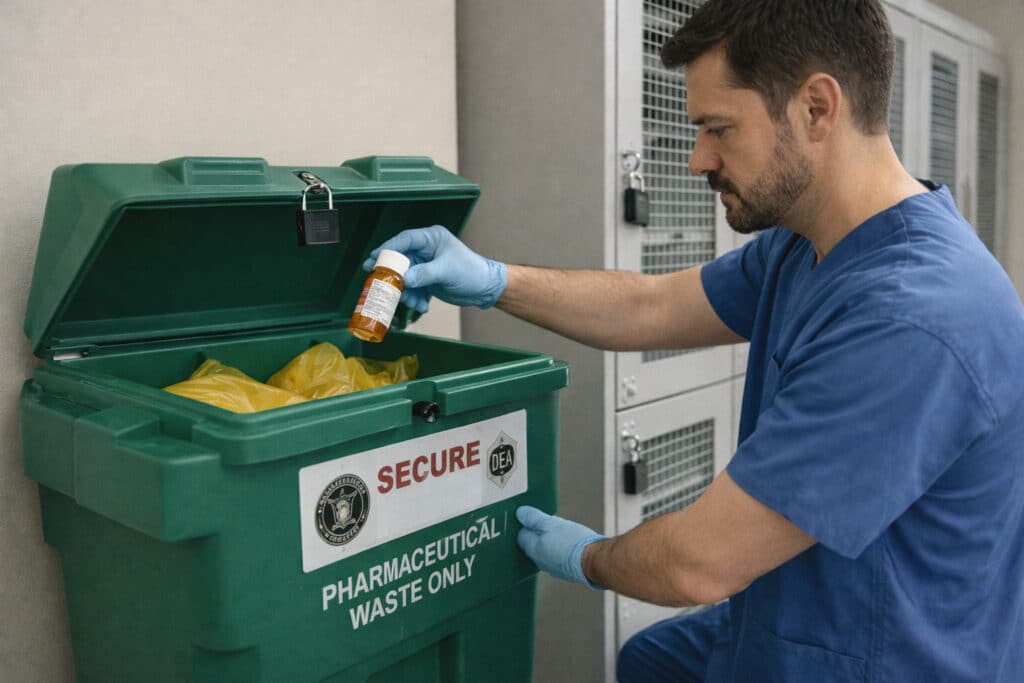
DEA requires non-retrievable destruction of controlled substances like opioids and benzodiazepines to prevent diversion, with fines up to $100,000 per violation. Naperville healthcare facilities must segregate by DEA schedules, use incineration or charcoal neutralization, complete Form 41, and secure chain of custody. MedPro Disposal provides compliant pickup and certificates. Follow these steps for audit-ready compliance and license protection.
Struggling with DEA compliance for pharmaceutical waste disposal in your Naperville healthcare facility? One improper disposal of controlled substances risks audits, license revocation, and fines up to $100,000 per violation. This article reveals the exact requirements, step-by-step process, and best practices to ensure full compliance and peace of mind.
Introduction to DEA Pharmaceutical Waste Disposal Compliance
Managing pharmaceutical waste is one of the most strictly regulated aspects of healthcare operations. It isn’t just about keeping your facility clean; it is about preventing drug diversion and protecting public safety. The Drug Enforcement Administration (DEA) enforces rigorous standards to ensure controlled substances are handled, stored, and destroyed correctly.
For healthcare providers in Naperville, IL, and across the US, failing to meet these standards can lead to severe fines and legal action. The rules are designed to close the loop on drug distribution, ensuring that unused medication cannot be retrieved or abused.
Understanding these obligations is the first step toward a compliant, safe facility.
What Is Pharmaceutical Waste Under DEA Controlled Substance Regulations?
Not all medical waste is the same. When you are dealing with expired or unused medications, you need to categorize them correctly to know which disposal method applies. The DEA specifically targets drugs with a potential for abuse, but your facility likely generates other types of pharmaceutical waste simultaneously.
Here is how the categories generally break down:
- Controlled Substances: Drugs with high abuse potential, regulated by law (e.g., opioids, stimulants).
- Hazardous Waste: Toxic, corrosive, or reactive medications (e.g., chemotherapy drugs, some antibiotics).
- Non-Hazardous Waste: Medications posing no significant risk when properly disposed.
Defining Controlled Substances by DEA Schedules
The DEA categorizes drugs into “schedules” based on their medical use and potential for abuse. Schedule I drugs have no accepted medical use, while Schedules II through V are commonly found in healthcare settings.
Key compliance factors include:
- Schedule II–V drugs require logging disposal activity, maintaining destruction records, and completing DEA Form 41.
- Examples of controlled substances include opioids, benzodiazepines, and stimulants.
- Cannabis-based medications (where permitted) including oils, edibles, or infused pills may require regulated destruction.
Key DEA Disposal Requirements for Healthcare Facilities
The core goal of DEA regulations is to make controlled substances “non-retrievable.” This means the drug’s physical and chemical state must be permanently altered so it cannot be recovered or used. Simply throwing pills in the trash or flushing them down the drain does not meet this standard and is often illegal.
To stay compliant, your facility must focus on three main areas:
- Non-Retrievable Drug Destruction: Renders medication irretrievable to eliminate diversion risk.
- Documented Disposal and Chain of Custody: Log activity and complete DEA Form 41 for Schedule II–V drugs.
- Compliance with DEA, DOT, and EPA Standards for transport and destruction.
How Compliant Pharmaceutical Waste Disposal Works
Creating a compliant workflow protects your license and your patients. The process involves tracking a medication from the moment it is deemed waste until it is destroyed. Regulators expect documented, verifiable, and secure pharmaceutical waste disposal processes by 2025.
A solid system relies on clear steps that staff can follow easily. This minimizes human error and ensures that every pill is accounted for.
Step 1: Inventory and Segregation
You cannot dispose of what you haven’t identified. The first step is separating controlled substances from other waste streams immediately. Mixing controlled substances with regular trash or red-bag medical waste creates a compliance nightmare.
- Identify the DEA Schedule of the medication.
- Separate hazardous pharmaceutical waste from non-hazardous.
- Place items in the correct, labeled containers immediately to prevent theft or loss.
Step 2: Destruction Methods
Once segregated, the waste must be destroyed. The method used must permanently destroy the drug. While you might store waste onsite temporarily, final destruction usually happens via a third-party service.
Common compliant methods include:
- Incineration in hazardous waste combustors, municipal waste combustors, or hospital/medical/infectious waste incinerators.
- Activated charcoal-based neutralization for non-retrievable destruction per 21 CFR § 1317.90–1317.95.
- Another method that DEA has publicly deemed to meet their non-retrievable standard (incineration is currently the only such method).
Step 3: Documentation and Reporting
Paperwork is your proof of compliance. If you are audited, the DEA will want to see the trail of every controlled substance you destroyed.
Essential documentation steps include:
Maintain destruction records and complete DEA Form 41.
Receive a Certificate of Destruction (COD) from your reverse distributor or disposal partner.
Ensure chain of custody is intact for audit readiness.
Best Practices for DEA-Compliant Pharmaceutical Disposal
Staying compliant requires more than just following the rules; it requires a culture of safety. The best facilities build compliance into their daily routines so that it becomes automatic.
By establishing strong internal policies, you reduce the risk of diversion by employees or patients.
Implementing Secure Storage Protocols
Before waste is picked up, it sits in your facility. This is a vulnerable time for diversion. You need to ensure that waste containers are just as secure as your active inventory.
- Use double-locked cabinets or secure rooms for storage.
- Limit access to authorized personnel only.
- Use tamper-evident containers that show if someone has tried to open them.
Training Staff on DEA Protocols
Your system is only as good as the people running it. Staff members often make mistakes because they don’t understand the difference between hazardous waste and controlled substances.
- Train new hires immediately on waste segregation.
- Provide annual refresher courses on DEA regulations.
- Clearly post instructions near disposal bins to remove guesswork during busy shifts.
Conducting Regular Audits
Don’t wait for a DEA inspector to find a problem. Self-auditing helps you catch gaps in your documentation or physical security before they become legal issues.
- Conduct monthly inventory checks of waste logs.
- Verify that Certificates of Destruction match your shipping manifests.
- Perform random spot checks on storage security and container integrity.
Common Mistakes in Pharmaceutical Waste Disposal and How to Avoid Them
Even well-intentioned facilities can slip up. The regulations are complex, and old habits die hard. Identifying common pitfalls helps you avoid them.
Here are the most frequent errors:
- Flushing medications: Prohibited under EPA rules for hazardous waste pharmaceuticals.
- Tossing into regular trash bins: Violates DEA non-retrievable standards and puts drugs in the public waste stream.
- Using open-top disposal containers: Increases diversion risk significantly; always use secured, narrow-opening containers.
Avoiding these mistakes protects your facility from fines and reputational damage.
Benefits of Partnering with MedPro Disposal for DEA Compliance
Handling controlled substance disposal alone is risky and complicated. MedPro Disposal offers a reliable solution for healthcare providers who need to focus on patient care rather than regulatory logistics.
We provide secure, recurring pickup services and mail-back programs tailored to your volume. Our team ensures you have the correct containers, proper manifests, and final destruction documentation to satisfy DEA and EPA requirements. With cost-effective contracts and national reach, we simplify the compliance puzzle for you.
Conclusion and Next Steps
Proper pharmaceutical waste disposal is non-negotiable for modern healthcare facilities. It protects your community from drug abuse and your business from federal penalties. The rules are clear: no hazardous waste pharmaceuticals, including controlled substances, can be disposed of into sewer systems.
Review your current protocols today. Are you using the right containers? Is your staff trained? If you are unsure, it is time to bring in an expert partner to secure your waste stream.
Frequently Asked Questions
What are the fines for DEA non-compliance in pharmaceutical waste disposal in Naperville, IL?
Fines start at $10,000 per violation for improper controlled substance disposal, escalating to $250,000 for repeat offenses or diversion risks, per DEA enforcement data from Illinois facilities in 2023.
How often must healthcare facilities in Naperville complete DEA Form 41?
Facilities must complete DEA Form 41 for each disposal event of Schedule II-V drugs, retaining records for 2 years; Naperville clinics report quarterly audits showing 95% compliance with this requirement.
Can hospitals in Illinois use mail-back kits for DEA-compliant disposal?
Yes, DEA-approved mail-back kits with prepaid shipping ensure non-retrievable destruction via incineration; Naperville hospitals like Edward Hospital use them for low-volume controlled substances, receiving CODs within 30 days.
What training is required for staff handling controlled substances in Naperville?
OSHA and DEA mandate initial training plus annual refreshers on segregation and Form 41; Naperville facilities average 4 hours yearly, reducing errors by 40% per local health department reports.
How long can controlled substance waste be stored onsite before disposal?
DEA allows up to 60 days in secure, locked containers before transfer; Naperville providers must log weekly inventories to comply with Illinois EPA overlap rules.