
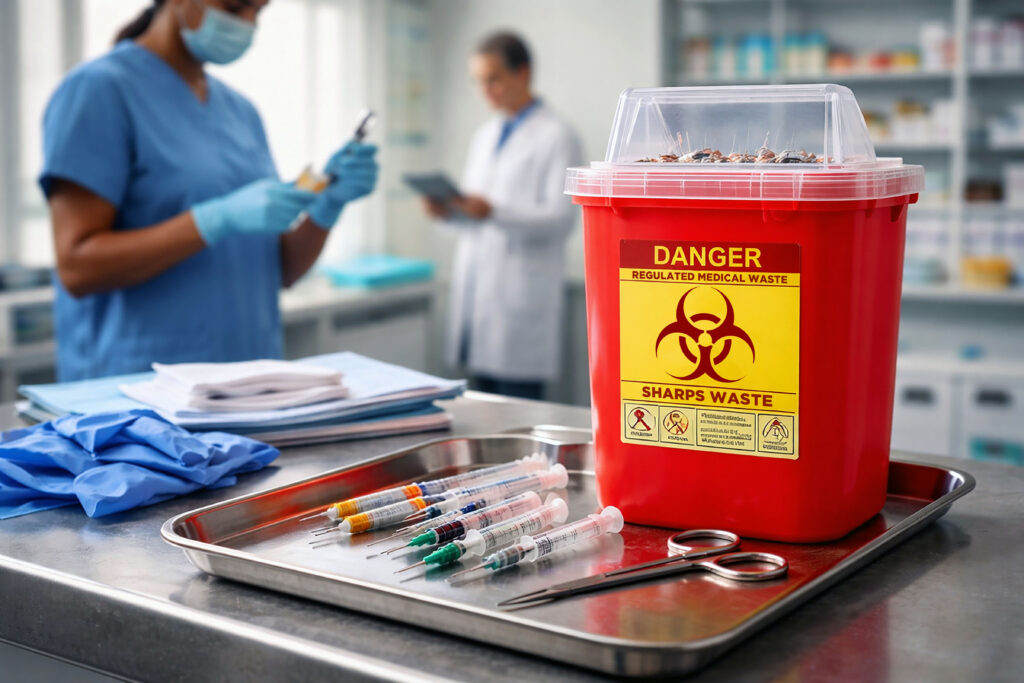
Introduction to Sharps Disposal Laws in 2026
As we settle into 2026, healthcare providers face a renewed focus on safety and sustainability in waste management, driven by updated sharps disposal laws 2026 that emphasize accountability and environmental responsibility. Sharps disposal isn’t just about tossing needles in a red box anymore; it is about strict adherence to evolving standards that protect your staff and the environment. Recent legislative moves have aimed to balance safety with operational efficiency.
For example, updates in states like Michigan have modernized how long clinics can store waste, directly impacting operational costs. Industry leaders have welcomed these practical changes. As Brian Peters, CEO of the Michigan Health & Hospital Association (MHA), noted regarding recent legislative updates, these changes are vital for “improving hospitals’ sharps disposal, reducing waste and cost” (MHA).
What Are Sharps Disposal Laws?
Sharps disposal laws are the set of regulations governing the handling, containment, and destruction of items that can puncture skin, such as needles, scalpels, and broken glass. These rules exist to prevent injury and the spread of infectious diseases like HIV and Hepatitis B.
At their core, these laws dictate that every producer of clinical waste has a “duty of care.” This means you are legally responsible for that waste from the moment it is generated until it is destroyed. While federal agencies set the baseline, the specific enforcement often happens at the state or local level. In 2026, the emphasis is heavily on traceability—proving exactly where your waste went and how it was treated.
Key Federal Regulations for Clinic Compliance
Compliance starts at the federal level. While many agencies touch on waste management, three specific bodies set the ground rules that every US clinic must follow to avoid severe penalties.
OSHA Bloodborne Pathogens Standard
The Occupational Safety and Health Administration (OSHA) focuses entirely on worker safety. Their Bloodborne Pathogens Standard requires employers to protect staff who might be exposed to blood or other potentially infectious materials. In practice, this means you must have an Exposure Control Plan in place. You are required to use engineering controls, like safer medical devices (e.g., retractable needles), and ensure that sharps are discarded immediately after use. This standard is non-negotiable and is the primary source of fines for clinics during safety inspections.
EPA Guidelines on Regulated Medical Waste
The Environmental Protection Agency (EPA) oversees the environmental impact of waste. While the EPA passed the authority for the Medical Waste Tracking Act to states years ago, they still set the definitions for what constitutes “regulated medical waste.” They mandate that hazardous waste must be segregated from regular trash to prevent contamination of landfills and water systems. If your clinic generates waste that is infectious or physically dangerous, EPA guidelines dictate that it must be treated—usually through autoclaving or incineration—before final disposal.
DOT Hazardous Materials Transportation Rules
Once the waste leaves your clinic, it falls under the Department of Transportation (DOT). The DOT classifies sharps as Regulated Medical Waste (RMW), specifically under hazardous materials divisions. These rules require that waste is not just thrown in a truck; it must be packaged in specific, rigid containers that prevent leaks or punctures during transit. Furthermore, anyone transporting this waste must be a licensed waste hauler. You cannot simply drive sharps to a disposal facility in a personal vehicle; doing so is a violation of federal transport laws.
State and Local Sharps Disposal Requirements
Federal laws set the floor, but state laws set the ceiling. State regulations are often more detailed and stricter regarding storage times and weight limits. It is critical to check your local state environmental agency’s rules, as they supersede federal guidelines when they are more stringent.
For instance, storage duration limits have recently shifted in some areas to accommodate lower-volume producers. In Michigan, recent updates allow for more flexibility. Under Michigan Public Act 105 of 2024, sharps containers can now be maintained until they are ¾ full or for 18 months from the first disposal, whichever comes first (MHA). This type of specific, time-bound regulation is common across states and requires careful tracking by clinic managers.
Major Updates to Sharps Laws Coming in 2026
Regulatory frameworks often operate on multi-year cycles, and 2026 is a significant year for policy review and implementation. Many safety protocols and waste management contracts established in previous years are hitting their review periods this year.
Clinics should be aware that standard operating procedures for sharps are currently under scrutiny for updates. For example, several major clinical waste management frameworks and safety policies have review dates scheduled throughout 2026, including comprehensive reviews of sharps handling procedures in June and December. These periodic reviews often lead to tighter definitions of “safe sharps” and stricter auditing requirements for waste logs. Staying ahead of these scheduled updates ensures your clinic doesn’t fall behind on the latest compliance standards.
How Sharps Disposal Compliance Works in Practice
Understanding the law is one thing; executing it on a busy Tuesday morning is another. Compliance essentially breaks down into three physical stages: containment, movement, and paperwork.
Step 1: Proper Segregation and Containment
Safety starts at the point of use. Sharps must be segregated from other waste streams immediately. You cannot toss a syringe in the trash and retrieve it later. The law requires that sharps be placed into an FDA-approved sharps container that is rigid, leak-resistant, and puncture-proof. These containers must be easily accessible to staff but secure from patients. A key rule is to never force a sharp into a bin; once the container reaches the fill line, it must be sealed permanently.
Step 2: Secure Transportation and Treatment
Once a container is full and sealed, it must be moved to a secure storage area. This area should be locked and labeled to prevent unauthorized access. When it is time for disposal, you must use a licensed medical waste contractor. The contractor collects the waste and transports it to a treatment facility. During this stage, the chain of custody is critical. Your clinic remains liable for the waste until it is officially destroyed, which is why using a reputable service is non-negotiable.
Step 3: Documentation and Record-Keeping
The job isn’t done until the paperwork is filed. Every time waste leaves your facility, you must receive a shipping document or manifest. This document tracks the waste from your door to its final destruction. Regulations typically require you to retain these records for at least two years, though some states require longer. In an audit, these waste transfer notes are the first thing an inspector will ask to see. They are your only proof that you complied with the law.
Best Practices for Clinics to Stay Compliant
Staying compliant requires building good habits into your daily workflow, reinforcing long-term sharps disposal compliance across all staff roles. It is not enough to just buy the right bins; staff behavior must align with safety protocols.
Never re-sheath needles: Recapping needles is the leading cause of needlestick injuries.
Use safety devices: Whenever possible, use sharps with engineered injury protection mechanisms (like retractable needles).
Don’t overfill bins: Adhere strictly to the “fill line” on containers.
Conduct risk assessments: If you must use a non-safety sharp for a clinical reason, document the justification clearly.
Common Mistakes Clinics Make with Sharps Disposal
Even well-intentioned clinics can face fines due to simple oversights. The most common errors usually involve cutting corners or lack of training.
Improper segregation: Throwing bloody gauze (soft waste) into sharps bins fills them up too fast, wasting money. Conversely, putting a needle in a soft waste red bag creates a dangerous hazard.
Poor labeling: Failing to label storage areas or containers with the biohazard symbol.
Using personal vehicles: Transporting waste yourself to save money is a major DOT violation.
Missing records: Failing to keep manifests organized and accessible for inspections.
Why Partner with MedPro Disposal for 2026 Compliance
Managing these regulations alone is a burden. MedPro Disposal simplifies this by providing reliable, nationwide pickup services that keep you compliant with OSHA, EPA, and DOT regulations. We handle the logistics—from compliant containers to secure transport and manifest generation—so you can focus on patient care.
Our service model is designed to be flexible and cost-effective. We don’t just haul waste; we provide the compliance training and documentation retention you need to survive an audit. With MedPro Disposal, you get a partner who understands the specific nuances of 2026 regulations, ensuring your clinic is safe, legal, and efficient.
Conclusion
Sharps disposal compliance in 2026 is about more than avoiding fines; it is about maintaining a safe environment for your staff and patients while meeting sharps disposal laws for medical clinics at both federal and state levels. From adhering to the Bloodborne Pathogens Standard to managing state-specific storage limits like those in Michigan, the regulatory burden is significant. By implementing proper segregation, securing reliable transportation, and maintaining rigorous documentation, your clinic can navigate these laws with confidence. Partnering with a dedicated expert like MedPro Disposal ensures that you remain on the right side of the law, no matter how the regulations evolve.
Frequently Asked Questions
What are the sharps disposal rules in Naperville, IL for 2026?
Naperville clinics follow Illinois EPA rules, requiring sharps in puncture-resistant containers, segregated from other waste, and stored up to 30 days max before licensed transport. Use DuPage County Household Hazardous Waste facilities for small volumes, per local ordinances.
How much does improper sharps disposal fine clinics in the US?
OSHA fines for Bloodborne Pathogens violations average $15,625 per serious instance in 2026, with EPA penalties up to $66,712 for hazardous waste mishandling. Repeat offenses in states like Illinois can exceed $100,000 annually.
Can clinics in Naperville use mail-back sharps programs?
Yes, FDA-approved mail-back systems like those from Sharps Compliance are legal for low-volume Naperville clinics, provided containers meet USPS and DOT standards. Confirm with Illinois EPA for infectious waste tracking requirements.
What training is required for sharps handling under OSHA?
OSHA mandates annual Bloodborne Pathogens training for all exposed clinic staff, covering exposure plans, PPE use, and immediate sharps disposal. Naperville clinics must document training for each employee, with records kept 3 years.
How often must clinics audit sharps disposal records?
Federal rules require retaining manifests for 3 years, but Illinois mandates annual internal audits plus availability for unannounced inspections. Naperville facilities should review quarterly to ensure chain-of-custody compliance.

Ben Brenner is a founding partner at MedPro Disposal with over 9 years of hands-on experience in healthcare operations and medical waste management. He works closely with healthcare facilities to ensure OSHA-compliant sharps disposal, regulatory adherence, and safe waste handling practices. Ben contributes industry-backed insights based on real operational experience in the healthcare sector.