

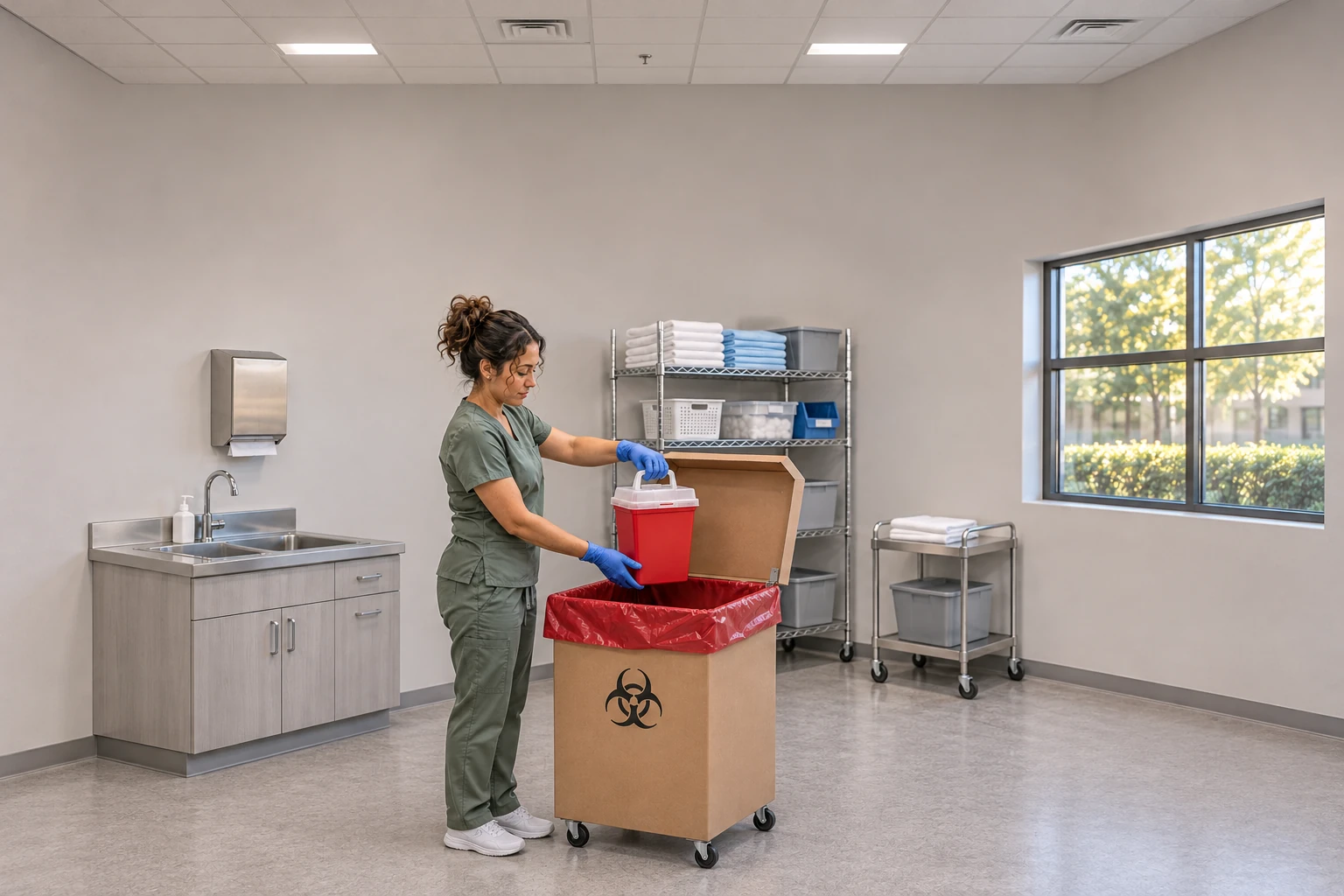
A Texas-only guide to setting up medical waste and sharps pickup for a new urgent care. It covers TCEQ and DSHS rules, generator duties, registered transporters and records.
In This Article
- 01Key Takeaways
- 02What does Texas call medical waste, and who regulates it?
- 03What must a Texas urgent care do as the generator?
- 04Who disposes of special waste from health care-related facilities in Texas?
- 05What are the sharps disposal options for a Texas urgent care?
- 06How do I set up medical waste and sharps pickup before opening?
- 07Sources
- 08Frequently Asked Questions
A new Texas urgent care sets up medical waste and sharps pickup by contracting a TCEQ-registered medical waste transporter that delivers to an authorized treatment facility, and MedPro Disposal can arrange that service through partner haulers. Texas calls the waste "special waste from health care-related facilities." The Texas Commission on Environmental Quality (TCEQ) regulates it under 30 TAC Chapter 326, and the Department of State Health Services (DSHS) sets the definitions and approved treatment methods in 25 TAC Chapter 1.
Your clinic is the generator, so the duty to package, label, ship and keep records is yours. Do the setup before opening day: estimate your monthly weight, pick a registered transporter, put sharps containers in every exam and procedure room, and start your shipping records file. For the generic national checklist and vendor comparison, see our urgent care compliance guide.
Key Takeaways
- Texas regulates "special waste from health care-related facilities" as medical waste: sharps, bulk blood and body fluids, microbiological waste, pathological waste and certain animal waste.
- Texas classes a site as a small quantity generator at 50 pounds or less of medical waste per month, and as a large quantity generator above 50 pounds.
- Storing medical waste you generated on site needs no TCEQ permit, registration or notification if it is stored securely and does not create a nuisance.
- Texas generators must keep records of untreated medical waste shipments for three years and make them available to TCEQ.
What does Texas call medical waste, and who regulates it?
Texas calls it "special waste from health care-related facilities," and TCEQ treats it as "medical waste" under 30 TAC 326.3(23). The definition covers five categories from the sources listed in 25 TAC 1.134: animal waste, bulk blood and body fluids, microbiological waste, pathological waste and sharps. It also includes federally defined regulated medical waste under 49 CFR 173.134(a)(5). TCEQ's own guidance notes that its word "medical" is equivalent to DSHS's "health care-related."
The split between agencies is simple. TCEQ writes the generator, transporter and facility rules in 30 TAC Chapter 326. DSHS defines the waste and approves treatment methods (25 TAC 1.131 to 1.137). Exam gloves and similar items are not medical waste by themselves. TCEQ guidance defines "bulk" as a containerized volume of 100 mL or more, and waste can become regulated if blood commingled in one container reaches that volume.
What must a Texas urgent care do as the generator?
The generator is the site that produces the waste, and under 30 TAC 326.3(14) that is your clinic location. Your duties fall into four areas: classification, packaging and labeling, storage, and records.
Classify your site by monthly weight
A small quantity generator (SQG) makes 50 pounds or less of medical waste per month, and a large quantity generator (LQG) makes more than 50 pounds. The category matters mostly for self-transport and on-site treatment. It does not change your duty to manage the waste properly. Estimate your weight from expected patient volume and procedures, then recheck after the first few months.
Package and label before anything leaves the building
Generators that ship waste off site must package and label it under 30 TAC 326.17, 326.19 and 326.21. Under 326.19, bagged waste goes into an outer container that is rigid, leak resistant, impervious to moisture, strong enough to resist tearing and bursting, and sealed. TCEQ does not read this to rule out cardboard boxes made for medical waste. Federal DOT packaging rules (49 CFR 173.134 and 173.196) apply to infectious substances as well.
Store securely, without a permit
Storing waste you generated on site needs no permit, registration or notification, as long as it is stored securely and does not create a nuisance (30 TAC 326.31(a)). Keep the storage spot locked or access-controlled and away from public areas. TCEQ guidance says a 45 degree Fahrenheit limit applies to putrescible or untreated waste held more than 72 hours after collection, and that cooling during pre-collection storage at your clinic is optional.
Keep shipping records for three years
Texas generators must get a signed shipping receipt from a registered transporter and keep records of every untreated medical waste shipment for three years after the shipment date. Records must be available for TCEQ inspection. You should also obtain a receipt from the treatment facility confirming proper treatment. The treatment facility must send the generator a copy of the shipping document with a treatment statement within 45 days, and the transporter must give you a written weight or volume statement within 45 days of shipment.
Who disposes of special waste from health care-related facilities in Texas?
A registered medical waste transporter carries the waste, and an authorized treatment or disposal facility treats it. Under 30 TAC 326.53, a transporter that is not the generator must hold a TCEQ registration by rule and keep a manifest or similar record of each collection and deposit. TCEQ publishes a searchable list of registered transporters, and you should verify the registration before you sign.
Untreated medical waste may be stored, processed or deposited only at a facility authorized to accept it. Treatment facilities operate under a TCEQ registration (30 TAC 326.61(a)). After treatment, TCEQ says the waste may generally go to a Type I municipal solid waste landfill with a shipping document stating it was treated. Keep that paper trail with your records.
If you want one contracting party for the chain, MedPro Disposal takes legal title to regulated medical waste at pickup (not hazardous waste), and in Texas it works through partner haulers. See our Texas medical waste page for service details.
What are the sharps disposal options for a Texas urgent care?
Texas treats sharps from a health care-related facility as medical waste, and TCEQ lists four ways to manage them. Pick the one that fits your volume and staffing.
| Option | What TCEQ says | Authorization |
|---|---|---|
| Registered transporter pickup | Transporter takes sharps to an authorized facility for treatment and disposal | Transporter holds registration by rule (30 TAC 326.53); you keep shipping records |
| Self-transport | SQGs may haul their own untreated waste to an authorized facility; LQGs may too | SQGs are exempt (326.31(b)); LQGs need registration by rule (326.53) |
| U.S. Postal Service or equivalent | Allowed under USPS mailing standards, to an authorized facility | No authorization needed (326.31(d)) |
| On-site treatment | Use a DSHS pre-approved method (25 TAC 1.136) or an approved alternative technology | Notify TCEQ (SQG: 326.39; LQG: 326.41; Form TCEQ-20788) |
Most urgent cares choose scheduled pickup because staff time stays on patients. Low-volume sites may compare mail-back. Our mail-back vs scheduled pickup guide covers the tradeoffs, and the sharps container disposal page explains the service. MedPro does not sell sharps containers, so confirm you have approved containers in place before day one.
Pharmaceutical waste is separate. TCEQ says to manage EPA-listed or toxic pharmaceutical waste as hazardous waste (40 CFR 261.33) and nonhazardous pharmaceutical waste as special waste under 30 TAC Chapter 330. Controlled substances (DEA Schedule II to V) never go in a red bag or regulated medical waste container.
How do I set up medical waste and sharps pickup before opening?
Set up pickup in six steps, and finish them before your doors open.
- Estimate monthly weight. Project sharps and other medical waste by exam rooms and procedures to decide whether you will be an SQG or LQG.
- Map your waste streams. Separate sharps, bulk blood and body fluid waste, microbiological waste, pharmaceutical waste and regular trash before the first patient.
- Choose a registered transporter. Confirm its TCEQ registration, and ask which authorized treatment facility receives your waste. Our questions to ask a medical waste company help here.
- Set up containers and storage. Place sharps containers in each room, and pick a secure, access-controlled storage spot that will not create a nuisance.
- Schedule pickup and agree on weight reporting. Ask the transporter to record weight or volume on the manifest and label.
- Create your records file. Keep signed shipping receipts and treatment confirmations for three years. Our new practice setup checklist covers day-one tasks beyond Texas rules.
Frequently Asked Questions
How do I set up medical waste and sharps pickup for a new urgent care in Texas?
Hire a TCEQ-registered medical waste transporter that delivers to an authorized treatment facility, and do it before you open. Estimate your monthly weight, set up sharps containers and secure storage, and keep signed shipping receipts for three years (30 TAC Chapter 326). Storing your own waste on site needs no permit if it is secure and not a nuisance.
Who disposes of special waste from health care-related facilities in Texas?
A registered medical waste transporter moves it, and an authorized treatment or disposal facility handles it. The facility that generated the waste is responsible for packaging, labeling and records. TCEQ regulates the process under 30 TAC Chapter 326, and DSHS approves treatment methods under 25 TAC 1.136.
Does a Texas urgent care need a TCEQ permit to store medical waste on site?
No. Small and large quantity generators are exempt from permit, registration or notification to store medical waste generated on site, if it is stored securely and does not create a nuisance (30 TAC 326.31(a)). Treating your own waste on site is different and requires notifying TCEQ.
How long must a Texas generator keep medical waste shipping records?
Three years after the date of shipment. TCEQ guidance says generators must keep records of all untreated medical waste shipments sent off site and make them available for inspection. Keep the signed transporter receipt and any treatment confirmation together.
What is a small quantity generator of medical waste in Texas?
A small quantity generator produces 50 pounds or less of medical waste per month. A large quantity generator produces more than 50 pounds per month. The difference affects self-transport: SQGs are exempt from registration under 30 TAC 326.31(b), while LQGs need registration by rule under 30 TAC 326.53.
Can a Texas urgent care mail sharps for disposal?
Yes, if the shipment follows U.S. Postal Service mailing standards, or an equivalent delivery service's, and goes to an authorized facility. No TCEQ authorization is needed for this (30 TAC 326.31(d)). Compare it with scheduled service in our mail-back guide.
Sources
- TCEQ: Information for Medical Waste Generators (checked 2026-11-16)
- TCEQ: What is Medical Waste? (checked 2026-11-16)
- TCEQ: Transporting Medical Waste (checked 2026-11-16)
- TCEQ: Disposing of Sharps, Syringes, and Other Related Waste (checked 2026-11-16)
- TCEQ RG-001: Texas Regulations on Medical Waste (checked 2026-11-16)
Want more like this in your Google results?
Add MedPro as a preferred source on Google