
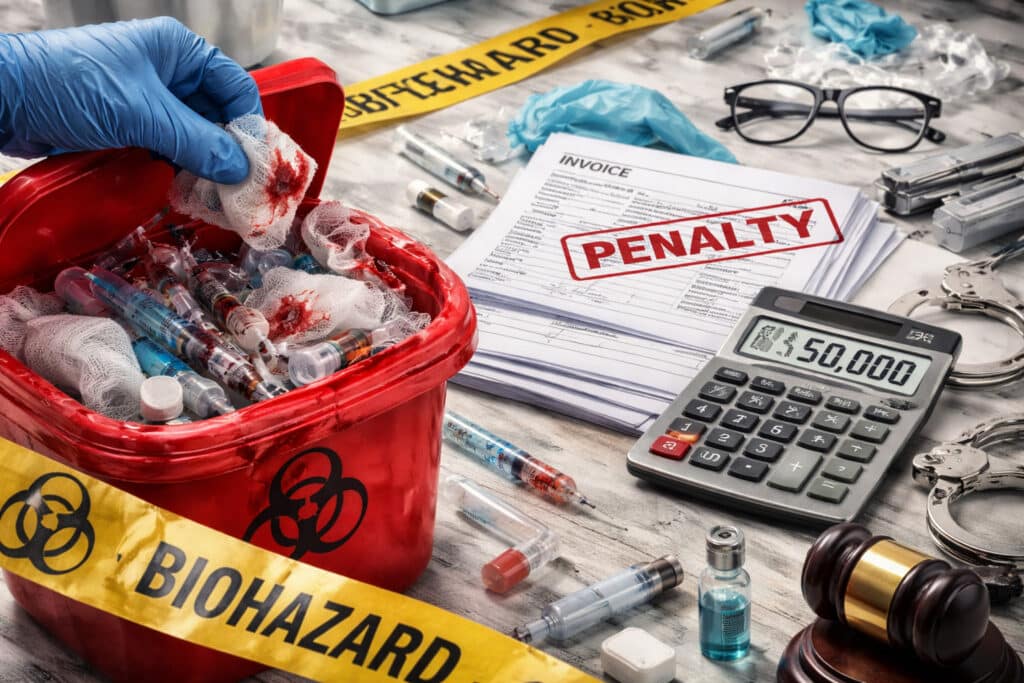
Improper medical waste disposal carries financial and legal consequences that many healthcare facilities underestimate. When biohazard waste is mixed with regular trash – or when disposal protocols are ignored – facilities face regulatory fines, civil liability, and operational disruptions. The cost implications of mixing regular trash with biohazard waste range from thousands to tens of thousands of dollars per day in penalties alone, depending on the state. Understanding medical waste disposal fines and biohazard waste compliance costs is the first step toward protecting your facility from avoidable financial exposure.
Medical Waste Disposal Fines: What Regulators Can Actually Charge You
Federal and state agencies have broad authority to penalize healthcare facilities that mishandle regulated medical waste. The financial exposure is significant and accumulates quickly.
Federal-Level Penalties
Under the Resource Conservation and Recovery Act (RCRA), EPA violations related to hazardous waste mismanagement can carry penalties of up to $75,000 per day per violation. OSHA also has authority to cite facilities for bloodborne pathogen standard violations, with penalties for serious violations reaching into the tens of thousands of dollars per citation.
State-Level Penalties
State penalties vary widely but are consistently significant:
- Maryland – Fines up to $25,000 per day, with potential criminal charges for repeat or egregious violations
- Virginia – Civil penalties up to $32,500 per violation under DEQ regulations
- Washington, D.C. – Fines up to $50,000, plus possible business license revocation for repeated violations
- Minnesota and Pennsylvania – Fines ranging from $1,000 to $25,000 per day for improper storage, labeling, or disposal
These figures represent per-day or per-incident amounts. A facility cited for multiple violations simultaneously can face combined penalties that far exceed a single fine.
The Cost Implications of Mixing Regular Trash With Biohazard Waste
One of the most common – and costly – compliance errors in healthcare settings is the improper commingling of regulated medical waste with ordinary solid waste.
Why Mixing Waste Streams Creates Compounding Liability
When biohazard waste enters the regular trash stream, it creates a chain of regulatory exposure:
- Waste hauler liability – Municipal waste contractors are not licensed to handle regulated medical waste. Contaminated loads can trigger their own regulatory actions, which may be traced back to the originating facility.
- Landfill contamination – If infectious material reaches a municipal landfill, the generating facility can be held responsible for remediation costs.
- Worker injury claims – Sanitation workers, janitors, or waste handlers injured by improperly discarded sharps or contaminated materials may pursue civil claims against the facility.
Hidden Operational Costs
Beyond direct fines, facilities that mix waste streams often face:
- Increased disposal costs when waste haulers reclassify loads
- Mandatory retraining programs required by regulators following a violation
- Third-party audits imposed as part of a consent agreement
- Elevated insurance premiums following documented compliance failures
These indirect biohazard waste compliance costs frequently exceed the value of the original fine.
Liability Exposure Beyond the Fine: Legal and Reputational Consequences
Regulatory fines are only one dimension of the financial risk. Healthcare facilities also face civil liability and reputational damage that can affect long-term operations.
Civil and Criminal Liability
Improper disposal of medical waste – particularly when it results in public exposure or worker injury – can lead to civil lawsuits. In cases involving repeated or willful violations, some states have provisions for criminal charges against facility administrators or compliance officers. This is distinct from the regulatory fine itself and can result in personal liability for individuals in leadership roles.
Reputational and Operational Risk
A documented compliance violation becomes part of the public record in many states. For physician practices, dental offices, and hospitals, this can affect:
- Patient trust and retention
- Relationships with insurance networks and credentialing bodies
- Staff recruitment and retention
The downstream revenue impact of reputational damage is difficult to quantify but real. Facilities that invest in proper compliance infrastructure generally avoid this category of risk entirely.
How to Avoid Medical Waste Disposal Fines and Stay Compliant
Compliance is not a one-time action – it requires consistent systems, trained staff, and a reliable disposal partner. The following practices address the most common sources of violations.
Establish Clear Waste Segregation Protocols
Use Proper Containers From the Point of Generation
Regulated medical waste must be placed in appropriate containers – red biohazard bags, sharps containers, or labeled rigid containers – at the point of generation. Mixing waste streams typically begins when staff are unsure which container to use or when the correct container is not immediately available.
Train All Staff, Not Just Clinical Personnel
OSHA’s Bloodborne Pathogens Standard requires training for all employees who may have occupational exposure. This includes housekeeping and administrative staff who may handle waste containers. Documented training records are reviewed during inspections and can mitigate penalty severity when violations are found.
Work With a Licensed Medical Waste Disposal Provider
Verify Licensing and Insurance
A compliant disposal provider should carry proper state licensing, maintain manifest documentation, and carry liability insurance that covers the waste from point of pickup through final treatment. Facilities that use unlicensed haulers retain legal responsibility for the waste even after it leaves their premises.
Maintain Waste Manifests and Disposal Records
Regulators may request disposal records going back several years. Maintaining organized manifest documentation – and transitioning to the EPA’s e-Manifest system where applicable – reduces exposure during audits and inspections.
Conduct Periodic Internal Audits
Self-auditing is one of the most cost-effective compliance tools available. A quarterly review of waste containers, labeling practices, storage areas, and staff training records can identify gaps before a regulator does. Facilities that demonstrate proactive compliance efforts are often treated more favorably during enforcement proceedings.
Frequently Asked Questions
What are the most common violations that lead to medical waste disposal fines?
The most frequently cited violations include improper waste segregation, inadequate container labeling, failure to maintain disposal manifests, and lack of documented staff training. Mixing biohazard waste with regular trash is consistently among the top enforcement triggers across state programs.
How much can a healthcare facility be fined for improper biohazard waste disposal?
Fines vary by state and violation type. Federal EPA violations can reach $75,000 per day per violation. State-level fines typically range from $1,000 to $50,000 per violation or per day, depending on severity, intent, and the facility’s compliance history.
Does OSHA regulate medical waste disposal directly?
OSHA regulates the handling and containment of medical waste at the point of generation under the Bloodborne Pathogens Standard (29 CFR 1910.1030). State environmental agencies and the EPA regulate downstream disposal and treatment. Both can issue separate citations for the same underlying incident.
What are the cost implications of mixing regular trash with biohazard waste?
Mixing waste streams can trigger regulatory fines, waste hauler reclassification fees, mandatory retraining requirements, and civil liability if workers are injured. Indirect costs – including higher insurance premiums and third-party audits – often exceed the original fine amount.
Can a facility face criminal charges for improper medical waste disposal?
Yes. In states like Maryland and others with strict enforcement frameworks, willful or repeated violations can result in criminal charges against the facility or its administrators. Criminal exposure is most common when violations result in documented public health harm.
How often should a healthcare facility review its medical waste compliance program?
A quarterly internal audit is a reasonable baseline for most facilities. Facilities that generate higher volumes of regulated medical waste, or those that have received prior violations, should consider more frequent reviews and periodic third-party compliance assessments.

Ben Brenner is a founding partner at MedPro Disposal with over 9 years of hands-on experience in healthcare operations and medical waste management. He works closely with healthcare facilities to ensure OSHA-compliant sharps disposal, regulatory adherence, and safe waste handling practices. Ben contributes industry-backed insights based on real operational experience in the healthcare sector.