
We recently ran a survey—and let’s just say the results were eye-opening. A ton of people (seriously, a LOT of people) admitted they’re not entirely sure how to distinguish hazardous waste from biohazardous waste. And guess what? We don’t blame them one bit. The terminology alone can be confusing—hazardous, biohazardous, infectious, chemical… it can get overwhelming!
But fear not! If you’ve ever looked at a suspicious substance oozing from an old container in the back of your storage room and wondered, “Wait, is this hazardous waste or biohazardous? waste”—you’ve landed on the right page. Our goal today is to clear up the confusion, focus on the ins and outs of hazardous waste, and also provide enough context around biohazardous waste to keep you safe, compliant, and hopefully less stressed out. After all, nobody wants a surprise visit from the EPA (Environmental Protection Agency) or an unexpected biological hazard on their hands!
Below, we’ll explore exactly what hazardous and biohazardous wastes are, the key differences between them, examples by industry, how to store and dispose of them properly, and—of course—the crucial regulations you absolutely need to know. So, grab your coffee (or tea, we don’t judge) and let’s dive right in.
Why It’s Important to Understand the Difference Between Hazardous and Biohazardous Waste
Let’s start with a simple question: Why does it matter if you call it “hazardous” or “biohazardous” waste? Aren’t both of them just types of potentially dangerous waste that nobody wants lying around?
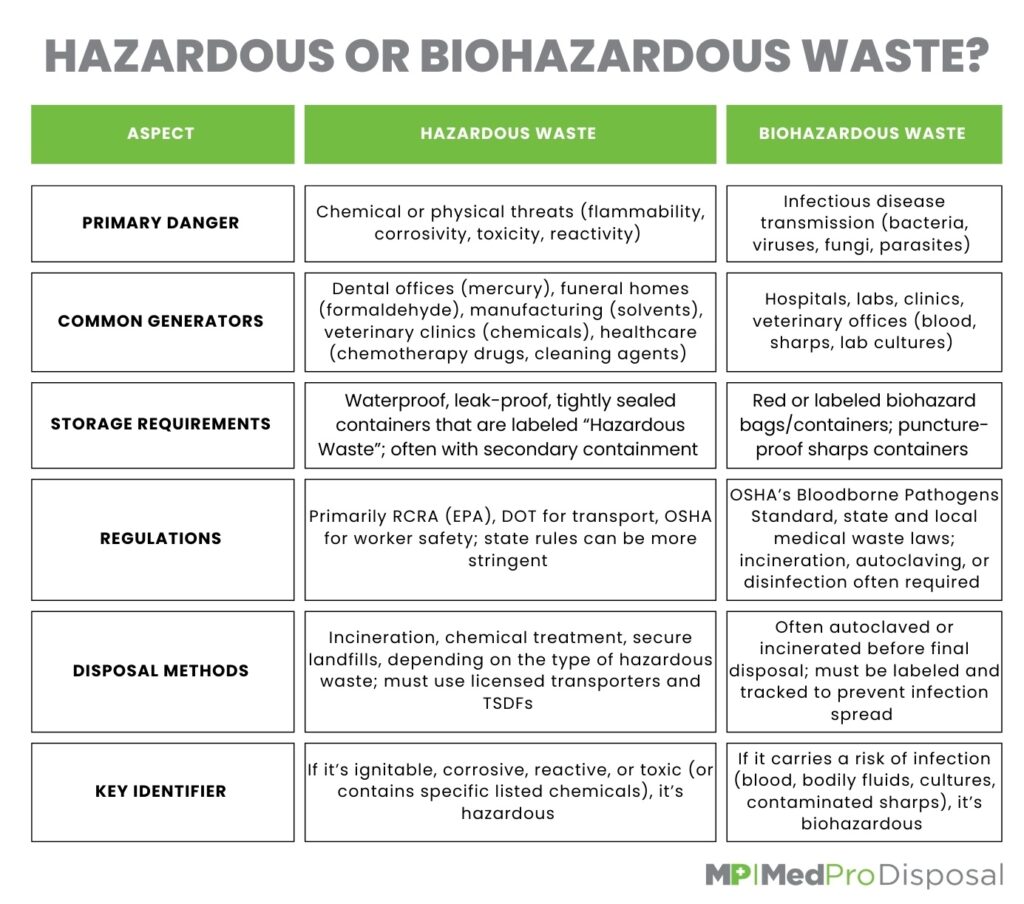
Well, yes and no. Both categories do pose serious risks if not managed properly. But how you handle them, store them, and dispose of them can differ greatly because their underlying threats are different. Hazardous waste is primarily dangerous due to its chemical properties—like flammability, corrosivity, toxicity, or reactivity. Biohazardous waste, on the other hand, can spread infectious diseases (think bloodborne pathogens, lab cultures, contaminated sharps, etc.).
Failing to correctly identify and separate these wastes can lead to everything from environmental damage and hefty fines to serious health risks for you, your team, and the public. So, let’s get the nuances down pat.
The financial stakes are significant. RCRA violations for improper hazardous waste handling carry fines of up to $70,117 per day per violation. OSHA violations under the Bloodborne Pathogens Standard for improper biohazardous waste handling carry fines up to $15,625 per violation for serious infractions and up to $156,259 for willful violations. Misclassifying your waste – treating hazardous waste as biohazardous or vice versa – can trigger violations under both regulatory frameworks simultaneously.
For even more detail, check out our full blog on understanding different types of medical waste.
What Is Hazardous Waste? A Deep Dive
Hazardous waste is any substance that is dangerous or potentially harmful to human health or the environment. This can be in the form of liquids, solids, gases, or sludges and might include items like corrosive chemicals, flammable solvents, or substances containing heavy metals (like mercury or lead).
In the United States, the Resource Conservation and Recovery Act (RCRA), enforced by the Environmental Protection Agency (EPA), sets the stage for defining and regulating hazardous waste. Under RCRA, a waste is considered “hazardous” if it exhibits one or more of the following characteristics:
- Ignitable (Flammable) – It catches fire easily or has a flash point below 140°F (60°C).
- Corrosive – It can corrode metals or cause chemical burns to skin (often very acidic or very alkaline).
- Reactive – It tends to explode or produce toxic fumes when exposed to air, water, or other conditions.
- Toxic – It can harm or kill living organisms upon ingestion, inhalation, or absorption.
Examples of Hazardous Waste
One of the most common mistakes people make is assuming hazardous waste only comes from big, industrial manufacturing plants. Not true! Hazardous waste is found in places you might not expect—like dental clinics or funeral homes.
Here’s a closer look:
Dental Industry
Dentists often handle materials that, if mishandled, could pose significant risks.
- Dental Amalgam Containing Mercury
Those familiar silver fillings contain mercury, a substance known for its toxicity. Even trace amounts require careful containment and disposal to prevent environmental contamination. Modern dental practices often use amalgam separators to capture mercury before it enters wastewater systems, ensuring compliance with environmental standards. - X-ray Fixer and Developer Chemicals
X-ray imaging is vital for diagnosing oral issues, but the chemicals involved in processing these images can be corrosive and hazardous. These substances demand specialized treatment to neutralize their effects before disposal, highlighting the importance of industry-specific waste management protocols.
Surgical Centers
The fast-paced environment of surgical centers generates a variety of hazardous materials.
- Disinfectants and Sterilants
Chemicals like glutaraldehyde and peracetic acid, used to sanitize surgical tools, are often corrosive or toxic. These materials can harm healthcare workers and the environment if not managed properly. - Pharmaceutical Waste
Expired or unused medications, particularly those with controlled or hazardous properties, require specialized disposal methods. Drugs like opioids or cytotoxic agents are subject to stringent guidelines to prevent misuse or accidental exposure.
Veterinary Clinics
Veterinary practices face unique challenges due to the types of hazardous materials they handle.
- Pesticides/Flea & Tick Treatments
Topical solutions designed to protect pets from pests often contain chemicals that, when mishandled, can be toxic to both humans and animals. Proper storage and disposal prevent unintended exposure or environmental contamination. - Chemotherapy Drugs
Treatment drugs for animals are as potent and hazardous as their human counterparts. Special disposal protocols are necessary to avoid harming handlers or contaminating water sources.
Funeral Homes
The funeral industry deals with hazardous waste materials that demand careful attention to safety and environmental impact.
- Embalming Fluids
Formaldehyde, a common embalming agent, is carcinogenic and poses risks during handling and disposal. Funeral homes must follow strict guidelines to minimize exposure and environmental release. - Cleaning Agents and Solvents
Many cleaning products used in this industry are flammable or corrosive, requiring proper labeling, storage, and disposal.
General Healthcare Facilities
Healthcare facilities manage a wide range of hazardous waste types, making comprehensive disposal plans essential.
- Mercury Thermometers and Blood Pressure Devices
Though largely phased out, older devices containing mercury still surface. Mercury poses significant environmental and health risks, necessitating special recycling or disposal procedures. - Pharmaceuticals
Medications such as warfarin and nicotine-based products are classified as hazardous when discarded, requiring strict protocols to prevent accidental exposure or environmental damage.
Manufacturing and Construction (Honorable Mention)
While not traditionally linked to healthcare, these industries also contribute to hazardous waste challenges.
- Paints, Stains, and Varnishes
These materials often contain volatile organic compounds (VOCs), which can be toxic or ignitable. Safe disposal methods are necessary to prevent air pollution and fires. - Solvents and Adhesives
Frequently flammable, these products pose risks in both usage and disposal. - Heavy Metals (e.g., Lead, Chromium)
Often found in plating or finishing processes, heavy metals are toxic and require careful disposal to avoid contaminating soil and water supplies.
Hazardous vs. Biohazardous Waste – Side-by-Side Comparison
| Hazardous Waste | Biohazardous Waste | |
|---|---|---|
| Primary risk | Chemical – toxic, flammable, corrosive, reactive | Biological – infectious disease transmission |
| Governing regulation | RCRA (EPA) – 40 CFR Parts 260-299 | OSHA Bloodborne Pathogens Standard – 29 CFR 1910.1030 |
| Container color | Yellow, black, or satellite accumulation containers | Red bags, red containers, or sharps containers |
| Label requirement | “Hazardous Waste” + contents + accumulation start date | International biohazard symbol |
| Treatment method | Incineration, chemical treatment, secure landfill | Autoclaving, incineration, chemical disinfection |
| Storage time limit | 90 days (LQG), 270 days (SQG), no limit (VSQG) | Varies by state – typically 30-90 days |
| Manifest required | Yes – Uniform Hazardous Waste Manifest | Yes – medical waste tracking document |
| Fine for violation | Up to $70,117 per day per violation | Up to $156,259 per willful OSHA violation |
| Examples | Mercury, formaldehyde, chemotherapy drugs, solvents | Blood-soaked materials, sharps, pathological waste, cultures |
How to Properly Segregate Hazardous Waste
Proper waste segregation is essential for effective hazardous waste management. If your facility handles multiple waste streams (and it likely does), keeping hazardous waste separate from other waste types is critical to ensuring compliance and minimizing risks. Here’s how to approach it:
Identify the Waste
- Perform a waste evaluation. Check the Safety Data Sheets (SDS) for the chemicals you’re using.
- If a substance has one or more of the RCRA characteristics (ignitability, corrosivity, reactivity, toxicity), treat it as hazardous.
Label Containers Clearly
- Use waterproof, corrosion-resistant containers.
- Slap on a clear label that says “Hazardous Waste,” listing the contents (e.g., “Spent Solvent, Flammable”).
Use Separate Storage Areas
- Flammable materials should be stored away from oxidizers.
- Acids and bases should never cozy up together in the same cabinet. If they mix, it could spell trouble (and by “trouble,” we mean violent chemical reactions).
Train Your Team
- Everyone in the facility—yes, even the interns—should know how to identify and segregate hazardous waste.
- Periodic refresher trainings are a must to stay on top of changing regulations.
When Waste Is Both Hazardous AND Biohazardous
Some waste streams in healthcare qualify as both hazardous and biohazardous simultaneously. These are called “dual-regulated wastes” and they require compliance with both RCRA and OSHA standards at the same time.
The most common examples in healthcare settings:
Chemotherapy waste – Cytotoxic drugs like cyclophosphamide are RCRA listed hazardous waste (U-listed) AND biohazardous because they are infectious agents. Chemo waste must go into yellow chemotherapy containers (not standard red biohazard bags) and requires incineration – autoclaving is not sufficient.
Formaldehyde-preserved pathological specimens – Pathological tissue preserved in formaldehyde is biohazardous (human tissue) and hazardous (formaldehyde is an F-listed RCRA waste). Both sets of disposal rules apply.
Mercury-contaminated blood collection tubes – If blood collection tubes contain mercury-based preservatives, the waste is both biohazardous (blood) and hazardous (mercury is a RCRA characteristic waste – toxic).
The rule of thumb: When waste qualifies under both categories, apply the stricter standard. If RCRA requires incineration but OSHA would allow autoclaving, use incineration. Always default to the more stringent requirement.
How Long Can Hazardous Waste Stay On-Site?
The timeframe for storing hazardous waste depends on two main factors: the quantity of waste you generate and your generator status according to the EPA. Generally, you might see terms like:
- Large Quantity Generators (LQG): Generate 1,000 kg or more of hazardous waste per month (or more than 1 kg of acutely hazardous waste). LQGs usually have up to 90 days to store waste on-site before it needs to be shipped off.
- Small Quantity Generators (SQG): Generate between 100 kg and 1,000 kg per month. SQGs can typically store waste up to 180 days (or 270 days if the treatment facility is far away).
- Very Small Quantity Generators (VSQG): Generate 100 kg or less per month. Regulations are less stringent, but you still need to manage waste properly to avoid mixing or illegal disposal.
Pro Tip: Make sure you know your generator status, because that determines exactly how long you can keep hazardous waste in your facility. Violating these time limits can result in steep fines (and none of us want that).
Generator status is not permanent – it resets every calendar month based on how much hazardous waste your facility generates that month. If your facility generates more than 1,000 kg in a single month due to a cleanout, renovation, or unusual event, you are classified as an LQG for that month and must comply with the 90-day storage limit. This is one of the most common compliance surprises for small and mid-size healthcare facilities.
Proper Disposal Methods for Your Hazardous Waste
- Licensed Hazardous Waste Carriers: Ensure you partner with a registered and licensed transporter (like MedPro Disposal!) to handle your hazardous waste. Attempting to transport it yourself without the necessary certifications can lead to compliance issues and safety risks.
- Approved Treatment, Storage, and Disposal Facility (TSDF): Utilize facilities specifically designed to manage hazardous waste. These facilities use specialized methods like incineration, chemical treatment, or secure landfills to safely and effectively handle different types of waste.
- Manifest System: In accordance with RCRA regulations, every shipment of hazardous waste must be meticulously tracked from generation to final disposal using a Uniform Hazardous Waste Manifest. This system ensures accountability and compliance at every step. With MedPro Disposal, your manifests are always provided and easily accessible.
For a step-by-step breakdown of what happens after your waste is picked up – including transport requirements, treatment methods, and how the manifest chain closes out – see our complete guide to biohazard waste disposal.
RCRA Hazardous Waste: The 4 Characteristics
Under the Resource Conservation and Recovery Act (RCRA), a waste is classified as hazardous if it exhibits one or more of these four characteristics:
Ignitability – Liquids with a flash point below 140 degrees Fahrenheit, non-liquids that can catch fire under standard conditions, or compressed gases and oxidizers. Example: alcohol-based disinfectants in bulk quantities.
Corrosivity – Aqueous solutions with a pH of 2 or lower (strongly acidic) or 12.5 or higher (strongly alkaline). Example: certain laboratory cleaning agents and battery acid.
Reactivity – Waste that is unstable under normal conditions, reacts violently with water, generates toxic gases, or is capable of detonation. Example: certain expired pharmaceutical compounds.
Toxicity – Waste that, when tested using the Toxicity Characteristic Leaching Procedure (TCLP), leaches hazardous concentrations of specific contaminants including heavy metals (lead, mercury, cadmium) or pesticides. Example: fluorescent lamps containing mercury, certain chemotherapy drug residues.
If your waste exhibits any of these four characteristics, it is regulated as hazardous waste under RCRA – regardless of whether it also qualifies as biohazardous.
RCRA Listed Waste – The Other Category
Beyond the 4 characteristics, RCRA also designates certain wastes as hazardous by name – these are called “listed wastes.” They are hazardous regardless of whether they exhibit ignitability, corrosivity, reactivity, or toxicity. For healthcare facilities, the most relevant listed waste categories are:
P-Listed Waste (Acutely Hazardous) – Unused commercial chemical products that are acutely toxic. In healthcare, this includes certain pharmaceuticals like warfarin (above 0.3% concentration), physostigmine, and epinephrine. P-listed waste has stricter storage and disposal requirements than standard hazardous waste.
U-Listed Waste (Toxic) – Unused or off-specification commercial chemical products. Common healthcare examples include chloroform, formaldehyde, and certain chemotherapy drugs like cyclophosphamide and melphalan.
F-Listed Waste (Non-Specific Source) – Waste from non-specific industrial processes. In healthcare settings, this most commonly applies to spent halogenated solvents used for cleaning surgical instruments.
If your facility disposes of any of these substances, they must be managed as RCRA hazardous waste – even if they were never used and even if they don’t exhibit any of the 4 characteristics.
What Is Biohazardous Waste?
While the spotlight here is on hazardous waste, we’d be remiss if we didn’t also define biohazardous waste—especially since so many folks conflate the two. Biohazardous waste consists of items that can spread infectious diseases to humans, animals, or the environment. Our team has written a comprehensive guide on biohazardous waste for you to learn even more.
Examples include:
- Blood-Soaked Materials: Gauze, bandages, or PPE saturated with human or animal blood.
- Sharps: Used needles, syringes, scalpels, or other sharp instruments that could puncture skin.
- Pathological Waste: Organs, tissues, or bodily fluids removed during procedures.
- Microbiological Waste: Culture dishes, test tubes, and other lab materials that might harbor pathogens.
- Animal Waste: Carcasses or bedding from animals infected with certain pathogens.
Biohazardous waste is governed by OSHA’s Bloodborne Pathogens Standard and various state medical waste regulations. Typically, it’s kept in red, clearly labeled containers or bags and treated via incineration, autoclaving (steam sterilization), or chemical disinfection before final disposal. The major difference? Its primary hazard is infectious disease transmission, whereas hazardous waste is mainly about toxic, corrosive, flammable, or reactive chemical properties.
Biohazardous waste color coding at a glance:
- Red bags and containers – infectious waste and regulated medical waste
- Yellow bags and containers – chemotherapy and cytotoxic waste
- Sharps containers (typically red or yellow) – needles, syringes, blades, broken glass
- Black containers – RCRA hazardous pharmaceutical waste (P-listed and U-listed drugs)
For step-by-step instructions on selecting the correct bag, filling it to the right level, and sealing it compliantly, see our guide on how to properly use biohazard bags.
Practical Tips to Make the Difference Between Hazardous and Biohazardous Waste More Obvious
Conduct a Waste Audit
Don’t assume you know all the waste streams in your facility—do an audit. Identify every type of waste produced, from leftover solvents to used needles. Determine which are hazardous and which are biohazardous. Then, map out a plan for proper storage and disposal.
Create Clear Signage and Labeling
We can’t stress this enough: label, label, label. All containers for hazardous waste must have clear markings indicating the contents, their hazards, and the accumulation start date. For biohazardous waste, use the universally recognized biohazard symbol. Place signs near disposal stations to remind staff what goes where.
Train and Retrain Your Staff
It’s not enough to do a one-time training session and call it a day. Regulations evolve, employees come and go, and best practices can change. Commit to annual or semi-annual training sessions, and keep a record of each employee’s training history.
Keep Up with Record-Keeping
- Manifests: Keep them safe and organized.
- Inspection Reports: Document your storage areas and check for leaks or labeling errors.
- Incident Reports: If there’s ever a spill or exposure, record it immediately and investigate to prevent recurrence.
Engage a Professional Waste Hauler
Working with a licensed hazardous waste hauler not only keeps you compliant but also removes a huge headache. These companies know the ins and outs of labeling, transport, disposal, and documentation. They can also offer you guidance to streamline your waste management process.
Don’t Neglect State-Specific Rules
The EPA sets the baseline, but each state can—and often does—impose stricter regulations. Always check with your state’s environmental protection agency. For instance, California’s rules (under CalEPA) can be more stringent than federal standards.
State requirements can affect storage timelines, container specifications, treatment methods, and manifest documentation. For a state-by-state breakdown of medical waste disposal requirements updated for 2026, see our state-by-state medical waste disposal regulations checklist.
Frequently Asked Questions
Is biohazardous waste the same as hazardous waste?
No. Biohazardous waste and hazardous waste are two distinct regulatory categories. Biohazardous waste is dangerous because it can spread infectious diseases – it is governed by OSHA and state medical waste laws. Hazardous waste is dangerous because of its chemical properties (toxicity, flammability, corrosivity, or reactivity) – it is governed by the EPA under RCRA. Some waste can qualify as both simultaneously, in which case both sets of rules apply.
What makes waste biohazardous?
Waste is classified as biohazardous if it contains or has been contaminated with biological material capable of causing infection in humans, animals, or the environment. This includes human blood and blood products, bodily fluids, pathological tissue, sharps contaminated with blood, microbiological specimens, and animal waste from infected animals.
What are the 4 characteristics of hazardous waste under RCRA?
Under the Resource Conservation and Recovery Act, waste is classified as hazardous if it is ignitable (flash point below 140 degrees Fahrenheit), corrosive (pH below 2 or above 12.5), reactive (unstable, explosive, or generates toxic gases), or toxic (leaches harmful concentrations of specific contaminants under the TCLP test).
Can one waste item be both hazardous and biohazardous?
Yes. Chemotherapy waste, formaldehyde-preserved pathological specimens, and mercury-contaminated blood collection materials are common examples of dual-regulated waste. When waste qualifies under both categories, the stricter standard applies.
What container do I use for hazardous waste vs. biohazardous waste?
Hazardous waste goes into yellow, black, or satellite accumulation containers labeled “Hazardous Waste” with contents and accumulation start date. Biohazardous waste goes into red bags or red containers marked with the biohazard symbol. Chemotherapy waste requires yellow containers specifically. Sharps require rigid puncture-resistant containers regardless of whether they are hazardous, biohazardous, or both.
What are the fines for improper hazardous waste disposal?
RCRA violations carry civil penalties of up to $70,117 per day per violation. Criminal penalties for knowing violations can include fines up to $50,000 per day and imprisonment up to 2 years. OSHA violations under the Bloodborne Pathogens Standard carry fines up to $15,625 per serious violation and up to $156,259 per willful violation.
Wrapping Up: The Key Differences Between Hazardous and Biohazardous Waste in a Nutshell
Staying compliant starts with understanding the difference between hazardous and biohazardous waste:
- Hazardous Waste poses chemical risks like toxicity and flammability and requires RCRA-compliant handling and specialized disposal.
- Biohazardous Waste involves infectious risks, such as blood or lab cultures, and must follow OSHA and state regulations for safe treatment and disposal.
Proper segregation and disposal of hazardous waste are essential to ensure safety, protect your team, and avoid costly penalties. Navigating compliance requirements can be overwhelming, but you don’t have to tackle it alone. Our experts are here to simplify the process, provide tailored solutions, and keep your facility fully compliant. Let us help you handle your hazardous waste disposal with confidence—contact us today to get started!