
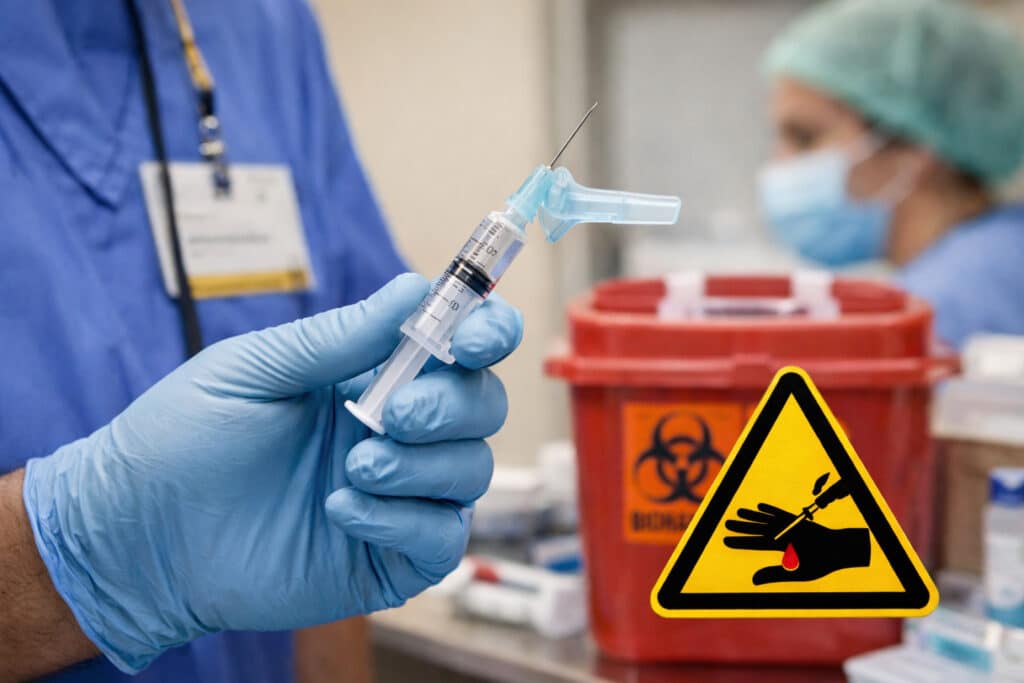
OSHA mandates engineering controls like self-sheathing needles, sharps logs, and annual training to prevent 385,000 annual US needlestick injuries, which risk HIV (1 in 300), hepatitis B (1 in 3 unvaccinated), and C (1 in 30). Combine with work practices avoiding recapping, immediate disposal in puncture-resistant containers, and post-exposure protocols. Cuts infections, costs, and compliance risks for Naperville healthcare facilities.
Every year, nearly 385,000 healthcare workers in the US suffer needle stick injuries, risking exposure to HIV, hepatitis B, and hepatitis C. OSHA’s Needlestick Safety and Prevention Act requires all employers with occupational exposure to implement a written protocol covering engineering controls, work practice controls, and post-exposure response. This guide covers every element of OSHA needlestick protocol, CDC-recommended first aid steps, and needle stick injury prevention and management requirements your facility must meet.
What Is a Needle Stick (Needle Prick) Injury?
A needle stick injury occurs when a hypodermic needle or other sharp medical instrument accidentally penetrates the skin. These injuries are a primary concern in healthcare settings because the sharp object is often contaminated with blood, tissue, or other body fluids from a patient. This creates a direct route for potential infections to enter the bloodstream of the healthcare worker.
The scope of this problem is massive. According to industry data, needle stick injuries make up more than 80% of all percutaneous exposure incidents in the United States. These incidents aren’t limited to nurses or doctors; they affect laboratory staff, waste management personnel, and housekeeping staff who may encounter improperly disposed sharps. Understanding this definition is the first step toward effective prevention.
Why Needle Stick Injuries Pose Serious Risks
The primary danger of a needle stick injury isn’t the physical wound itself, which is often small, but the biological payload it carries. These injuries can transmit over 20 different bloodborne pathogens. The most significant threats are Hepatitis B (HBV), Hepatitis C (HCV), and the Human Immunodeficiency Virus.
The transmission rates vary by pathogen, but the risks are statistically significant:
- Hepatitis B: The risk of contracting HBV after a sharps injury is roughly 1 in 3 if the source is positive and the worker is unvaccinated.
- Hepatitis C: The risk is approximately 1 in 30.
- HIV: The risk is estimated at 1 in 300.
Beyond the physical illness, the psychological toll is heavy. A study found that 12% of trainee doctors with a needle stick injury showed signs of PTSD, which is four times the rate of the general public.
OSHA Requirements for Needle Stick Injury Prevention and Management
The Occupational Safety and Health Administration (OSHA) enforces strict regulations to protect healthcare workers from these injuries. Compliance is not optional; it is a federal requirement designed to reduce occupational exposure. The foundation of these requirements lies in creating a safe environment where hazards are identified and controlled before an accident happens. Employers must implement a combination of engineering controls, work practice modifications, and administrative policies to remain compliant.
Bloodborne Pathogens Standard (29 CFR 1910.1030)
This standard is the core regulation governing sharps safety. It requires employers to protect employees who face occupational exposure to blood or other potentially infectious materials. Under this standard, facilities must implement Universal Precautions, treating all human blood and certain body fluids as if they are known to be infectious. It also mandates the use of safer medical devices and requires employers to provide Hepatitis B vaccinations to at-risk staff at no cost.
Needlestick Safety and Prevention Act
Passed in 2000, this Act updated the Bloodborne Pathogens Standard to be more specific regarding sharps. It mandates that employers solicit input from non-managerial employees responsible for direct patient care when identifying and selecting safety devices. This ensures that the people actually using the equipment have a say in what works best. It also requires facilities to maintain a sharps injury log to track the type and brand of devices causing injuries.
Who Does OSHA’s Needlestick Safety and Prevention Act Apply To?
The Needlestick Safety and Prevention Act applies to all employers whose workers face occupational exposure to blood or other potentially infectious materials (OPIM). This includes any facility where sharps are routinely used or handled – not just hospitals.
Covered employers include:
- Hospitals and health systems
- Physician and specialty practices
- Dental offices
- Clinical and diagnostic laboratories
- Home health agencies
- Long-term care and nursing facilities
- Dialysis centers
- Correctional facility health units
- Emergency medical services and first responder organizations
- Funeral homes and mortuary services
- Any employer where housekeeping, waste management, or laundry staff may encounter contaminated sharps
The Act also applies to non-managerial employees. Employers must solicit input from frontline workers who perform direct patient care when selecting and evaluating safety-engineered sharps devices. This is not optional – it is a documented compliance requirement under 29 CFR 1910.1030.
Sharps Injury Logging and Reporting
Documentation is a critical component of OSHA compliance. Employers must maintain a Sharps Injury Log for the recording of percutaneous injuries from contaminated sharps. This log must be maintained in a way that protects the confidentiality of the injured employee.
Required data points include:
- The type and brand of device involved in the incident.
- The department or work area where the exposure occurred.
- An explanation of how the incident happened.
Engineering Controls for Needle Stick Prevention
Engineering controls are the most effective way to prevent injuries because they remove or isolate the hazard from the workplace. These are physical items or devices that protect the worker without relying on the worker’s behavior. In the hierarchy of controls, these come first. Examples include self-sheathing needles, needleless IV systems, and blunt-tip suture needles. While these tools are essential, they must be paired with proper training to be effective.
Safety-Engineered Sharps Devices
Safety-engineered devices (SEDs) have built-in mechanisms to cover the needle after use. These include retractable needles or sliding shields. However, simply buying them isn’t enough. Research has shown that in some cases, the incidence of needle stick injuries actually increased to 2.2 per 100 healthcare workers after SED deployment, highlighting that technology must be accompanied by rigorous training on how to use the specific mechanism correctly.
Approved Sharps Disposal Containers
Proper containment is vital for safety. OSHA requires that contaminated sharps be discarded immediately in appropriate containers. These containers must meet four specific criteria:
- Closable: To prevent spillage during transport.
- Puncture-resistant: To stop needles from poking through the sides or bottom.
- Leak-proof: To contain fluids on the sides and bottom.
- Labeled or color-coded: Usually red with the biohazard symbol to warn of the danger.
Needle Stick Injury Prevention and Management: Work Practice Controls
Work practice controls refer to the manner in which a task is performed. These are behavioral changes intended to reduce the likelihood of exposure. Even the best engineering controls can fail if staff members use unsafe techniques. Facilities must establish standard operating procedures that prohibit dangerous habits and encourage safe handling from the moment a sharp is picked up until it is disposed of.
Proper Injection and Device Use Techniques
How a device is handled matters immensely. For example, injection pens have unique risks. Data indicates that injection pens were responsible for 39% of needle stick injuries connected to subcutaneous injections. Staff must be trained not just on standard syringes but on every specific device type they encounter. This includes keeping hands behind the needle at all times and never effectively handing a sharp to another person.
Immediate Disposal Protocols
The “drop, don’t force” rule applies to disposal. Sharps should be disposed of immediately after use. Containers should be located as close as feasible to the area of use. A common violation occurs when containers are allowed to overfill. Staff should never reach into a container or try to push trash down to make room. Once a container is three-quarters full, it must be sealed and replaced.
OSHA Needlestick Compliance: Administrative Controls and Training
Administrative controls involve the policies, procedures, and schedules that reduce exposure risk. This includes ensuring adequate staffing levels so nurses aren’t rushing, which often leads to accidents. It also involves the creation of a comprehensive Exposure Control Plan (ECP). This written document is the roadmap for how the facility addresses bloodborne pathogens and must be accessible to all employees.
Developing an Exposure Control Plan
Every facility handling medical waste must have a written Exposure Control Plan. This plan is not a static document; OSHA requires it to be reviewed and updated at least annually. The review must document the consideration and implementation of appropriate commercially available and effective safer medical devices. It must also reflect changes in technology that eliminate or reduce exposure to bloodborne pathogens.
Ongoing OSHA-Compliant Training Programs
Training is not a one-time event. OSHA mandates that training be provided at the time of initial assignment and at least annually thereafter.
Training must cover:
- The epidemiology and symptoms of bloodborne diseases.
- Modes of transmission.
- The facility’s Exposure Control Plan.
- How to recognize tasks that may involve exposure.
- The use and limitations of engineering controls and PPE.
MedPro Disposal’s OSHA compliance training covers all bloodborne pathogen requirements and can be completed online through our staff compliance portal.
Role of Personal Protective Equipment (PPE)
Personal Protective Equipment (PPE) acts as the last line of defense between the worker and the hazard. While PPE like gloves cannot prevent a needle form puncturing the skin, they serve a critical purpose. The material of the glove can wipe off up to 86% of the blood on the outside of a needle before it penetrates the skin, significantly reducing the volume of blood inoculated during an injury.
Standard PPE for sharps handling includes:
- Gloves: Latex or nitrile, worn for all anticipated contact with blood.
- Gowns: Fluid-resistant gowns to protect skin and clothing.
- Eye Protection: Face shields or goggles if there is a risk of splashing or spraying.
OSHA Needlestick Protocol: Post-Exposure Response Steps
Time is the most critical factor following a needle stick injury. Facilities must have a clear, posted protocol that employees can follow immediately without hesitation. The response involves immediate first aid, reporting the incident to a supervisor, and seeking medical evaluation. Delaying care can significantly impact the efficacy of post-exposure prophylaxis (PEP), especially for HIV.
CDC Needlestick First Aid: What to Do Immediately After a Needle Prick Injury
If a needle stick occurs, the worker should act instantly. The recommended steps are:
- Wash the wound thoroughly with soap and water. Do not squeeze the wound – squeezing may force infectious material deeper into the tissue.
- Flush the area with running water for several minutes.
- If the eyes, nose, or mouth were exposed, flush with clean water or saline.
- Do not apply bleach, caustic agents, or strong antiseptics to the wound.
- Report the incident to your supervisor immediately.
- Seek medical evaluation within 2 hours – do not wait, as post-exposure prophylaxis (PEP) for HIV must begin as soon as possible.
- Cooperate with baseline blood testing for HBV, HCV, and HIV as directed by the treating physician.
Note: The CDC explicitly states – wash with soap and water, do not squeeze the wound. This step is the most critical and most frequently mishandled in the immediate aftermath of a needle stick injury.
Medical Evaluation and Follow-Up
Medical professionals will assess the risk based on the type of exposure and the source patient’s status. While the risk of HIV transmission from a single percutaneous needlestick is about 0.3%, and Hepatitis C is about 1.8%, these odds warrant immediate testing. The evaluation should include baseline blood work for the injured employee and, if possible, testing of the source patient.
Common Mistakes in Needle Stick Prevention
Despite regulations and training, preventable errors continue to cause injuries. Identifying these common pitfalls is essential for improving safety culture.
Avoid these frequent mistakes:
- Recapping Needles: This is a major violation. Statistics show 14% of injuries in trainee doctors and 30% in nurses occurred while recapping.
- Disassembling Devices: Taking apart injection pens or removing needles manually increases risk.
- Improper Disposal: Leaving sharps on trays or bed linens instead of immediate disposal.
- Overfilling Containers: Forcing items into full bins creates a hazard for everyone.
Best Practices Summary and Next Steps with MedPro Disposal
Preventing needle stick injuries requires a layered approach. It starts with engineering controls like safety-engineered devices and accessible disposal containers. It is supported by work practice controls that prohibit recapping and mandate immediate disposal. Finally, it is reinforced through administrative controls like the Exposure Control Plan and rigorous, ongoing training.
Protecting your staff is about more than just avoiding fines; it’s about maintaining a safe environment for the people who care for patients.
MedPro Disposal can help you maintain this safety standard. We provide reliable medical waste disposal services and comprehensive OSHA compliance training to ensure your facility meets all federal and state regulations.
Here is how we help:
- Reliable Pickups: Scheduled removal of sharps and regulated medical waste.
- Compliance Training: Online OSHA and HIPAA training portals for your staff.
- Cost-Effective Solutions: Transparent pricing without hidden fees.
Contact MedPro Disposal today to secure your facility and protect your team.
Needle Stick Prevention Checklist: OSHA Compliance for Healthcare Facilities
Use this checklist to verify your facility meets OSHA needle stick injury prevention and management requirements. Each item corresponds to a specific federal obligation under 29 CFR 1910.1030 and the Needlestick Safety and Prevention Act.
Engineering Controls
- Safety-engineered sharps devices (SEDs) are in use for all applicable procedures
- Needleless IV systems are deployed where clinically feasible
- Sharps disposal containers are puncture-resistant, leak-proof, closable, and labeled with the biohazard symbol. MedPro Disposal provides OSHA-compliant sharps container disposal services for healthcare facilities of all sizes.
- Containers are replaced when three-quarters full – never overfilled
Need help implementing these requirements? MedPro Disposal offers medical waste disposal and compliance support for healthcare facilities across Illinois.
Work Practice Controls
- Needle recapping by hand is prohibited in all departments
- Sharps are disposed of immediately after use at the point of care
- Containers are located as close as feasible to the area of use
- Staff are trained on device-specific handling for all sharps types used in the facility
Administrative Controls
- Written Exposure Control Plan (ECP) is in place and reviewed annually
- ECP documents consideration of safer medical devices and reflects current technology
- Non-managerial frontline staff were consulted in device selection
- Sharps Injury Log is maintained per 29 CFR 1910.1030 with required data fields
Training and Vaccination
- Bloodborne pathogen training provided at initial assignment and annually thereafter
- Training records document date, content, and attendees
- Hepatitis B vaccination offered to all at-risk employees at no cost
- Post-vaccination antibody testing offered 1-2 months after series completion
Post-Exposure Protocol
- Written post-exposure protocol is posted in all clinical areas
- Protocol includes CDC first aid steps: wash with soap and water, do not squeeze the wound
- Medical evaluation available within 2 hours of exposure
- Sharps Injury Log entry completed for every percutaneous incident
Frequently Asked Questions
Who does OSHA’s Needlestick Safety and Prevention
The Needlestick Safety and Prevention Act applies to all employers with workers who have occupational exposure to blood or other potentially infectious materials. This includes hospitals, dental offices, laboratories, home health agencies, long-term care facilities, correctional health units, funeral homes, and any facility where housekeeping or waste management staff may encounter contaminated sharps.
What is the CDC first aid protocol after a needlestick injury?
Per CDC guidelines, immediately wash the wound thoroughly with soap and water. Do not squeeze the wound – squeezing may increase the risk of exposure by forcing infectious material deeper into the tissue. Flush with saline if available, report to your supervisor, and seek medical evaluation within 2 hours for post-exposure prophylaxis assessment.
What is the OSHA needlestick protocol for post-exposure response?
OSHA requires employers to have a written post-exposure protocol that covers immediate first aid, incident reporting to a supervisor, confidential medical evaluation at no cost to the worker, baseline blood testing, and documentation in the Sharps Injury Log. Post-exposure prophylaxis for HIV must begin as soon as possible after exposure – ideally within 2 hours.
What needle stick injury statistics are reported in Illinois hospitals?
Illinois healthcare facilities report over 4,000 needle stick injuries annually per IDPH data. Facilities like Edward Hospital in Naperville report approximately 5-10 incidents per 100 beds annually, consistent with national trends. These figures underscore the importance of local training programs and facility-level compliance audits.
How often must OSHA require Hepatitis B vaccination boosters for exposed workers?
OSHA requires Hepatitis B vaccination at no cost initially, with boosters only if post-vaccination antibody testing shows levels below 10 mIU/mL, typically tested 1-2 months after the series and not routinely annually.
What are Illinois-specific reporting rules for needle stick injuries beyond OSHA?
In Illinois, facilities must report needle stick injuries to the IDPH within 24 hours if involving high-risk pathogens, in addition to OSHA’s Sharps Injury Log requirement. Naperville clinics commonly use electronic reporting systems for faster compliance documentation.
How do safety-engineered sharps devices reduce injuries in US healthcare facilities?
Safety-engineered devices cut needle stick injuries by 50-70% per CDC data when staff are properly trained on the specific activation mechanism. Automatic retraction and passive shielding designs are most effective in high-volume clinical settings.
What are the fines for OSHA needle stick prevention violations in Illinois?
OSHA fines for serious needle stick violations start at $16,131 per instance, escalating to $161,323 for willful non-compliance. Illinois facilities may face additional state penalties up to $10,000 per violation, making proactive compliance significantly more cost-effective than reactive enforcement response.


