
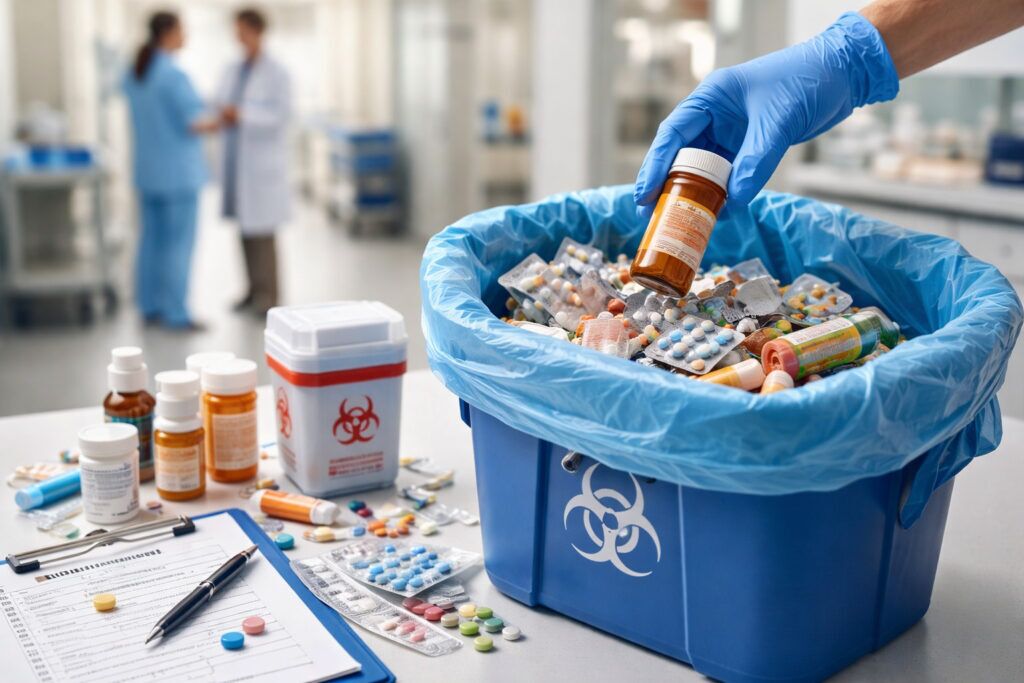
EPA Subpart P mandates segregation of pharmaceutical waste in Illinois LTC facilities using color-coded bins: black for hazardous, blue/white for non-hazardous, red for sharps, yellow for trace chemo. Avoid flushing to prevent $70K/day fines and ensure DEA non-retrievable destruction. Train staff, audit quarterly, partner with certified services. Cuts compliance risks, protects residents, slashes penalties.
Struggling to manage pharmaceutical waste disposal for LTC facilities without triggering EPA fines or DEA scrutiny? One compliance slip can cost tens of thousands in penalties, crippling operations amid tight budgets. This article delivers targeted best practices, like segregation protocols and certified partnerships, proven to slash risks and streamline disposal for Illinois long-term care providers.
Introduction to Pharmaceutical Waste Disposal in LTC Facilities
Managing medications in a long-term care (LTC) facility is complex enough without the added burden of figuring out how to throw them away. But proper long-term care pharmaceutical waste disposal isn’t just about keeping the trash room tidy; it is a critical safety and compliance issue. Incorrect disposal can lead to dangerous drug diversion, environmental contamination, and severe financial penalties.
The regulatory environment is notoriously difficult to track. As industry experts have noted, “The long-term care industry has been mired in a maze of onerous, voluminous and often overlapping and contradictory rules and regulations”. For facility administrators and directors of nursing, understanding these rules is the only way to protect both your residents and your license.
What Constitutes Pharmaceutical Waste in Long-Term Care Settings
Before you can dispose of waste properly, you have to know exactly what you are holding. In a nursing home or assisted living facility, pharmaceutical waste covers much more than just expired pills. It includes any medication that is no longer needed, spilled, contaminated, or left over after a resident passes away.
To stay compliant, your staff must be able to identify these distinct categories:
- Hazardous waste pharmaceuticals: Drugs listed by the EPA (P-listed or U-listed) or those with characteristics like toxicity or ignitability.
- Non-hazardous pharmaceuticals: Medications not on the EPA lists but still requiring secure disposal to protect the water supply.
- Controlled substances: Drugs like opioids that require strict DEA adherence to prevent theft or misuse.
- Trace chemotherapy waste: Items like IV bags or tubing that held cytotoxic drugs.
Key Regulations for Pharmaceutical Disposal in US LTC Facilities
The days of flushing unused meds down the toilet are long gone. Today, waste management is governed by a mix of federal and state agencies. The EPA’s Subpart P rule, finalized in 2019, created a specific framework for healthcare facilities, removing the ambiguity that used to exist. This rule bans sewering (flushing) of hazardous waste pharmaceuticals entirely.
Simultaneously, you must align with the DEA’s Secure and Responsible Drug Disposal Act, which focuses on preventing drug diversion. On top of that, USP 800 guidelines dictate how to handle hazardous drugs to protect healthcare workers. It is a multi-layered system where a violation of one rule often triggers a violation of another.
EPA and RCRA Requirements
The Resource Conservation and Recovery Act (RCRA) is the primary law governing hazardous waste. Under the EPA’s Subpart P, LTC facilities are treated as healthcare facilities rather than industrial generators. This simplifies some paperwork but tightens the disposal requirements.
Facilities are often categorized by how much waste they generate. For example, facilities with 20 or fewer beds often qualify as Very Small Quantity Generators (VSQG), typically generating 100 kg (220 lbs) or less of hazardous waste per month.
| Category | Requirement |
| Foundation | Cradle-to-grave management liability |
| Hazardous Waste | Strict compliance with Subpart P |
| Prohibition | No flushing (sewering) of hazardous waste |
DEA Rules for Controlled Substances
The Drug Enforcement Administration (DEA) cares primarily about security. Their “Final Rule” allows LTC facilities to dispose of residents’ controlled substances, but only if they render the waste “non-retrievable.” This means the drug must be permanently altered so it cannot be used again. Simply crushing a pill and mixing it with kitty litter is often insufficient. You generally need to use a DEA-registered reverse distributor or an on-site destruction method that meets this high standard.
State-Specific Variations
Federal rules are just the baseline. Individual states often enforce stricter environmental regulations that supersede EPA minimums. For instance, some states classify certain drugs as hazardous that the federal government does not, or they may have more rigorous storage time limits. You must verify your specific state requirements, as compliance with federal law does not automatically guarantee compliance with local authorities in places like California, Washington, or Minnesota.
How Pharmaceutical Waste Disposal Works in LTC Facilities
Effective disposal is a process, not a one-time event. It starts the moment a medication is deemed waste and ends only when it is destroyed. In practice, this means your facility needs a workflow that moves waste from the resident’s room to a secure hold area without error.
The process generally involves three stages: identification, segregation, and destruction. Staff must identify the drug type immediately—mixing a controlled substance with regular trash is a major violation. Written policies must guide every step, ensuring that a nurse on the night shift follows the same protocol as the day shift supervisor.
Collection and Segregation Processes
Segregation is the most critical step on the floor. You cannot toss everything into one bin. Best practice involves using distinct containers at the point of generation:
- Black containers are typically used for RCRA hazardous waste.
- Blue or white containers are often used for non-hazardous pharmaceutical waste.
- Red containers are for sharps and biohazard waste (often with trace chemo).
- Yellow containers are specifically for trace chemotherapy waste.
Packaging and Labeling Standards
Once waste is in the bin, it must be packaged correctly for transport. The Department of Transportation (DOT) has strict rules here. Containers must be rigid, leak-proof, and properly labeled with the specific contents. You cannot just write “Trash” on a box. Labels must identify the hazard class (e.g., “Hazardous Waste Pharmaceuticals”) to ensure safety for anyone handling the container downstream.
Transportation and Final Treatment Methods
You generally cannot haul this waste to the dump yourself. You must use a licensed waste hauler. Hazardous pharmaceutical waste is typically transported to a permitted facility for incineration. This high-heat destruction ensures the chemicals are broken down completely. Controlled substances also require a documented chain of custody until they are rendered non-retrievable, ensuring they never hit the streets.
Specific Best Practices for LTC Pharmaceutical Waste Management
Building a compliant program requires more than just buying the right bins. It requires a culture of safety. The best facilities integrate LTC pharmaceutical waste management into their daily clinical routines so it doesn’t feel like an extra chore.
Key strategies include:
- Written Policies: Have a clear SOP that is accessible to all staff.
- Vendor Partnership: Work with experts who understand the specific needs of LTCs.
- Continuous Education: Regulations change, and so does your staff. Keep everyone updated.
Implement Employee Training Programs
Training is not optional; it is a regulatory requirement. Staff must know how to handle hazardous drugs safely and how to segregate waste. The consequences of ignorance are expensive. Under recent rules, maximum civil penalties for RCRA violations can exceed $70,000 per day, per violation. Regular training sessions protect your facility’s bottom line and your employees’ health.
Use Color-Coded Containers and Segregation Protocols
Visual cues are the most effective way to prevent mistakes. When a nurse is rushing, they shouldn’t have to read fine print to know where to toss a vial.
- Standardize colors: Use the same color scheme throughout the entire facility.
- Placement: Put bins near where the waste is generated (med carts, nursing stations).
- Signage: Place clear posters above bins listing common drugs for each category.
Schedule Regular Audits and Compliance Checks
Don’t wait for a state inspector to find a problem. Conduct your own internal audits quarterly. Check your waste manifests to ensure they are signed and returned. Walk the floor to see if staff are actually using the bins correctly. If you find a nicotine patch in the regular trash or a sharp in the pharmaceutical bin, use it as a teaching moment immediately.
Partner with Certified Disposal Services
Managing this alone is risky. A certified waste disposal partner does more than pick up the boxes. They provide the correct containers, handle the complex DOT manifesting, and offer proof of destruction. Look for a partner who offers compliance training modules and keeps you updated on regulatory shifts. They act as your insurance policy against non-compliance.
Common Mistakes in LTC Pharmaceutical Waste Disposal
Even well-intentioned facilities make errors. The most common mistake is improper segregation. When non-hazardous waste is thrown into hazardous waste bins, you overpay for disposal fees. Conversely, throwing hazardous waste into regular trash creates legal liability.
Other frequent pitfalls include:
- Sewering: Flushing meds is almost always prohibited now.
- Unsecured storage: Leaving waste containers in areas accessible to residents or visitors.
- Record keeping gaps: Failing to keep manifests on file for the required 3–5 years (depending on the state).
Choosing a Reliable Partner for LTC Waste Disposal
Selecting a waste management provider is a strategic decision. You need a partner who understands the specific constraints of the long-term care environment—where resident safety is paramount and budgets are tight.
Look for a provider that offers transparent pricing without hidden fees and provides a comprehensive solution, including sharps, hazardous waste, and compliance training. The right partner simplifies the “maze” of regulations, allowing your staff to focus on what they do best: caring for residents. By securing a reliable disposal service, you ensure your facility remains safe, compliant, and efficient throughout 2026 and beyond.
Frequently Asked Questions
What are the pharmaceutical waste disposal requirements for LTC facilities in Naperville, IL?
Illinois follows EPA Subpart P and requires licensed haulers for hazardous pharmaceuticals; Naperville facilities must also comply with DuPage County hazardous waste rules, prohibiting sewering and mandating 90-day storage limits for over 220 lbs/month.
How often must LTC facilities in Illinois conduct pharmaceutical waste training?
Annual training is required under EPA and Illinois EPA rules for LTC staff handling waste; Naperville facilities should document sessions quarterly to meet Joint Commission standards and avoid $70,000+ daily RCRA fines.
Can Naperville LTC facilities use mail-back systems for controlled substances?
Yes, DEA-approved mail-back envelopes render controlled substances non-retrievable; Naperville nursing homes like those in DuPage County use them for small volumes, ensuring chain-of-custody manifests for compliance.
What are the costs of pharmaceutical waste disposal for small LTC facilities near Naperville?
VSQG LTCs (under 20 beds) pay $200-500 monthly for pickup and incineration in Naperville area; costs rise 20-30% for improper segregation, per local providers like Stericycle servicing Illinois.
How do I perform a quick compliance audit for pharma waste in my Illinois LTC?
Quarterly, check bin usage, review 3-year manifests, and test 10% of waste samples; Naperville facilities use Illinois EPA checklists to verify segregation, reducing audit findings by 40% per industry data.


