

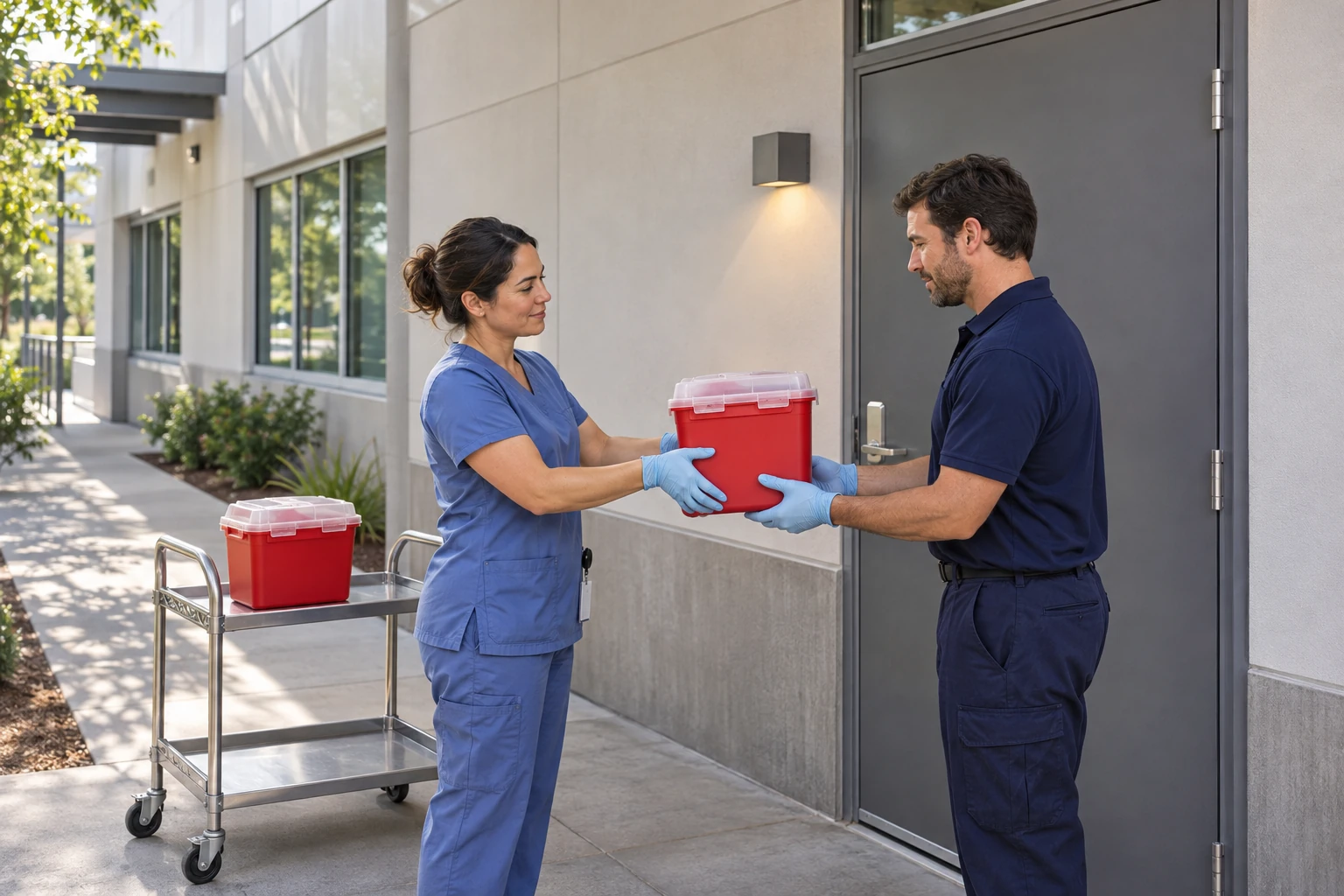
Pick a sharps pickup schedule from how fast your containers fill, not from a calendar default. This guide covers frequency, monthly cost drivers and setup for practices, med spas and dental offices.
In This Article
- 01Key Takeaways
- 02How often should a sharps container be picked up?
- 03How do you match container size to your pickup schedule?
- 04How much does a sharps pickup program cost per month?
- 05How does setup work from the first container to the first pickup?
- 06What do med spas and dental offices need to check before signing?
- 07How do practices handle sharps pickup with a service like MedPro Disposal?
- 08Sources
- 09Frequently Asked Questions
The right sharps container pickup schedule is set by how fast your containers fill, not by a fixed calendar interval. MedPro Disposal offers scheduled sharps container pickup for small practices, med spas and dental offices, and the same three decisions apply to any provider: how often to pick up, what it will cost each month, and how to get the first container into service.
OSHA does not set a pickup interval. It requires that sharps containers be replaced routinely and never overfilled, so the schedule is yours to build around your own volume. State rules on storage and transport vary, and your state's own rules apply.
Key Takeaways
- OSHA requires sharps containers to be replaced routinely and not allowed to overfill (29 CFR 1910.1030(d)(4)(iii)(A)), but it does not name a pickup interval.
- Pickup frequency follows container size and how fast containers fill. Low-volume sites such as med spas often fill a small container slowly, while busy dental and physician offices fill containers fast.
- Monthly cost depends on container size and count, pickup frequency, location and the service type. Ask for every charge to be listed in the quote.
- Setup is five steps: request a quote with your counts, confirm who supplies containers, place them at the point of use, set the first pickup, and train staff and keep records.
How often should a sharps container be picked up?
A sharps container should be picked up before it reaches its fill line, so the interval is the time your busiest container takes to fill. Start with your fill rate, then pick the nearest schedule your provider offers, such as monthly, every other month, quarterly or on call.
OSHA's bloodborne pathogens standard says containers must be closable, puncture resistant, leakproof on the sides and bottom, and labeled or color-coded. During use they must be easy to reach, kept upright, and replaced routinely without being allowed to overfill. The standard sets no number of days, so the failure to avoid is a full container still in use.
| Practice type | Typical sharps pattern | Schedule to start with |
|---|---|---|
| Med spa with injectables | Low volume, a few needles per treatment room per day | Longer interval or on-call pickup, adjusted after you see how fast the container fills |
| Small medical practice | Moderate volume from injections, draws and vaccines | Monthly or every other month |
| Dental office | Steady needles and blades across several operatories | Monthly, with more containers rather than larger gaps |
| Urgent care or multi-provider clinic | High volume, several stations | Monthly or more often, based on the busiest station |
Treat these as starting points, not rules. Review the schedule after the first two or three pickups and change it if containers arrive nearly empty or sit full between visits. Some states also limit how long regulated medical waste can be stored on site, so check your state's rules before you stretch the interval. Our state pages are the place to start.
How do you match container size to your pickup schedule?
Match container size to the number of stations that generate sharps and how long you want a container to last. OSHA expects containers close to where sharps are used, so several smaller containers at the point of use beat one large container in a back room.
- Count every place a sharp is used: treatment rooms, operatories, procedure rooms, the lab and any injection area.
- Put one container at each place, as close to the point of use as is feasible.
- Note how long each container takes to reach its fill line over two to four weeks.
- Pick the pickup interval that keeps the fastest container under its fill line, and size up only where one station fills much faster than the rest.
Low-volume sites sometimes find that mail-back fits better than a route pickup. We compare the two in mail-back kits vs scheduled pickups and cover mail-back setup in how to set up mail-back disposal for small practices.
How much does a sharps pickup program cost per month?
The monthly cost of a sharps pickup program depends on container size and count, pickup frequency, your location and the service type. We do not quote a price here because a number that fits one practice will be wrong for the next.
Use the same checklist to compare any two quotes:
- How many containers, and what size, are included per visit.
- How often the truck stops, and what a missed or extra stop costs.
- Whether the quote lists every charge, including fuel, stop and environmental fees.
- Whether containers are supplied by the provider or bought separately.
- What the contract says about term, changes in volume and ending service.
For the cost factors in more detail, read how much medical waste disposal costs. For contract terms, see medical waste service agreements and pricing.
How does setup work from the first container to the first pickup?
Setup takes five steps, and most of the work is yours before the first truck arrives. Do them in this order.
- Request a quote with your counts. Give the number of stations, container sizes and an estimate of how fast they fill. The provider confirms it serves your address.
- Confirm who supplies containers. Some providers supply them and some do not. Containers must meet OSHA's closable, puncture-resistant, leakproof and labeled or red requirements.
- Place containers at the point of use. Set them upright and within easy reach of staff, and away from public areas.
- Set the first pickup date and a staging spot. Choose a locked or supervised place for sealed containers, and tell staff who closes and hands off each container.
- Train staff and keep records. Staff should close a container before moving it, and put it in a secondary container if it might leak. Keep each pickup record with your exposure control plan files.
OSHA also requires each employer with occupationally exposed employees to keep a written exposure control plan and a sharps injury log, so pickup records belong in the same compliance file. See the new practice medical waste setup checklist for a full list.
What do med spas and dental offices need to check before signing?
Med spas and dental offices need to confirm three things before signing: that the service covers their address, that containers meet transport packaging rules, and that their state's rules are met. A med spa with a small injectable volume and a dental office with steady daily use will end up with different schedules.
For transport, the Department of Transportation requires non-bulk sharps containers to be puncture-resistant and securely closed according to the packaging manufacturer's instructions (49 CFR 173.197). Ask your provider to confirm that the containers it picks up meet that rule.
The EPA says medical waste is primarily regulated by state environmental and health departments, because the federal Medical Waste Tracking Act expired in 1991. Each state uses its own name for the waste and sets its own registration, storage and recordkeeping rules. Rules vary by state, and your state's own rules apply. Start with the state-by-state checklist and our state pages.
Controlled substances (DEA Schedule II-V) never go in a red bag, a regulated medical waste container or a regular pharmaceutical waste container. They follow separate DEA and state rules. Dental teams can find more in the dental office sharps container guidelines and on our dental practices page. Medical offices can start at physician practices.
How do practices handle sharps pickup with a service like MedPro Disposal?
Practices that use a service like MedPro Disposal hand off pickup, treatment paperwork and liability in one arrangement. MedPro was founded in 2009, is based in Naperville, Illinois, and has served 40,000+ providers, with 30% average savings.
MedPro takes legal title to regulated medical waste at pickup (not hazardous waste), and carries $33M in insurance (general liability, umbrella and pollution combined). MedPro does not sell sharps containers, so confirm container supply when you request a quote. Outside the Chicago area, service runs through partner haulers, and MedPro confirms service at your address when you ask for a quote.
For what the scheduled exchange itself includes, see the sharps container disposal service page. For a price estimate, use the cost guide.
Frequently Asked Questions
How often should sharps containers be picked up?
Sharps containers should be picked up before they reach the fill line, so the interval depends on how fast your fastest container fills. OSHA requires containers to be replaced routinely and not allowed to overfill (29 CFR 1910.1030(d)(4)(iii)(A)) but sets no number of days. Many practices start with a monthly schedule and adjust after the first few pickups.
Does OSHA or EPA set how often medical sharps must be picked up?
No. OSHA's sharps container paragraph names no pickup interval, and the EPA says medical waste is primarily regulated by state environmental and health departments since the Medical Waste Tracking Act expired in 1991. Any storage time limit comes from your state, so check your state's own rules.
How much does a sharps container pickup service cost per month?
Monthly cost depends on container size and count, pickup frequency, location and service type. Ask each provider to list every charge on the quote, including stop, fuel and environmental fees. See the cost guide for the factors.
Does a med spa need a sharps pickup service?
A med spa needs a lawful way to dispose of its sharps, and pickup is one option. OSHA's bloodborne pathogens standard requires contaminated sharps to go in closable, puncture-resistant, leakproof, labeled or red containers, and disposal must follow federal, state and local rules. Low-volume med spas may choose a long pickup interval or mail-back instead.
What container will a sharps pickup company take?
A pickup company will take a closed container that meets the packaging rules for transport. DOT requires non-bulk sharps containers to be puncture-resistant and securely closed per the manufacturer's instructions (49 CFR 173.197(b)). Ask your provider to confirm in writing that its containers meet that rule.
Sources
- 29 CFR 1910.1030, Bloodborne pathogens (eCFR) (checked 2026-11-24)
- 49 CFR 173.197, Regulated medical waste (eCFR) (checked 2026-11-24)
- EPA, Medical Waste (checked 2026-11-24)
General guidance only. Medical waste rules vary by state and can change, so confirm current requirements with your state agency. Your MedPro account team can confirm what applies to your facility.
Want more like this in your Google results?
Add MedPro as a preferred source on Google