

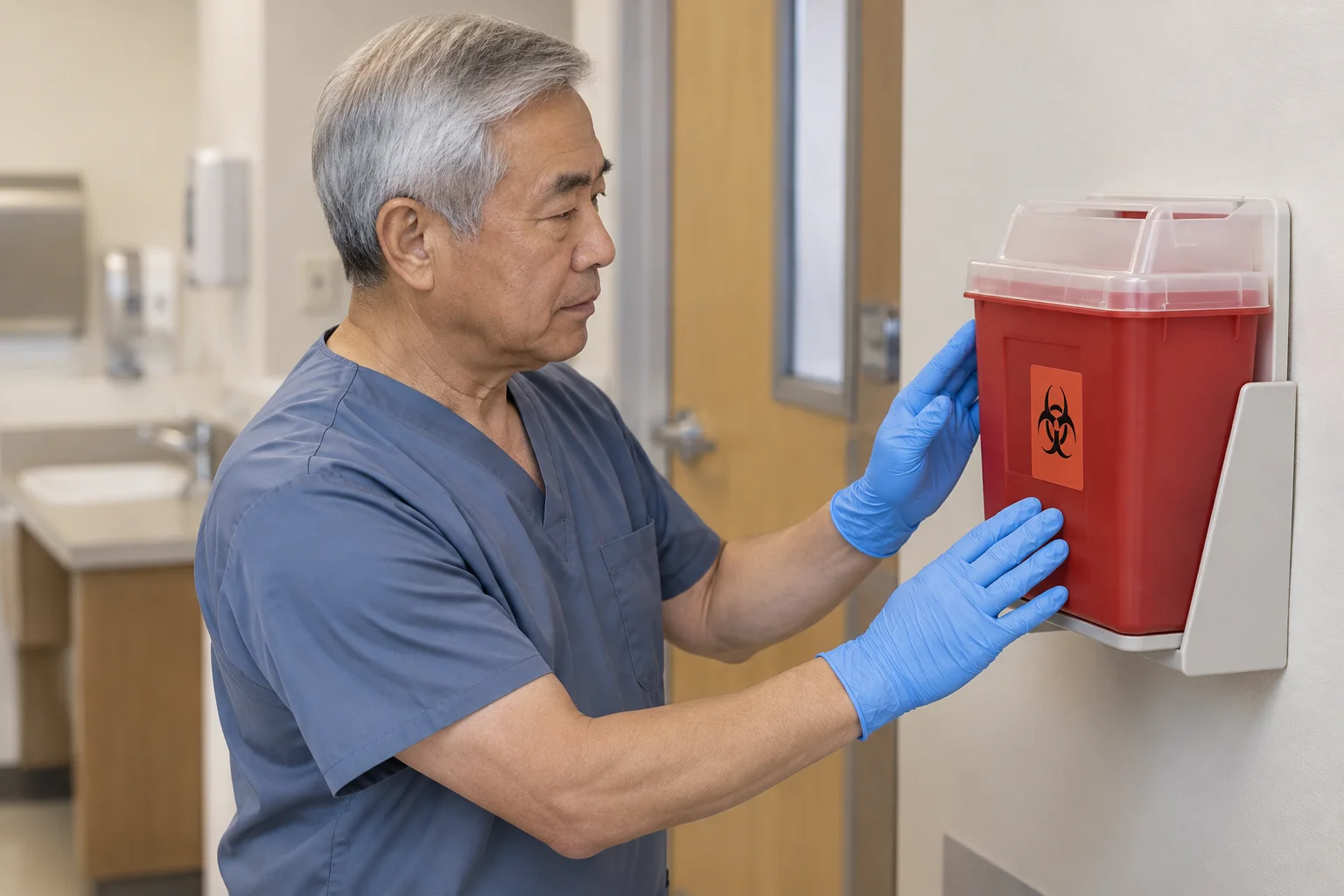
What Are Sharps?
Sharps are defined as any medical device that has a sharp point that can cut through skin (clever name, right?).
That being said, just because they’re medical devices does not mean they are only used at medical facilities. Almost 10% of Americans are diabetic and a large majority of them need to use syringes for insulin injection, not to mention the many other diseases that require the use of sharps at home.
Find Out How Much You Can Save Instantly. Try our on-line savings calculator.
Savings calculator
Sadly, there are approximately
200,000
diabetic cats and
150,000
dogs in the United States have diabetes. This means that even if no
human
in your house needs to use a syringe, your pets still may have to!
In some states it is actually illegal to dispose of sharps in anything but a sharps container for public safety reasons.
What Can You Put in The Sharps Container?
Well, technically you can put anything (except pharmaceutical waste) that will fit in the container, but really other medical waste should go into a biohazard bag so it can be properly sorted and sterilized. Putting other medical waste into its proper bag will also save you money as you won’t have to get your container picked up as often.
Officially though, the FDA says you should put things like needles, syringes, lancets, auto-injecting pens, and connection needles into the sharps container.
Why Do Sharps Need to Be Put into A Separate Container?
Imagine you are a garbage man just doing your daily job, pick up a trash bag and BOOM you get stuck by a needle! Getting stuck by a random syringe is an awful experience, you don’t know if it hit any nerves, where it came from, what diseases it might be carrying etcetera.
Getting stuck by a needle that isn’t yours is simply terrifying. This nurse’s forum details stories about when they got stuck by needles that were used on HIV+ patients and the fear that comes with it.
Several nurses and one resident I know at our facility have been stuck with HIV-positive ABG needles in the last year, which have a much higher rate of transmission than insulin needles, and fortunately they were all ok, though they did go through the obvious freak out and drug therapy stage. I myself have stuck myself twice in my nursing career, once an insulin needle and once an ABG needle. It's a horrible feeling but the chances are very small. Both times the patient was a little old man, HIV and Hep C negative. I was lucky.
Used needles can carry a lot of lifelong or potentially deadly diseases. Some examples from the CDC are Staph Infection, Malaria, Hepatitis A (though very rare) and Hepatitis B/C, HIV, West Nile, and the particularly scary prion diseases.
The most infamous prion disease is Creutzfeldt-Jakob disease. It is a degenerative neurological disease that progresses incredibly fast and is almost always fatal within a year of initial onset.
Needless to say, not discarding sharps into their proper containers is incredibly dangerous and irresponsible.
Where Can I Get a Sharps Container?
First of all, let me congratulate you for using a proper and safe sharps disposal method! Luckily for you, MedPro offers various sized sharps containers through our mail back program, and they come with free return shipping for when they are full!
What Can I Do with A Full Sharps Container?
MedPro has you covered again! If you got a sharps container from somewhere else, you can schedule a low cost pickup with us or if you are using our mail back program just place it in our shipping box and leave it with your regular UPS pickup. It’s truthfully that simple.
Common Questions
- What can you put in a sharps container?
- Anything that can puncture or cut skin and has been contaminated — needles, syringes, lancets, scalpels and blades, auto-injectors, infusion sets, and contaminated broken glass. Don't put in medications, soft biohazard waste like gauze, or ordinary trash such as caps and wrappers; they belong in their own streams.
- When should a sharps container be replaced?
- The FDA advises disposing of a sharps container when it is about three-quarters full, and OSHA requires containers to be replaced routinely and never allowed to overfill. Close and lock the container at the fill line, and never push sharps in or shake the container to make room.
- What color are sharps containers?
- Most sharps containers are red. OSHA requires them to be labeled with the biohazard symbol and the word “BIOHAZARD” or be red. Yellow containers are commonly used for sharps contaminated with trace chemotherapy agents.
- What does OSHA require for sharps containers?
- Under 29 CFR 1910.1030, sharps containers must be closable, puncture resistant, leakproof on the sides and bottom, and labeled or color-coded. They must be easily accessible and as close as feasible to where sharps are used, kept upright, replaced routinely without overfilling, closed before removal, and placed in a secondary container if leakage is possible.
Want more like this in your Google results?
Add MedPro as a preferred source on Google